
2016 Budget: Jobs for Today and Tomorrow
The 2016 Budget included the Province’s plan to invest about $160 billion in infrastructure over 12 years, which began in 2014–15. Ontario continues to help communities grow by investing in infrastructure projects such as building child care spaces, schools, hospitals, transit, highways and roads.
Making Progress
As part of the Province’s commitment to build Ontario up, over the next 10 years the government plans to provide:
- $12 billion in capital grants for child care and education;
- $3 billion in capital grants for postsecondary infrastructure;
- $12 billion in capital grants for health infrastructure;
- $55 billion in public transit;
- $26 billion in highways; and
- $30 billion in other infrastructure investments including affordable housing, tourism and cultural centres.
The government is committed to long-term planning to help ensure that its infrastructure is aligned with the needs of Ontarians. The Province will also be releasing an update on its infrastructure plan that will provide more details on investments over the next 10 years.
Child Care and Education Infrastructure
Expanding quality child care services and child and family programs helps Ontarians in their everyday lives. Families and communities benefit from programs and services that promote early learning and development, support parents and caregivers, and provide referrals to specialized services.
Over the past three years, the government has increased its efforts to support families by helping to create 56,000 new licensed child care spaces. This builds on provincial investments since 2003 that supported an 87 per cent increase in child care spaces, for a total of nearly 351,000 spaces.
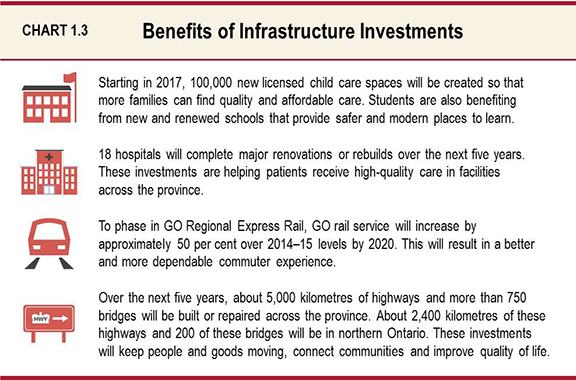
To meet the demands of a growing and changing province, starting in 2017, over a five-year period the government will create an additional 100,000 licensed infant-to-preschool child care spaces. Working closely with schools and municipalities, the Province will provide funding through a mixed approach of school-based, community-based and home-based expansion. This will double the current capacity for children from infancy to age four.
As a first step in supporting this new initiative, the Province is planning to invest $65.5 million in the 2016–17 school year, as part of a larger investment, to create approximately 3,400 additional child care spaces. This increased investment in the current school year will support additional capital renovations and new spaces in schools. Ensuring that more Ontario families receive high-quality and affordable licensed child care in flexible settings is part of Ontario’s plan to make life easier for families.
These new investments will advance and build on ongoing work with parents and community partners to develop a child care and early-years system focused on quality, affordability, accessibility, parent choice and flexibility. For more information, see Section C: Investing in People’s Talents and Skills in this chapter.
Modern facilities across the province offer students an enhanced learning experience, while supporting student achievement and well-being for generations to come. That is why, in the 2016–17 school year, Ontario’s school boards are opening 29 new schools, and an additional 16 schools have undergone major additions and renovations.
| Examples | Region and Project Description |
|---|---|
New Schools |
Central Ontario:
Eastern Ontario:
Greater Toronto Area:
|
| Additions/ Renovations
|
Northern Ontario:
Eastern Ontario:
Southwestern Ontario:
|

In June, the Province committed to providing an additional $1.1 billion over two school years to improve existing school infrastructure across Ontario. This investment builds on $1.6 billion in existing funding that has been allocated for repairs and renewal, for a total of $2.7 billion. The funding is estimated to benefit more than 2,100 schools, with repair and renewal projects valued at $100,000 or more, in addition to many other smaller projects. Over the next 10 years, this will bring the Province’s total infrastructure investment to $12 billion in the education sector, in response to local needs, while creating contemporary learning environments for students.
Postsecondary Education Infrastructure
As announced in the 2016 Budget, the Province is committed to improving postsecondary infrastructure and expanding access to high-quality college and university education by investing $3 billion over the next 10 years.
Expanding Postsecondary Education
Ontario is planning to invest up to $180 million in two new university-led postsecondary sites in Brampton and Milton focused on science, technology, engineering, arts and mathematics (STEAM). The government will launch a call for proposals in January 2017. These sites will help develop Ontario’s highly skilled workforce by increasing experiential learning opportunities, helping students acquire the talent and skills for the knowledge economy, and encouraging partnerships in high-demand fields.
This plan is the second phase of Ontario’s major expansion in postsecondary infrastructure. In May 2015, Ontario announced the creation of the York University–Markham Centre campus in partnership with Seneca College.
Since the 2016 Budget, the Province has collaborated with the federal government, colleges and universities to implement the Post-Secondary Institutions Strategic Investment Fund in Ontario. This initiative will lead to shared investments of more than $1.9 billion in research, innovation and training infrastructure at Ontario postsecondary institutions (see Section C: Investing in People’s Talents and Skills in this chapter for more details). Projects benefiting from this fund include:
- University of Toronto — Almost $190 million to upgrade nearly half of the university’s research labs over the next two years.
- Algonquin College – Approximately $45 million to support the creation of the Innovation, Entrepreneurship and Learning Centre that will house a Centre of Excellence for Cyber Security, a Centre of Excellence for Energy Innovation, and flexible classroom and work space. The investment will also allow for the establishment of an Institute for Indigenous Entrepreneurship, which will support Indigenous students, alumni and community partners.
- Niagara College — Approximately $35 million to support construction of the new Agri-Food and Agri-Business academic facilities. The project will include research, incubation and testing space, and would support growth and productivity in the agri-food sector.
- Sault College — Approximately $18 million to support the development of the new Institute for Environment, Education and Entrepreneurship (iE3). The iE3 will create state-of-the-art experiential learning spaces and give students the best opportunity to thrive in a new economy.
- Collège Boréal – Over $10 million for the construction of a new Wellness Centre at the college’s Sudbury campus and to modernize the college’s Windsor campus, increasing energy efficiency and reducing greenhouse gas (GHG) emissions.
- Fanshawe College — Approximately $9 million to refresh its existing building to include a new Centre for Advanced Research and Innovation in Biotechnology.
Health and Social Infrastructure
Strengthening Ontario’s health care system gives Ontarians faster access to the right care, now and in the future. Ontario plans to invest $12 billion over the next 10 years in capital grants for health care infrastructure projects to help patients receive high-quality care. Over the next five years, 18 hospitals across Ontario will complete major renovations or rebuilds. The Province is also working with hospitals to plan 19 additional major capital projects to expand and renovate existing facilities.
Ontario also plans to invest in community health infrastructure by providing capital grants to community organizations such as Community Health Centres, Aboriginal Health Access Centres, Family Health Teams and Nurse Practitioner-Led Clinics.
Construction is underway at:
- William Osler Health System’s Etobicoke General Hospital — To build four new storeys and create 250,000 square feet of new space for services needed by the community, such as emergency and critical care.
- Hawkesbury and District General Hospital — To expand the emergency department and add an intensive care unit, a family birthing unit, and a 12-bed inpatient mental health and day program unit. The project will modernize surgical areas and consolidate services, such as specialized clinics, rehabilitation, hemodialysis and cardiology, into a new wing that will be more accessible to patients.
- St. Joseph’s Care Group in Thunder Bay — To accommodate a Specialized Mental Health Program. A new three-level wing is being built with approximately 66,000 square feet, and about 12,000 square feet are being renovated. The project will provide 38 specialized mental health beds, with associated programs and services being transferred from the Lakehead Psychiatric Hospital site to the St. Joseph’s Hospital site.
- University of Ottawa Heart Institute Cardiac Life Support Services Redevelopment Project— An investment of $162 million will expand the facility to accommodate shifting demographics and technological advancements, and will improve access to high-quality, specialized cardiac services for residents in the Champlain Local Health Integration Network region. Construction is underway for a new tower and renovations are being made to the existing facility, totalling about 239,000 square feet, to expand cardiac catheterization, cardiac surgery, a cardiac surgery intensive care unit, cardiac imaging programs and support services.
Planning is underway for:
- Toronto’s Centre for Addiction and Mental Health — A major expansion that will improve access to mental health and addictions services for patients. With approximately 655,000 square feet of new space, the redevelopment will include inpatient and outpatient clinical services, research and educational facilities, and patient and family recreation and resource facilities.
- New Groves Memorial Community Hospital in Fergus and Centre Wellington Region — A hospital that will improve access to services for patients, with more space for emergency, ambulatory, diagnostic and inpatient services, more private inpatient rooms, and up-to-date technology and clinical resources for physicians and staff.
- New Health Hub in Orléans — A hub that will consolidate select services from three hospitals and four community health service providers onto one site. When complete, patients in the Orléans area will benefit from bilingual, integrated and patient-centred services closer to home, including ambulatory care, mental health and wellness, geriatric support and wellness, diagnostic imaging and active rehabilitation.
The Province is also supporting the health care sector through the Health Infrastructure Renewal Fund. This year, Ontario is providing $175 million — an increase of $50 million over last year’s funding — to support crucial infrastructure projects in 135 hospitals and extend the useful life or improve the quality of their facilities.
In addition, Ontario’s investment of $92 million from the Green Investment Fund into social housing retrofits is already helping to improve energy efficiency and reduce GHG emissions. The Province is investing $82 million towards energy retrofits for high-rise social housing towers of 150 units or more, and a further $10 million to help improve electricity efficiency in approximately 1,300 single social housing homes, which are often found in smaller and rural communities. This investment will help lower GHG emissions by about 3,600 tonnes over a 20-year period.
Moving Ontario Forward
The government’s Moving Ontario Forward plan is supporting public transit, transportation and priority infrastructure across the province. The plan is supported by the multi-year asset optimization strategy, which includes broadening the ownership of Hydro One and unlocking the value of other Provincial assets to raise $5.7 billion over time to fund priority infrastructure projects.
Outside the Greater Toronto and Hamilton Area
Through Moving Ontario Forward, the Province is investing in initiatives outside the Greater Toronto and Hamilton Area (GTHA) that help connect regions, develop new economic opportunities and support critical infrastructure in communities.
Ontario Community Infrastructure Fund
The government is providing funding through the Ontario Community Infrastructure Fund (OCIF) to small, rural and northern municipalities to help build and repair roads, bridges and other critical infrastructure.
Ontario recently announced that it will triple OCIF funding to $300 million per year by 2018–19. The additional funding will give municipalities the opportunity to bring their total funding up to $2 million over two years to deliver critical infrastructure projects. Municipalities will also have the option to accumulate formula-based funding for up to five years to invest in larger significant infrastructure projects.
Small Communities Fund
Through the Small Communities Fund, the Province and federal government are each providing $272 million over 10 years for infrastructure projects in municipalities with populations of fewer than 100,000 people to support jobs and spur economic growth.
As part of this initiative, 126 projects have been approved under two intakes. This includes $90 million each from the federal and provincial governments to support the delivery of ultra-high-speed Internet in southwestern Ontario. This initiative is part of the Southwestern Integrated Fibre Technology proposal that will deliver fibre-optic coverage to more than 300 communities with a total population of 3.5 million.
Natural Gas
In fall 2016, the Province will launch the interest-free, $200 million Natural Gas Access Loan program. The program is designed to help finance the building of new natural gas infrastructure and the costs of converting to natural gas. To provide opportunities for remote communities to access affordable energy, liquefied and compressed natural gas infrastructure will also be eligible under the program. Access to natural gas can help stimulate the economy, particularly in smaller communities, by attracting new industry, making commercial transportation more affordable, benefiting agricultural producers and providing consumers with more energy choices.
Connecting Links Program
As announced in the 2016 Budget, the Province will be providing $20 million in 2016–17, growing to $30 million per year by 2018–19, to help municipalities repair roads and bridges connecting two ends of a provincial highway through a community or to a border crossing.
In 2016–17, 23 municipalities will receive funding to improve road safety and support jobs.
| Municipality | Project Description |
|---|---|
| City of Cornwall | $3.0 million to rehabilitate the Canadian National Railway overpass on Brookdale Avenue on the city’s Highway 138 connecting link. |
| City of North Bay | $2.9 million to rehabilitate the Trout Lake Road overpass on the city’s Highway 63 connecting link. |
| Municipality of Chatham–Kent | $3.0 million for the reconstruction of McNaughton Avenue and Murray Street in the community of Wallaceburg. |
Supporting Transit and Transportation Systems
The Province is also investing in the following transit projects:
- Ottawa Light Rail Transit (LRT) stage 2 — More than $1 billion investment that will add about 30 kilometres of new light rail service and 19 new stations, providing an east–west connection from Nepean via Vanier to Orléans and a southern connection to Riverside South. This investment also supports a spur to the airport and an extension to Trim Road in Orléans.
- Region of Waterloo transit hub — Commitment of up to $43 million to help fund the region’s proposed transit hub in downtown Kitchener. This investment will allow transit commuters to connect to GO rail and bus services, the future LRT line in Waterloo Region, VIA Rail services, and local and intercommunity bus service.
- GO rail service expansion to Waterloo Region — Working with Canadian National Railway to enable two-way, all-day GO rail service along the Kitchener corridor. Planning and technical analysis are underway.
- GO rail service expansion to Niagara Region — Working with Canadian National Railway to start consultations, planning and design work to introduce weekday GO rail service between the future Confederation GO Station in Hamilton and Niagara Region. Construction of this station is anticipated to begin in 2017, with completion planned for 2019.
Major improvements are also being made to highways and roads across the province, including:
- Highway 417 in Ottawa — Construction is expected to start in 2017 to widen a section of the highway from Maitland Avenue to Island Park Drive by one lane to four lanes in each direction.
- Highway 6 between Freelton and Guelph — Moving forward with plans for improving traffic flow. This project includes a new five-kilometre route that bypasses the community of Morriston and provides an improved connection to Highway 401 and the Hanlon Expressway in Guelph. Highway 401 will be widened from six to ten lanes and will include future high-occupancy vehicle lanes. Construction is anticipated to start in 2019.
- Maley Drive in Sudbury — Working with the federal government to each provide up to $26.7 million to extend the road to help reduce congestion and commute times and support economic development in the region.
- Ring of Fire — Continue working with First Nations and other partners to move forward with greater access to the Ring of Fire and remote First Nation communities.
Inside the Greater Toronto and Hamilton Area
New and upgraded transportation and transit infrastructure is essential to improve the quality of Ontario’s communities and build an integrated transportation network. Through Moving Ontario Forward, the Province is investing in priority transit projects inside the GTHA.
Regional Express Rail
GO Regional Express Rail (RER) is one of the largest infrastructure projects in North America. It will provide two-way, all-day service with 15-minute frequencies in both directions during weekdays, evenings and weekends, with electrification in core areas along five of the seven GO rail corridors.
Ontario is moving forward with implementation of GO RER. For example:
- Between July and September 2016, more than 45 public meetings and stakeholder briefings were held to inform communities about integrated transit planning and receive public feedback on key transit initiatives; and
- Procurement for infrastructure work on the Barrie, Stouffville, Lakeshore East, Lakeshore West and Kitchener rail corridors is underway. This includes station upgrades, grade separations and track work along these corridors.
As a first step to phasing in GO RER and service enhancements across the GO network, Metrolinx continues to implement network-wide GO rail service improvements. Effective September 2016, Metrolinx added:
- Two new GO train trips during the morning/afternoon commute along the Milton GO corridor, between Milton GO Station and Union Station in Toronto; and
- Four extended weekday GO train trips during the morning/afternoon commute along the Kitchener GO corridor, serving Kitchener, Guelph and Acton.
With these improvements and other provincial enhancements, GO rail service across the network will increase by approximately 50 per cent over 2014–15 levels by 2020.
Other Transit Projects
- Metrolinx’s “The Big Move” priority projects — Initiatives recently announced include an investment of more than $200 million to support the planning and design work for transit projects included in Metrolinx’s regional transportation plan, including the Yonge North Subway Extension, Relief Line and Durham–Scarborough Bus Rapid Transit.
- Hurontario LRT — The Province launched the procurement process for this project with the release of a request for qualifications in October. The scope of the project includes 22 stops over 20 kilometres of dedicated rapid transit between Port Credit GO Station in Mississauga and Gateway Terminal at Steeles Avenue in Brampton, with connections to GO rail and local bus services.
- Hamilton LRT — The Province is investing up to $1 billion towards the capital construction costs to build a new LRT line in Hamilton.
Ongoing Investments in Transportation
In addition to the Moving Ontario Forward plan, the Province is continuing to invest in transportation infrastructure to help move people and goods and support a competitive economy.
| Type | Project Description |
|---|---|
 |
Highway 69 — Expansion continues between Sudbury and Parry Sound. A new section of four-lane highway opened in summer 2016. Highway 407 East Phase 1 — Opened in June to traffic from Brock Road in Pickering to Harmony Road in Oshawa. Construction is underway on Phase 2 of this project, which will extend Highway 407 from Harmony Road to Highway 35/115 in Clarington. High-Occupancy Toll Lanes — Opened in September on 16.5 kilometres of the Queen Elizabeth Way from Trafalgar Road in Oakville to Guelph Line in Burlington. |
 |
Eglinton Crosstown LRT — The 10-kilometre underground tunnelling is now complete and preparatory demolition and construction work for stations is underway. This LRT will have 25 stations and stops along Eglinton Avenue between Weston Road and Kennedy Station, and will link to 54 bus routes, three TTC interchange subway stations and GO Transit. ION Stage 1 in Waterloo — The Province has committed up to $300 million to support ION, the Region of Waterloo’s 36-kilometre rapid transit project. Construction of the adapted Bus Rapid Transit component, linking Cambridge to Kitchener, is complete and has opened for service. Construction of the LRT portion of the project connecting Waterloo to Kitchener is well underway. GO Train from Oshawa to Bowmanville — Working with Canadian Pacific Railway to extend the GO train network by nearly 20 kilometres. Polar Bear Express — The Province is investing $17 million to modernize and upgrade the year-round rail service connecting Cochrane to Moosonee and the James Bay Coast. |
 |
Expanded GO Bus Service — In September 2016, Metrolinx introduced improvements between:
Adding GO Bus Bypass Shoulders on Highway 401 — Eastbound between Regional Road 25 in Milton and the Highway 401/407 interchange. GO Parking — In July, more than 220 new parking spaces opened at the Mount Pleasant GO Station in Brampton. In fall 2016, construction begins in Mississauga to add more than 250 parking spaces at the Streetsville GO station. |
 |
#CycleON Initiative — The Province established the $10 million Ontario Municipal Cycling Infrastructure Program to help municipalities build and improve cycling infrastructure. Thirty-seven projects in various municipalities were approved for funding. |
Securing a Clean Energy Future
Enhancing a safe, clean, reliable and affordable electricity system is part of the government’s economic plan to build Ontario up.
Investments in Electricity Infrastructure
Since 2003, significant investments have been made in the province’s electricity system, including more than $35 billion in cleaner generation, as well as other critical infrastructure upgrades. Ontarians are now benefiting from a cleaner and more reliable system, which helps to avoid costly power outages while creating health and environmental benefits. As the first place in North America to end its use of polluting coal power, smog days have gone from a regular occurrence in the province to a rarity, and GHG emissions from the electricity sector have been reduced by 80 per cent since 2005.
Darlington Refurbishment Project
Ontario Power Generation (OPG) has commenced refurbishment of the first of four units at its Darlington Nuclear Generating Station. The project’s $12.8 billion budget is about $1.2 billion lower than initially projected. The refurbishment project will span 10 years and will secure 3,500 megawatts (MW) of affordable, reliable, emissions-free power. A Conference Board of Canada study has estimated that refurbishment and continued operation of Darlington up to 2055 will contribute about $90 billion to Ontario’s gross domestic product and that the continued operations of Darlington will increase employment by an estimated average of 14,200 jobs annually, including 2,300 to 2,600 jobs onsite.1
Feed-In Tariff Program
Building on the success of the Feed-In Tariff (FIT) program, in June, the Independent Electricity System Operator (IESO) offered 936 renewable energy contracts, totalling 241 MW of power. Since the FIT and microFIT programs were introduced in 2009, Ontario has continued to reduce costs through annual price reviews, saving ratepayers at least $1.9 billion.
Ontario–Quebec Agreement
On October 21, Ontario and Quebec announced that they had finalized an agreement for trading electricity, energy capacity and energy storage. Starting in December 2016 and ending in 2023, the agreement will create opportunities for both provinces to more effectively use each other’s energy resources, reduce electricity-sector GHG emissions, and deliver value for electricity ratepayers.
Under the agreement, Ontario will reduce electricity system costs for consumers by an estimated $70 million from previous forecasts by importing up to two terawatt hours annually of clean hydroelectric power from Quebec at targeted times when natural gas would otherwise be used. This will reduce electricity-sector GHG emissions by approximately one million tonnes per year.
The agreement with Quebec will allow Ontario to make better use of its intermittent renewable resources by allowing the storage of electricity in Quebec’s hydroelectric reservoirs in off-peak hours, with energy returned to Ontario in peak hours, reducing the amount of natural gas generation in Ontario.
The agreement confirms the close cooperation that exists between Ontario and Quebec on electricity trade and combating climate change.
Long-Term Energy Plan
Strategic and flexible long-term planning of the electricity system is required to ensure Ontarians have the power they need now and in the future.
In preparation for the next Long-Term Energy Plan (LTEP), in September, the IESO issued the Ontario Planning Outlook (OPO), which provides an objective baseline of electricity demand and supply outlooks and includes a 10-year review (2005–15) and a 20-year outlook (2016–35) for Ontario’s electricity system.
The OPO incorporates the GHG-reduction initiatives in Ontario’s Climate Change Action Plan (CCAP), up to 2020. The next LTEP is under development and, when completed, will support many of the CCAP’s goals and targets.
The OPO found that Ontario’s electricity system is well positioned to continue to meet provincial needs.
- Coal-fired generating plants have been retired and replaced with wind, solar, bioenergy, waterpower, refurbished nuclear and natural gas–fired resources;
- Non–fossil-fuel sources now generate approximately 90 per cent of the electricity in Ontario;
- Renewable energy comprises 40 per cent of Ontario’s generating capacity and generates approximately one-third of the electricity; and
- Nuclear generators account for one-third of Ontario’s generating capacity and produce nearly 60 per cent of Ontario’s electricity.
Following the release of the OPO, the government announced in September the suspension of the second round of the Large Renewable Procurement (LRP II) process and the Energy-from-Waste Standard Offer Program. This decision is expected to save up to $3.8 billion in system costs, relative to previous forecasts. The typical residential electricity consumer would also save an average of approximately $2.45 on their monthly bill.
The OPO will inform the government’s formal consultations with the sector and the development of the next LTEP. The consultation process began in October, with the next LTEP expected to be released in the first half of 2017.
Progress on Asset Optimization
The Province continues to make significant progress on its multi-year asset optimization strategy. The government remains on track to generate $5.7 billion over time to help fund further investments in public transit, transportation and other priority infrastructure under Moving Ontario Forward.
Broadening Hydro One Ownership
The Province is continuing to move forward with its plan to broaden Hydro One ownership. Ontario successfully completed a secondary offering of 14 per cent of common shares in April and raised approximately $2.0 billion in total gross proceeds. The Province now holds approximately 70 per cent of Hydro One common shares and will reduce its stake to 40 per cent over time. The government has achieved benefits for Ontarians through a staged approach that yielded 15 per cent more value per share in the April secondary offering compared to the initial public offering in November 2015.
By broadening Hydro One ownership, the Province expects to generate $4 billion in net revenue gains that, through the Trillium Trust, will be reinvested in infrastructure under Moving Ontario Forward, and $5 billion to reduce debt.
Hydro One Brampton Merger
The proposed merger of Hydro One Brampton with Enersource, Horizon Utilities and PowerStream is now being reviewed by the Ontario Energy Board for regulatory approval. If approved, the transaction will create the second largest electricity distributor in Ontario and allow for more efficient services and the continued provision of safe, reliable electricity.
Realizing Value from Ontario’s Real Estate Assets to Reinvest into Infrastructure
The Province successfully completed the sale of the Liquor Control Board of Ontario (LCBO) head office lands in June, through an open and competitive procurement process, raising $246 million in net proceeds.
The Province is also moving forward with its plans to unlock value from other real estate assets: OPG’s head office building and the Seaton and Lakeview lands.
Trillium Trust Update
In August, the government dedicated $3.2 billion in net revenue gains to the Trillium Trust from the sale of Hydro One shares in 2015. In October, the Province credited to the Trillium Trust $246 million in net revenue gains from the sale of the LCBO head office lands.
The government previously credited $1.35 billion in net proceeds from the sale of the Province’s shares in General Motors, bringing the total balance of the Trillium Trust to more than $4.75 billion.
The government will also move forward with a regulation to credit the Trillium Trust with the net revenue gains from the secondary offering of Hydro One shares.
As stated in the 2016 Budget, the government plans to begin drawing down on the balance in the Trillium Trust to support the largest investment in public infrastructure in Ontario’s history. Based on planned expenditures, in 2016–17 the Trillium Trust would help support initiatives such as GO RER, Hurontario LRT and the OCIF.
Beverage Alcohol Modernization
On October 28, 2016, the government delivered on its commitment to introduce the sale of wine alongside beer and cider in up to 70 grocery stores. Eventually, up to 450 grocery stores will be authorized to sell beer and cider and, of these, up to 300 may also sell wine. These improvements will provide consumers with added convenience and choice.
The Province has also taken steps to allow up to 70 existing private winery retail stores that operate just outside grocery store checkouts to operate inside the shopping area. These wine boutiques will provide enhanced consumer convenience in these stores.
In July, LCBO.com launched its new e-commerce platform, featuring almost 5,000 products from across Canada and abroad — more products than can be found in any LCBO store. This platform has expanded consumer choice and convenience and will be further expanded to even more products that can be delivered to a customer’s local store or shipped to their door.
To make everyday life easier, the government will be eliminating the fee charged by the LCBO for the purchase of beverage alcohol under a Special Occasion Permit. The elimination of the fee would reduce the burden and cost for individuals hosting private events, small businesses, charities and other special event organizers.
The government is committed to the safe and responsible consumption of alcohol, and continues to ensure that reforms to beverage alcohol retailing and distribution align with the Province’s social responsibility goals and priorities.
Footnotes
[1] Prince Owusu, Sabrina Bond and Pedro Antunes, “Continued Operation of Darlington Station: An Impact Analysis on Ontario’s Economy,” (Ottawa: The Conference Board of Canada, 2016).
Chart Descriptions
Chart 1.3: Benefits of Infrastructure Investments
This chart highlights examples of projects underway as part of the province’s infrastructure plan, such as child care spaces, schools, hospitals, transit, highways and roads.