The government is taking action to protect Ontario during this period of profound global change by unleashing the province’s full economic potential. It is driving new growth by creating jobs for workers and opportunities for businesses, supporting strategic investments and encouraging innovation in key sectors as part of an ambitious plan to make Ontario the most competitive place to invest, grow and succeed in the G7.
To support these efforts, the government has made progress by cutting red tape, streamlining permitting processes for job-creating investments and projects, as well as removing interprovincial trade barriers that will support the free movement of goods and labour and strengthen greater economic integration across Canada. These steps will improve economic conditions in the province and help attract strategic investments, improve competitiveness and create new markets and opportunities for Ontario workers and businesses. The government is also leveraging its domestic advantages by driving investments and supporting innovation in manufacturing, the auto sector, nuclear energy and other key sectors such as life sciences. In addition, work is underway to unlock Ontario’s vast supply of critical minerals in the Ring of Fire and bolster the province’s end-to-end critical minerals supply chain to help meet growing domestic and international demand, positioning the province for sustained economic growth.
Powering Ontario’s Energy Future
Ontario is determined to unleash its economic potential and make the province the most competitive place in the G7 to invest, create jobs and do business. The province is making record investments in energy infrastructure in order to build a more self-reliant economy, protect jobs, support workers and secure Ontario’s future as an energy superpower.
Positioning Ontario as a Global Nuclear Leader
Ontario is championing nuclear expansion and is leveraging its nuclear advantage to advance opportunities at home and globally. The government is delivering key nuclear priorities ahead of schedule and under budget and putting in place a nuclear expansion plan that is expected to create 150,000 new job opportunities and add over $800 billion to Canada’s economy.
Refurbishing the Darlington Nuclear Generating Station is a key pillar of Energy for Generations, Ontario’s first-ever integrated energy plan. Ontario reached a significant milestone with the completion of construction on the refurbishment of the Darlington Unit 4 nuclear reactor. Along with the overall refurbishment project coming in $150 million under budget, the refurbishment and continued operations at Darlington are expected to generate up to $90 billion in economic benefits for Ontario, support approximately 14,200 jobs and produce enough clean electricity to power 3.5 million homes.
Ontario has also approved the Ontario Power Generation (OPG) plan to refurbish four units at the Pickering Nuclear Generating Station, which will extend the facility’s operations for up to 38 years and increase capacity to power the equivalent of up to 2.2 million homes. The project is expected to create approximately 30,500 jobs during refurbishment, while sustaining 6,700 jobs through the station’s operation, contributing $41.6 billion to Canada’s gross domestic product (GDP).

As part of Ontario’s ambitious plan to expand nuclear energy generation, the government is advancing early-stage planning for new, large-scale nuclear energy generation, both at OPG’s Wesleyville site in Port Hope and at the Bruce C nuclear site in Bruce County. In February 2026, OPG signed a partnership agreement with the Municipality of Port Hope to support the Wesleyville project. The Wesleyville project will support 10,500 jobs across Ontario, including 1,700 new, good-paying jobs in Port Hope, representing an average 15 to 20 per cent boost to overall employment levels in the local area, while contributing $235 billion to Ontario’s GDP over its lifespan. Bruce C is expected to contribute more than $217 billion to Ontario’s GDP and support an estimated annual average of 8,700 jobs in Ontario during the project’s lifespan.
Ontario continues to lead the G7 by building the first of four small modular reactors (SMRs) at the existing Darlington nuclear site. Once fully licensed and built, these four SMRs will produce enough reliable, affordable and clean electricity to power the equivalent of 1.2 million homes, and the government is supporting this project with a $1 billion investment through the Building Ontario Fund. Ontario’s SMRs will create 18,000 jobs during construction along with 3,700 jobs during operation, while contributing $38.5 billion to Canada’s GDP over 65 years.
The government recognizes that nuclear projects are complex and capital-intensive and is exploring the potential for innovative equity partnership opportunities and ownership models that can unlock private sources of capital for the successful development of nuclear generation projects. By attracting investment from pension funds and other institutional investors, the government’s goal is to keep more Canadian energy dollars working here at home.
Ontario’s leadership in nuclear power is further demonstrated by recent agreements leveraging Ontario’s nuclear energy expertise to build two new large-scale nuclear reactors in Bulgaria and explore opportunities to deploy SMR expertise to Belgium. Other agreements are already in place, such as those in Estonia and Poland, to deploy 24 SMRs, as well as an agreement to support major refurbishment projects currently underway at Romania’s Cernavoda Nuclear Power Plant.
Accelerating Electricity Transmission Expansion
The government has taken a major step forward to power Northern Ontario and unlock the vast economic potential of the Ring of Fire by declaring the Greenstone Transmission Line a priority project. The 230-kilometre line will run from Nipigon Bay to near Aroland First Nation and the gateway to the Ring of Fire and will create more than 7,000 jobs while driving economic growth in the North. With electricity demand in Northern Ontario projected to increase by 81 per cent by 2050, Ontario is making historic investments to build the infrastructure needed to deliver clean, reliable power to the region. Once complete, Greenstone will provide the capacity needed to unlock 350 to 700 megawatts (MW) of additional hydroelectricity and other power generation.
The province also accelerated the Barrie to Sudbury Transmission Line. The new 290-kilometre, 500-kilovolt transmission line will run from the Essa Transformer Station near Barrie to the Hanmer Transformer Station in Sudbury and will create over 9,000 jobs.
First Nations will have access to Hydro One’s Equity Partnership Model, which will include First Nation leadership in decision-making and up to 50 per cent ownership of the lines.
Ontario has also approved a plan to build the province’s first-ever underwater high-voltage transmission line from near the Darlington Nuclear Generating Station to downtown Toronto. The line, which will be the third transmission line to Toronto, will deliver up to 900 MW of clean, reliable power, securing the electricity needed to fuel housing, transit and economic growth. To keep costs affordable, the government is proposing that the Independent Electricity System Operator (IESO) launch a competitive procurement process to select a transmitter, which will be informed by a consultation on the procurement design. This approach will drive value for ratepayers while accelerating construction and creating opportunities for Indigenous participation and good-paying jobs across the province.
These projects are in addition to others across the province, including the upgrading of two major electricity transmission lines between Orangeville and Barrie, and construction of the St. Clair Transmission Line that will connect the County of Lambton and the Municipality of Chatham-Kent.
Initiated by Ontario, the government has secured a landmark agreement with other Canadian provinces and territories to advance new electricity transmission projects and strategic interties across Canada. This first-of-its-kind interprovincial–territorial partnership marks a major nation‑building milestone, breaking down longstanding barriers between provincial grids and enabling a more connected, resilient and self-reliant energy system. The agreement lays the foundation for thousands of jobs, billions in investment and a modernized grid that advances Canada’s long-term energy future.
Unleashing Ontario’s Critical Minerals Advantage
Global demand for critical minerals, such as nickel, copper, lithium, cobalt, graphite and rare earth elements, is increasing. These minerals are the foundation upon which modern technology is built, and Ontario is one of the most mineral-rich areas in the world.
Ontario’s five-year Critical Minerals Strategy, launched in 2022, laid a strong foundation for securing the province’s position as a reliable global supplier of responsibly sourced critical minerals. However, escalating geopolitical tensions, supply chain disruptions, U.S. tariffs and rising trade protectionism call for a strategy that reduces foreign dependence and protects Ontario’s vital industries and workers.
In March 2026, the government announced a forward-looking vision to help make the province a critical minerals superpower by overhauling and modernizing Ontario’s Critical Minerals Strategy. Fortifying Ontario’s Economy: A Plan to Accelerate Responsible Resource Development is a new strategy that will be shaped by input from industry, Indigenous partners, communities and the public.
Ontario is inviting feedback on key priorities to unlock the province’s critical mineral wealth to create jobs, protect economic security, strengthen sovereignty and lead as a trusted G7 partner. These priorities include:
- Planning for growth to reduce exposure to global shocks;
- Building a future-ready workforce;
- Continuing to deliver regulatory certainty and faster permitting;
- Supporting exploration to find the mines of tomorrow;
- Building early, meaningful and mutually beneficial partnerships that support reconciliation, equity participation and shared prosperity with Indigenous communities; and
- Scaling up innovation, attracting global capital and anchoring domestic critical mineral supply chains.
As part of the announcement of a new strategy, the government also announced the addition of high-purity iron and aluminum to its Critical Minerals List. This is the first expansion since the inception of the list and it increases the number of critical minerals in Ontario to 35. High-purity iron is essential for the transition to “green steel” manufacturing using electric arc furnace technology in Ontario’s steel mills, while aluminum is a cornerstone material for the province’s world-class automotive, aerospace and defence sectors.
Fast-Tracking Mining Projects with One Project, One Process
Ontario’s outdated and fragmented system for mining permits has held back major infrastructure, mining and resource development projects in the province. In October 2025, the government implemented the One Project, One Process framework to speed up approvals for advanced exploration, mine development and mine expansion projects.
The framework streamlines government approvals into one process, coordinated by Ontario’s Mine Authorization and Permitting Delivery Team, maintains robust environmental standards and fulfils Ontario’s duty to consult with Indigenous communities. By simplifying the permitting process, Ontario is providing the certainty and predictability needed to open new mines faster and is also making it easier for companies to plan, hire and execute projects in Northern communities.
Since its launch in October, three major projects have been designated through the One Project, One Process framework, including:
- Frontier Lithium’s PAK Lithium Project (announced October 2025) — The PAK Lithium Project is the largest lithium project in Ontario, encompassing both a mine and mill, as well as a downstream conversion facility for manufacturing battery-quality lithium. Located 175 kilometres north of Red Lake, the site is one of the few commercially viable deposits for producing battery-grade lithium and is also closely aligned with the proposed lithium refinery in Thunder Bay, which would be the first lithium hydroxide conversion plant on the continent.
- Canada Nickel Company’s Crawford Nickel Project (announced January 2026) — Crawford, located 42 kilometres north of Timmins, is one of the world’s largest nickel resources with a mineral reserve estimate of 1,715 million tonnes. The project includes developing a nickel processing plant for stainless steel and electric vehicle markets, as well as planning to construct a stainless steel and alloy production facility. It is expected to attract a total of $5 billion in investment and, when complete, will be one of the largest mine and mill facilities in North America, contributing 1,300 direct jobs and adding $67 billion to Ontario’s GDP. This project was also recognized as one of national significance by the federal government and referred to the Major Projects Office.
- Kinross Gold’s Great Bear Project (announced February 2026) — Located 24 kilometres southeast of Red Lake in Northwestern Ontario, the Great Bear Project is a high-grade combined open-pit and underground gold mine. This project represents more than $5 billion in capital investment and is expected to create up to 1,100 good-paying jobs during its operational life. Kinross Gold’s preliminary economic assessment outlines a high-grade operation producing an average of over 500,000 ounces of gold per year at its peak, with potential for 5.3 million ounces of initial production and longer-term expansion potential supported by an ongoing regional exploration program.
In February 2026, the Fraser Institute’s Annual Survey of Mining Companies, 2025 reported that Ontario ranked as the most attractive jurisdiction in Canada for mining investment and the second most attractive jurisdiction globally.
Unleashing the Economic Potential of the Ring of Fire
The Ring of Fire covers approximately 8,000 square kilometres and represents one of the most promising mineral development opportunities in the world. The region is rich in minerals, such as nickel, copper, platinum group elements and chromite. Developing these resources has the potential to generate approximately $22 billion in economic activity over 30 years, creating over 70,000 jobs in industries across the province.
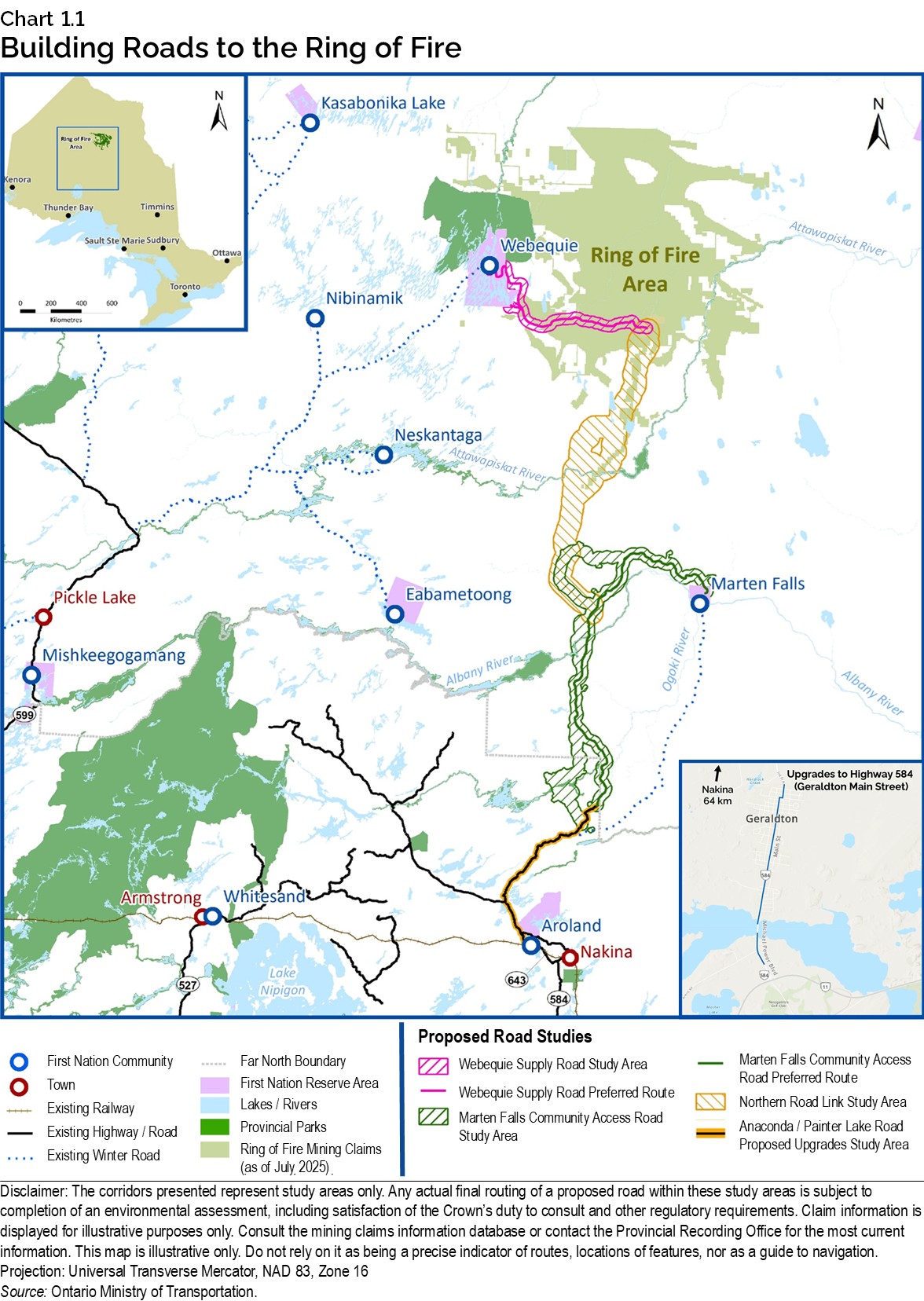
In partnership with First Nations, Ontario continues its plan to unlock the economic potential of the Ring of Fire by supporting the development of key infrastructure, including all-season, dependable road access and connections to provincial highways.
Creating Partnerships to Unlock Economic Prosperity
In 2025, the Ontario government signed three agreements with First Nations partners to help unlock the Ring of Fire. In October, Ontario signed a Community Partnership Agreement with Webequie First Nation and in November, Ontario also signed a Community Partnership Agreement with Marten Falls First Nation. These agreements will help to unlock economic development and accelerate construction of the all-season Webequie Supply Road (WSR) and the Marten Falls Community Access Road (MFCAR), while also supporting each partners’ additional key community priorities. Each agreement provides these communities with up to $39.5 million for community infrastructure and economic supports.
In January 2025, Ontario signed a Shared Prosperity Agreement with Aroland First Nation to drive economic growth and upgrade infrastructure in Northern Ontario. This agreement includes support for upgrades to Anaconda and Painter Lake Roads, which are important connections on the road to the Ring of Fire, as well as major new investments in infrastructure and energy transmission in the region, including the Greenstone Electricity Transmission Line. The agreement provides Aroland First Nation with $20 million for community economic and infrastructure projects.
Accelerating Construction on Roads to the Ring of Fire
In March 2026, at the annual Prospectors & Developers Association of Canada convention, Ontario released a plan to accelerate construction of the all-season roads to the Ring of Fire, with construction planned to start in June 2026 and roads beginning to open in November 2030, five years ahead of schedule.
This plan is supported by the partnership agreements mentioned above, a Co-operation Agreement with the federal government to eliminate duplication between provincial environmental assessments and federal impact assessments, as well as a streamlined regulatory environment to speed up approvals, including through the One Project, One Process framework.
Under the accelerated plan:
- The Webequie Supply Road is scheduled to start construction in June 2026 and open by November 2030, four years ahead of schedule;
- The Marten Falls Community Access Road is scheduled to start construction in August 2026 and open by November 2031, four years ahead of schedule;
- Upgrades to the Anaconda and Painter Lake Roads are scheduled to open by November 2030, two years ahead of schedule; and
- The Northern Road Link is scheduled to start construction in spring 2028 and open by November 2031, five years ahead of schedule.
Investing in Critical Infrastructure to the Ring of Fire
In January 2026, the government announced that it is declaring the Greenstone Transmission Line a priority project, in order to accelerate construction of the line that will run from Nipigon Bay to near Aroland First Nation and the gateway to the Ring of Fire. Ontario committed to building the Greenstone Transmission Line as part of the Aroland–Ontario Shared Prosperity Agreement.
In September 2025, Ontario announced an investment of $61.8 million in Geraldton’s Main Street Rehabilitation Project to fortify connections between Highway 11, at the south end, to Highway 584, at the north end, and ultimately, to the Trans-Canada Highway, which will be the first segment on the road network to the Ring of Fire. This critical road infrastructure project will be the gateway to the Ring of Fire and is part of the government’s strategy to unlock the economic potential of the region.
Building a Domestic Critical Minerals Supply Chain
Ontario’s critical minerals advantage will play a key role in growing strategic sectors, and Ontario is working to help ensure that minerals mined in Ontario will be processed and refined in Ontario, by workers in Ontario. First announced in the 2025 Budget, the $500 million Critical Minerals Processing Fund (CMPF) provides strategic financial support to accelerate the province’s critical minerals processing capacity and strengthen domestic supply chains.
Delivered through Invest Ontario, the province’s investment attraction agency, the CMPF complements the government’s ongoing efforts to unlock the economic potential of Ontario’s mineral resources sector in the Ring of Fire and across Northern Ontario. By ensuring that existing mineral processing facilities can maximize their production and by supporting the construction of new processing operations, the government is boosting Ontario’s manufacturing competitiveness and building a more resilient and self-reliant economy equipped with the tools needed to meet growing domestic and international demand for critical mineral resources.
Investing in Junior Mining Companies Through the Ontario Junior Exploration Program
Early mineral exploration is often high-risk, with long odds of success and operations in Northern regions and challenging terrain, making it difficult for companies to secure the necessary investments to move projects forward. Ontario is providing financial support towards eligible costs associated with early exploration to reduce risks for private investors and boost Ontario’s appeal as a jurisdiction of choice for mining investment. The government is investing an additional $30 million over the next three years into the Ontario Junior Exploration Program (OJEP), starting in 2026–27, to support early-stage mineral exploration. In July 2025, Ontario introduced two funding streams to help accelerate critical mineral projects: the New Prospector Stream and the enhanced Indigenous Participation Incentive.
This investment builds on the $10 million already announced in July 2025 and helps junior mining companies and licensed prospectors cover early exploration and development costs. Between 2021 and 2025, Ontario has provided $29.8 million in funding to 213 projects (162 of which included critical minerals exploration), leveraging an additional $61.8 million in private-sector investment.
Fostering Innovation in Ontario’s Critical Minerals Supply Chain
Launched in November 2022, the Critical Minerals Innovation Fund (CMIF) helps stimulate investment in critical minerals exploration, mining development, production and processing of domestically sourced critical minerals.
In July 2025, Ontario invested more than $7 million to launch a new intake of the CMIF. This investment builds on the $20 million invested through the CMIF since its launch in November 2022, supporting more than 29 Ontario-based projects. This new intake was open between July 2025 and October 2025, to support the research, development and commercialization of made-in-Ontario technologies for the province’s mining sector. The CMIF supports projects in four priority areas: battery supply chain, innovative techniques for deep exploration and mining, recovery of minerals and other innovative projects that support the critical minerals sector. Projects are currently moving through the evaluation process, reflecting continued strong demand for funding and innovation in Ontario’s critical minerals sector.
Advancing Ontario’s Life Sciences Sector
Ontario boasts a strong and growing life sciences sector, which is a key contributor to the province’s economy, employing more than 74,000 people across nearly 2,000 firms and generating more than $11.8 billion in exports annually. Since 2018, the province has attracted more than $6 billion in new life sciences investment and created over 6,700 additional jobs. The government continues its plan to establish Ontario as a global biomanufacturing and life sciences hub, by driving innovation, improving responsiveness to current and future health challenges and promoting better patient outcomes.
Driving Growth in Ontario’s Life Sciences Sector
To continue strengthening the province’s life sciences sector, the government is investing an additional $24 million over three years, starting in 2026–27, to renew the Life Sciences Scale-Up Fund (LSSUF). The LSSUF supports Ontario’s SMEs in the human health sciences sector, including medical isotopes, to commercialize market-ready products, scale operations, strengthen competitiveness and prepare for procurement opportunities. Strong demand in the program’s first round supported 14 projects and leveraged an additional $52 million in private-sector investment. This investment will continue to advance the government’s Life Sciences Strategy, Taking Life Sciences to the Next Level, to position Ontario as a leading jurisdiction for biomanufacturing and life sciences, innovation and the commercialization and early adoption of innovative health products and services.
Ontario’s Life Sciences Strategy, introduced in 2022 and expanded with Phase 2 in October 2024, aims to accelerate sector growth by strengthening research and development, improving access to capital, supporting the existing ecosystem and fostering a culture of innovation. Through this strategy, Ontario is targeting to grow employment in the sector to 85,000 high-value jobs by 2030, a 25 per cent increase from 2020.
Building Ontario’s Defence Industry
National defence is becoming an increasingly important pillar of Canada’s security and economic resilience. To meet its NATO commitment, the federal government is preparing to raise defence spending to 5 per cent of GDP by 2035, including $150 billion annually in military, industrial and infrastructure-related investments. The global expansion in defence procurement creates a significant opportunity to strengthen Canada’s industrial base and expand its export sector.
Ontario is well positioned to play a leading role in supplying national defence. As of 2022, the province accounted for roughly 36 per cent of Canada’s defence sector employment, the largest share of any province, reflecting strong capabilities across advanced manufacturing, aerospace, cybersecurity, artificial intelligence (AI) and emerging dual-use technologies. With over 300 companies generating over $5 billion in annual revenue and directly employing more than 13,000 people, Ontario is a national hub for defence manufacturing and innovation.
New federal initiatives and investments can leverage Ontario’s talent base and comparative advantages to support national security objectives, while creating jobs and anchoring high-value activity domestically. This includes measures to enhance the capacity of the Canadian Armed Forces through initiatives such as Canada’s Defence Industrial Strategy, as well as regionally focused programs that help small and medium-sized businesses integrate into domestic and international supply chains, including in priority areas such as armoured vehicles.
Ontario is working to build a globally competitive defence sector. The province has several initiatives that can support businesses as they look to meet federal defence procurement needs and expand exports, including:
- The Ontario Made Manufacturing Investment Tax Credit, which is available to help support investment in defence-related manufacturing buildings, machinery and equipment;
- The $500 million Critical Minerals Processing Fund designed to support and expand Ontario’s processing capacity of minerals that can play a key role in strategic sectors, including defence;
- Investing $215 million to support shipbuilding and the broader marine sector in the province, including the Ontario Shipbuilding Grant Program, which supports Canada’s National Shipbuilding Strategy; and
- Providing $50 million in venture capital funding through Venture Ontario for Ontario-based venture capital firms focused on technologies that support national defence and related technologies, such as artificial intelligence and cybersecurity.
Enhancing Ontario’s Position in Global Defence Markets
In March 2026, the government appointed Bernard Derible to serve as the province’s first-ever Ontario Military Defence Representative (OMDR) to help position Ontario as a trusted supplier of defence equipment and technology and attract new defence investments. The OMDR will promote Ontario’s defence industry in global markets and will leverage Ontario’s existing in‑market resources in Southeast Asia to help Ontario companies take advantage of growing export opportunities and connect with new international partners. The OMDR will also help identify high value investments that strengthen Ontario’s security, R&D capacity, domestic production and supply chain resilience.
Positioning Toronto as a Global Hub for Defence Financing
In January 2026, the Ontario government continued its advocacy to secure the City of Toronto’s selection as the headquarters of the new Defence, Security and Resilience Bank (DSRB) by launching a comprehensive bid book outlining the many attributes that make Toronto uniquely positioned to host the bank. The DSRB is a new multilateral institution focused on financing defence, security and resilience projects for NATO members and allied nations. The bank would help unlock capital for suppliers of all sizes, streamline multinational procurement and strengthen the industrial capacity of allied partners, while supporting Canada’s role in global security. The DSRB is expected to create up to 3,500 direct jobs and support thousands of additional indirect jobs, that would benefit Toronto as well as the entire province and country.
Accelerating New Opportunities for Investment and Growth
The government is creating the conditions for growth by fostering an economic environment where businesses looking for opportunities to grow can invest with confidence. By reducing barriers, supporting strategic investments and creating more opportunities for growth, the government is fighting to protect Ontario workers while building the province’s economic resiliency and long-term competitiveness.
Lowering Taxes for Small Businesses
Small businesses play an important role in Ontario’s economy, from family-owned businesses to innovative startups. To support these businesses, Ontario provides small businesses with a preferential CIT rate. To ensure Ontario’s small businesses continue to stay competitive and resilient, and as an important step in Ontario’s Tax Action Plan, the government is proposing to cut the small business CIT rate from 3.2 per cent to 2.2 per cent, effective July 1, 2026. By cutting the rate by more than 30 per cent, over 375,000 small businesses would benefit from an additional $1.1 billion in CIT relief over the next three years. A qualifying small business would benefit by up to $5,000 in additional tax relief each year, which could help them cover their expenses, invest in their business and grow.
This proposed tax cut builds on actions taken by the government to cut the small business CIT rate from 3.5 per cent to 3.2 per cent, starting in 2020, and to expand access to the preferential rate to more businesses, starting in 2023. Through the preferential small business CIT rate, the province already provides $3.45 billion per year in CIT relief to small businesses across Ontario.
See the Annex: Details of Tax Measures and Other Legislative Initiatives for more details.
Encouraging Business Investment in Ontario
The government is making Ontario the best place in the G7 to invest and do business, and improving Ontario’s competitiveness for business investment is a key cornerstone of this priority. That is why the government intends to lower the cost of capital investments by allowing businesses to accelerate the income tax deduction for the cost of depreciable assets, in parallel with changes announced by the federal government.
These changes would lower the cost for investment in a broad range of assets, by allowing:
- Immediate 100 per cent writeoffs for manufacturing and processing (M&P) machinery and equipment, M&P buildings, greenhouse buildings, certain clean technology assets and zero‑emission vehicles;
- Immediate 100 per cent writeoffs for productivity-enhancing assets;
- Immediate 100 per cent writeoffs for capital expenditures for R&D;
- Accelerated depreciation for liquefied natural gas equipment and related buildings;
- Accelerated depreciation from 4 per cent to 10 per cent for purpose-built rental housing; and
- Accelerated first-year deductions of up to three times the regular amount for most other depreciable assets.
Together, these measures would provide over $3.5 billion in Ontario income tax relief to qualifying businesses over four years, from 2025–26 to 2028–29. The measures would take effect following the passage of federal legislation for corresponding measures announced in the federal Budget 2025 and other announcements.
By taking action to allow faster writeoffs of capital investments and lower business costs, the government is creating the conditions that make Ontario an attractive place to start and grow a business.
Preparing Industrial Sites for Investment
The government continues to help assemble shovel-ready sites to support large-scale investments in Ontario that will help drive regional growth and job creation. The province competes with other jurisdictions that have a portfolio of these sites, putting Ontario at risk of losing out on investments if the province is unable to save businesses the time and money needed to prepare industrial land. Developing mega sites that are ready for business construction can attract high-value manufacturing projects that can boost Ontario’s long-term prosperity through job creation, increased investor funding and enhanced infrastructure development.
Advancing Strategic Projects Through Special Economic Zones
To support its plan to build a more competitive and resilient economy, the government recently enacted a new regulation for Special Economic Zones (SEZs). SEZs help create a predictable and stable environment for new investments, allowing designated projects within these zones to launch and progress significantly faster. They will support the advancement of job-creating investments and projects that are of strategic and critical importance to Ontario’s economic security.
Under the Special Economic Zones Act, 2025, the government’s new regulation establishing the criteria to designate SEZs, trusted proponents and projects came into effect on January 1, 2026. Informed by consultations with Indigenous communities, the regulation sets out the SEZ criteria while upholding the province’s strong environmental standards and fulfilling the Crown’s duty to consult. SEZs are an important tool for communities to unlock First Nations-led economic prosperity.
Identified projects and trusted proponents in designated zones that meet high standards for operation, safety and the environment could benefit from streamlined requirements, faster permitting and priority access to services such as the new One Project, One Process framework. The government will continue to prioritize new advanced exploration and mine production projects through this framework.
Strengthening Ontario’s Investment Pipeline Through Invest Ontario
Through Invest Ontario, the government is creating jobs and making Ontario more competitive by attracting new investments and positioning the province as one of the world’s top investment destinations. The investment attraction agency offers investors one-window access to expertise and tailored services, as well as financial support through the Invest Ontario Fund. In the 2025 Budget, the government allocated an additional $600 million to the Invest Ontario Fund, bringing the fund total to $1.3 billion. The additional funding will offer stability to investors and attract new opportunities for jobs and growth during a time of continued economic uncertainty. To date, Invest Ontario has announced over $12.4 billion in investments, which are expected to create more than 11,300 jobs across the province.
Promoting Investment in Environment-Friendly Carbon Storage
Carbon capture, utilization and storage (CCUS) includes activities designed to capture carbon dioxide and then transport, use or store it. Geologic carbon storage is one component of CCUS, involving the permanent storage of carbon dioxide in deep underground rock formations.
In February 2026, the government began accepting applications for commercial-scale geologic carbon storage projects. These projects will create opportunities for new investments that will help energy‑intensive industries cut greenhouse gas emissions by five to seven million tonnes annually, with the potential to create over 4,000 jobs and reduce costs for Ontario’s industries by nearly $1 billion.
The government will continue to work closely with industry stakeholders, municipalities, Indigenous communities, landowners and the public to ensure that the regulatory framework for geologic carbon storage projects remains safe and effective.
Carbon capture and storage projects have a proven track record of success. By 2023, there were almost 400 projects at various stages of development worldwide, including four active storage operations in Alberta and three in Saskatchewan, along with 28 planned storage projects in Alberta and five in Saskatchewan. Close to 300 million tonnes of carbon dioxide have already been captured underground worldwide.
Building New Trade Opportunities for Ontario Businesses
U.S. tariffs have disrupted supply chains, created significant economic uncertainty and continue to have an impact on firms in Ontario. These tariffs have also created an urgent need for Ontario to diversify trade and reach new markets, both internationally and across Canada. As Ontario navigates these turbulent waters, the government continues to break down internal trade barriers and provide support for businesses affected by U.S. tariffs to identify new markets and expand trade.
Enhancing Free Trade within Canada
Internal trade barriers have held back trade with other provinces, a significant contributor to the economy. In times of economic uncertainty, Ontario is taking a leadership role and reducing barriers through the Protect Ontario Through Free Trade Within Canada Act, 2025, passed in June 2025. Through this Act, Ontario also set the foundation for mutual recognition of goods and services and expanded labour mobility with first-in-Canada “As of Right” rules. Ontario is the first and only province to remove all of the province’s Party-Specific Exceptions under the Canadian Free Trade Agreement (CFTA).
In December 2025, Ontario took the next steps towards implementing mutual recognition of goods and services from other reciprocating Canadian jurisdictions by publishing a draft regulation under the Ontario Free Trade and Mobility Act, 2025 (OFTMA). Under this draft regulation, the province would recognize goods and services from other Canadian jurisdictions that are taking similar actions at home. This will play a substantial role in supporting economic integration across Canada by removing internal trade barriers that are estimated to cost the nation’s economy up to $200 billion every year in forgone economic activity and GDP.
In January 2026, Ontario also enacted historic labour mobility regulations that break down interprovincial barriers for workers and businesses and help employers access the skilled Canadian workers they need sooner. See the section “Protecting Workers by Promoting Labour Mobility” for more details.
To further support internal trade and mobility across Canada, Ontario has secured Memoranda of Understanding (MOUs) with 10 provinces and territories since April 2025. These MOUs strengthen economic cooperation between jurisdictions by supporting efforts to eliminate red tape, cut costs for businesses and open new pathways for skilled workers to move more freely across the country.
In January 2026, Ontario received the “One to Watch” Golden Scissors Award from the Canadian Federation of Independent Business (CFIB) for Ontario’s role in the Committee on Internal Trade’s Canadian Mutual Recognition Agreement (CMRA) on the Sale of Goods, signed on November 19, 2025 by the federal government and most provinces and territories. The CMRA will allow goods in one province to be sold in other provinces without having to meet additional testing, certification or other requirements, unless a government has identified a specific requirement it will retain. Ontario listed no applicable requirements in the CMRA. Ontario’s internal trade actions are helping firms pivot in response to global challenges, expand into new Canadian markets and contribute to a more resilient and competitive economy.
Taking Steps to Expand and Diversify Interprovincial and International Trade
The government is diversifying trade to new markets by promoting Ontario-made goods and services. In November 2025, Ontario invested an additional $100 million in the Ontario Together Trade Fund (OTTF) to help businesses with near-term investments so they can serve more interprovincial customers. The fund aims to support SMEs affected by U.S. tariffs in their efforts to diversify into new markets, strengthen trade resiliency and reshore critical supply chains. This investment brought the total program funding to $150 million over three years in response to strong demand for the program.
Ontario is working hard to support the expansion of trade and investment with non-U.S. countries. To further support trade within Canada and abroad, Ontario is investing $31 billion in roads, highways and other transportation infrastructure to ensure goods can reach new trade gateways, such as Port Saint John in New Brunswick, while ensuring that manufacturers, resource producers and shippers have the infrastructure needed to reach markets across Canada and around the world.
Ontario is also promoting trade with new international trading partners through its network of Trade and Investment Offices (TIOs). Working closely with federal, provincial, territorial and municipal partners, TIOs facilitate investment deals and help expand the province’s SME exports into global markets to raise Ontario’s commercial profile. These offices have facilitated market access for over 2,330 Ontario firms across several sectors. In November 2024, Ontario opened its fourteenth TIO in Singapore. In May 2025, Ontario strengthened its regional presence by appointing an Agent-General in Thailand, expanding strategic coverage and access to opportunities across Southeast Asia.
This global network complements Ontario’s broader trade diversification efforts. In 2025, the government undertook over 60 targeted export missions, helping Ontario companies increase export revenue by more than $110 million. In addition, Ontario is working closely with the federal government to advance provincial interests during Canada’s free trade agreement negotiations with new high-growth markets. Once in effect, these new trade agreements will offer important opportunities to diversify exports and expand Ontario’s presence in fast-growing regions.
Making Ontario Even More Competitive and Productive
As part of its plan to protect Ontario, the government is continuing to lay the groundwork for a more competitive and productive economy. The province is positioning itself to unlock stronger growth with an ambitious plan to make Ontario the most competitive place to invest, grow and succeed in the G7.
Further Cutting Red Tape to Build a More Competitive Ontario
Since 2018, Ontario has taken approximately 700 actions to reduce regulatory burdens, saving businesses, individuals and the broader public sector more than $1.3 billion in annualized compliance costs and delivering 1.8 million hours in annual savings.
The government continued to build on this progress through the passage of 12 legislative bills during the fall 2025 session. These bills are focused on cutting red tape, unleashing Ontario’s economy, investing in infrastructure, improving services and making life more affordable. Among them is the Protect Ontario by Cutting Red Tape Act, 2025, which will help reduce regulatory burdens to save people and businesses an additional $5.8 million and more than 256,000 hours every year.
The government is also cutting red tape and supporting trade, investment and economic growth to strengthen Ontario’s competitiveness through the Building a More Competitive Economy Act, 2025. This includes initiatives to streamline government processes for permits and approvals, champion local businesses and improve labour mobility by expanding “As of Right” provisions, which build on the province’s historic actions to reduce interprovincial trade barriers. Key reforms under the Act include:
- Reviewing all of Ontario’s economic development-focused permits by the end of 2028, with the goal of eliminating or transforming 35 per cent or more to position the province as the leading G7 jurisdiction for investment, while maintaining robust health, safety and environmental protections; and
- Creating a centralized digital permitting system that streamlines how businesses apply for and monitor permits, thereby reducing approval times, enhancing transparency and providing the certainty needed to invest and move projects forward.
In recognition of the government’s significant progress in cutting red tape in 2025, the Canadian Federation of Independent Business (CFIB) awarded Ontario its first-ever overall grade of “A” as part of its latest Red Tape Report Card. The report also recognized the province as having the lowest number of provincial regulatory restrictions per capita. In addition, the government received CFIB’s “One to Watch” Golden Scissors Award for outstanding red tape reduction efforts attributed to Regulatory Intelligence (REGi). REGi was launched in 2025 and is the first AI-powered tool in North America to leverage a Large Language Model for the identification of Ontario’s regulatory compliance requirements and red tape reduction opportunities.
The province will continue to build on these efforts and deliver real results that save time and money for businesses and families.
Enhancing Competitiveness by Lowering Costs for Businesses
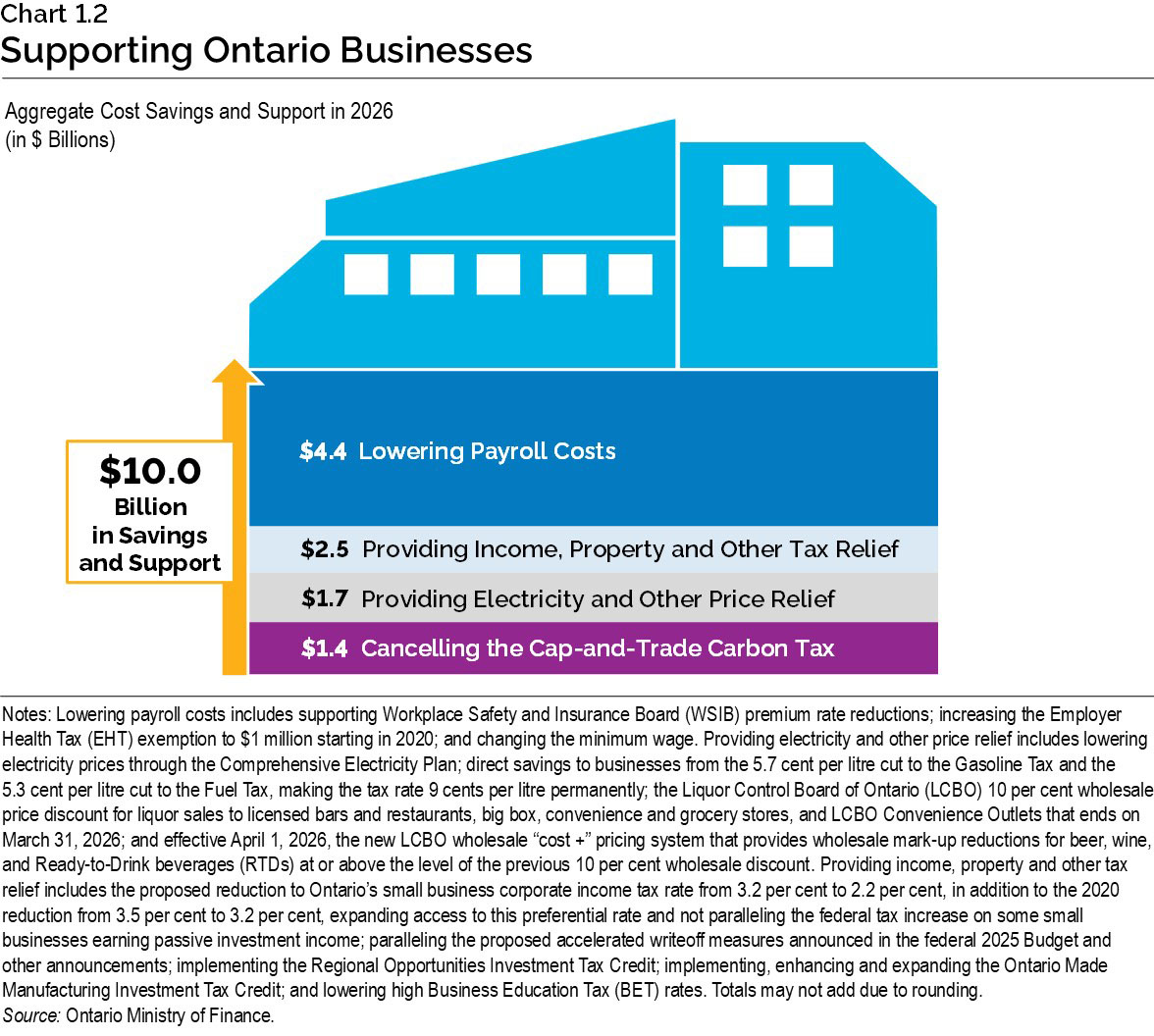
Through key actions taken since 2018, the government would enable nearly $10 billion in estimated cost savings and support for Ontario businesses in 2026, of which $4.8 billion would go to small businesses. Some of these actions include:
- Proposing to further cut the small business CIT rate to 2.2 per cent, which would provide up to $5,000 in additional tax relief each year, building on actions already taken to cut the rate from 3.5 per cent to 3.2 per cent and expand access to this preferential rate;
- Implementing and temporarily enhancing and expanding the Ontario Made Manufacturing Investment Tax Credit, which provides businesses up to $3 million in annual tax support for manufacturing or processing investments in the province;
- Cutting the Gasoline Tax by 5.7 cents per litre and the Fuel Tax by 5.3 cents per litre, to help reduce the cost of gas and fuel for Ontario businesses;
- Continuing to support businesses and ease financial pressures through the Workplace Safety and Insurance Board, which is further reducing the average premium rate to $1.23 per $100 of insurable payroll, the lowest level in more than 50 years;
- Increasing the Employer Health Tax (EHT) exemption from $490,000 to $1 million. The EHT exemption increase helps businesses by reducing the tax for eligible private-sector employers;
- Cancelling the cap-and-trade carbon tax to remove its cost impact from items such as gasoline, diesel fuel and natural gas;
- Lowering high Business Education Tax (BET) rates in 2021, providing $450 million in annual savings for over 200,000 employers, or 95 per cent of all business properties in Ontario;
- Lowering business costs by providing corporate income tax relief through paralleling proposed federal measures that would allow businesses to accelerate writeoffs of certain capital investments;
- Implementing the Comprehensive Electricity Plan in January 2021, which is lowering electricity costs by an estimated average of 9 to 13 per cent in 2026 for medium-sized and larger industrial and commercial customers, respectively;
- Extending the Liquor Control Board of Ontario (LCBO) wholesale discount of 10 per cent from the retail price on beverage alcohol wholesaled to bars and restaurants, big box, grocery and convenience stores from December 31, 2025, to March 31, 2026; and
- Reducing LCBO wholesale mark-ups by about $200 million per year to help support producers and retailers succeed in the expanded alcohol marketplace.
Creating New Growth Opportunities Through Innovation and Technology
Ontario’s innovation ecosystem continues to attract significant investment and create high-value jobs. Innovation is driving progress across a number of sectors, with new discoveries and critical technologies helping to protect and create good-paying jobs, while also keeping Ontario businesses competitive in the global market. By accelerating technology adoption, supporting homegrown research and equipping workers with the right skills and tools, Ontario is strengthening the conditions for more high-paying jobs, sustained growth and a more competitive economy.
Unlocking Growth Through Artificial Intelligence
Artificial intelligence represents a significant economic opportunity for Ontario. It has the potential to drive growth, enhance productivity and transform economies. Globally, AI has the potential to contribute US$15.7 trillion to the global economy by 2030. Research from Deloitte Canada, commissioned by the Vector Institute, estimates that between 2025 and 2035, AI adoption is projected to generate $122 billion in real GDP for Ontario and create an average 17,600 new jobs annually. The adoption of AI is also expected to boost labour productivity in the province by 1.6 per cent by 2035.
As global demand for AI-driven innovation continues to grow, Ontario is well positioned to unlock new opportunities and strengthen its competitiveness. The government is strengthening the foundations for the responsible use of AI, prioritizing clean energy to support data centres and driving economic transformation through the adoption of AI technologies across the economy.
Adopting Innovations in Artificial Intelligence Responsibly
Ontario is embracing transformational and powerful AI tools to help build a better province, while remaining committed to implementing appropriate guardrails in both the public and broader public sectors to ensure that AI systems are used transparently, accountably and responsibly.
In January 2025, the Enhancing Digital Security and Trust Act, 2024 (EDSTA) came into effect in Ontario. The EDSTA establishes a foundation to support the responsible use of AI. This legislation gives Ontario the tools it needs, as a leading Canadian jurisdiction, to ensure AI is governed and used in a transparent, responsible and accountable way.
As Ontario advances its digital economy, the government will accelerate the use of AI to boost economic growth, modernize and improve public services, and support innovation and transparency, while ensuring AI is used responsibly in the public sector.
Prioritizing Electricity for Data Centres That Strengthen Ontario’s Economy
According to a 2025 report published by the Independent Electricity System Operator, Ontario is home to approximately 100 data centres. The Ontario government is taking action to prioritize electricity for data centres that support the province’s economic interests, including those that create high-quality jobs, assist in domestic data hosting and strengthen Ontario’s position in the digital economy.
With the tools created within the Protect Ontario by Securing Affordable Energy for Generations Act, 2025, the province can set out certain criteria that data centres must meet before connecting or reconnecting to the electricity grid. This ensures Canadian data stay in Canada, protected from misuse.
Developing Ontario’s Artificial Intelligence Industrial Strategy
Ontario has established a strong AI foundation supported by its growing AI sector, including its deep pool of AI talent and increasing number of homegrown AI companies. To leverage these strengths and drive broader adoption across the economy, the government is developing a comprehensive provincial AI strategy. This will enhance Ontario’s position as a world-leading AI jurisdiction to attract investment and talent, support the growth of domestic firms and boost business productivity.
Working closely with industry and academic partners, the government is developing a coordinated plan, to be launched in summer 2026, that will support the scale-up of Ontario-based AI firms, expand access to sovereign compute and data resources and ensure the province has the digital and grid-ready energy infrastructure required for next-generation innovation. The strategy will also aim to increase adoption and deployment across communities and businesses in key sectors, with a focus on Ontario-made technology and talent. To set up Ontario for success, the government will also further advance the safe and responsible use of AI by establishing clear governance frameworks and enhancing AI literacy.
Strengthening Ontario’s Development and Adoption of Critical Technologies
To help Ontario businesses stay competitive on the global stage, the government is continuing to invest in critical technologies. Through an additional $107 million investment over three years, starting in 2026–27, the government is renewing the Critical Technology Initiatives (CTI) program and there will be an upcoming call for proposals to seek CTI delivery partners. The renewed funding will target projects that accelerate the development, commercialization and adoption of critical technologies such as AI, quantum technologies, cybersecurity and advanced connectivity, as well as critical manufacturing or supply-chain technologies such as robotics and semiconductors, in key sectors, such as advanced manufacturing, automotive, life sciences, mining, defence, agriculture and smart infrastructure. The CTI program launched in 2023.
In the first round, successful partners included the Vector Institute, the Ontario Centre of Innovation, the Ontario Bioscience Innovation Organization, the Quantum Valley Ideas Lab and the Canadian Cyber Threat Exchange. The development and adoption of these technologies have helped boost Ontario’s innovation ecosystem and AI infrastructure, creating new opportunities for businesses, increasing productivity and driving the development and adoption of transformative technologies. Since its inception, the CTI is on track to create or retain over 65,000 jobs and train over 14,000 highly qualified personnel, leading to the generation of over 700 new intellectual properties in the province.
Supporting Homegrown Research and Innovation by Investing in Ontario’s Research Infrastructure
Supporting homegrown research helps lead to groundbreaking discoveries and real-world applications that improve lives, while keeping Ontario businesses on the cutting edge of innovation. Research and innovations generated through Ontario’s colleges, universities, research hospitals and research institutes are advancing solutions to social, environmental and health challenges, while driving economic growth, strengthening key industries and enhancing international competitiveness.
The government is investing an additional $117.1 million over three years, starting in 2026–27, through the Ontario Research Fund–Research Infrastructure (ORF-RI), which will help continue to build, renovate and equip cutting-edge research facilities for critical projects across priority sectors, including agri-food, critical minerals, information technology, life sciences and manufacturing. This investment will strengthen Ontario’s research capacity and help attract and retain highly qualified personnel and support growth in the province’s innovation economy.
This builds on investments of over $47 million announced in January 2026 to support 195 research projects at universities, colleges and hospitals across the province as part of the government’s plan to protect Ontario by supporting high-impact, homegrown research, protecting good-paying jobs and helping Ontario businesses compete globally.
Making New Discoveries Through Ontario’s Research Institutes
The government continues to advance Ontario-made research and innovation to help keep ideas, expertise and intellectual property in the province and support long-term economic growth. To sustain the operations of established research programs, the government is investing $26 million over three years, starting in 2026–27, to maintain existing and planned levels of support for Ontario’s research institutes and continue to help catalyze the province’s research discoveries into world-leading breakthroughs and innovations. This will also continue to foster a skilled labour force, promote new business opportunities and support Ontario’s long-term economic growth.
Supporting Manufacturing Businesses and Workers
The manufacturing sector accounts for over 800,000 workers across the province and is a driving force behind Ontario’s economic strength and global competitiveness. As challenges facing Ontario manufacturers intensify due to U.S. trade policy, the government continues to help attract investments that will underpin the domestic manufacturing sector of the future.
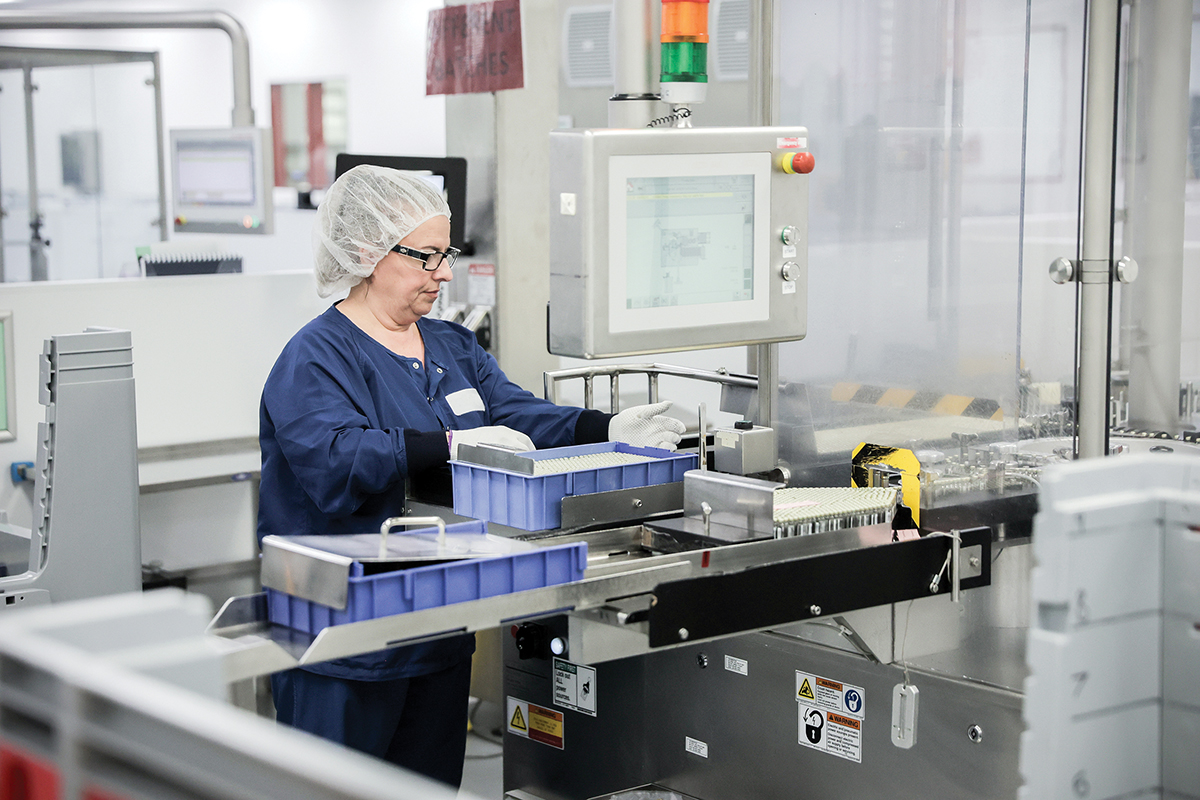
The government is promoting growth in the manufacturing sector and helping manufacturers compete by securing next-generation production facilities, strengthening domestic supply chains, leveraging productivity-enhancing technologies and building a workforce of the future.
To support manufacturing in the province, the government implemented the Ontario Made Manufacturing Investment Tax Credit, which provides support of up to $3 million per year to a qualifying corporation that makes eligible investments in buildings, machinery and equipment for use in manufacturing or processing in the province.
In addition, to further improve Ontario’s tax competitiveness for business investment, the government intends to allow businesses to accelerate the depreciation of a broad range of capital investments, in parallel with proposed federal measures. These measures include provisions that would allow qualifying corporations to immediately write off 100 per cent of the cost of buildings, machinery and equipment used in manufacturing or processing. The accelerated writeoff measures would provide over $3.5 billion in Ontario income tax savings over four years, helping make Ontario the best place in the G7 to invest and do business, pending the passage of federal legislation.
The government is also supporting Ontario’s competitiveness in the advanced manufacturing sector through the Advanced Manufacturing and Innovation Competitiveness (AMIC) Stream of the Regional Development Program. The AMIC Stream supports advanced manufacturers across the province by providing financial support and tools, primarily to small and medium-sized businesses, to help manufacturers invest in equipment, technologies and skills development. To date, the government has announced investments of approximately $50 million in over 40 companies and organizations through the AMIC Stream. This has leveraged $675 million in investments from industry, creating over 1,100 jobs.
Cultivating Cutting-Edge Growth in Ontario’s Agri-Food Sector
Ontario has a rich and diverse agri-food sector, producing over 200 agricultural commodities, with 60 per cent of the food produced in Ontario being processed and consumed in the province. To support the province’s agri-food sector, which contributed over $51 billion to GDP in 2024 and represented one in nine jobs in Ontario, the government released Grow Ontario: a provincial agri-food strategy in November 2022. The strategy has strengthened agri-food supply chains, grown agri-food talent and enhanced competitiveness by supporting the adoption of new technologies and practices.
Enhancing Agri-Food Innovation Through the Sustainable Canadian Agricultural Partnership
Since April 2023, Ontario has supported the agri-food sector through the Sustainable Canadian Agricultural Partnership (Sustainable CAP). This five-year program, a $3.5 billion investment by federal, provincial and territorial governments, includes $1 billion in federal programs and activities and a $2.5 billion commitment that is cost-shared between the federal government (60 per cent) and the provinces and territories (40 per cent). Sustainable CAP aims to strengthen the competitiveness, innovation and resiliency of Canada’s agriculture, agri-food and agri-based products sector.
In September 2025, the governments of Canada and Ontario invested in several companies through several Sustainable CAP programs, including:
- $14.6 million through the Resilient Agricultural Landscape Program (RALP) to help farmers make improvements to their farmland; and
- Up to $4.8 million in 48 research and innovation projects and supporting 20 companies through the Ontario Agri-Food Research Initiative (OAFRI).
This is in addition to the $9 million invested in the Ontario Agricultural Sustainability Initiative, funded through Sustainable CAP in 2024, to help farmers enhance the sustainability and competitiveness of their farms.
Strengthening Stability in the Agri-Food Sector Through Ontario’s Risk Management Program
Ontario’s Risk Management Program (RMP) helps farmers manage risks beyond their control, like fluctuating costs and market prices, so they can compete globally with confidence. This program supports over 383,000 jobs and $24 billion throughout Ontario’s agri-food supply chain across 8,500 farms, which produce cattle, hogs, sheep, veal, grains and oilseeds, as well as edible horticulture, through the Self-Directed Risk Management Program. In January 2025, the Ontario government announced an increase in annual funding for its RMP from $150 million to $250 million over three years to enhance support for farmers.
Supporting Agricultural Research Infrastructure
Ontario is investing nearly $50 million over the next three years, starting in 2026–27, into Agricultural Research and Innovation Ontario (ARIO), which includes the $41 million investment announced in October 2025. These investments will help support the province’s network of strategic agri-food research infrastructure, including 14 research station properties, with 5,600 acres and more than 200 buildings. ARIO helps translate research into practical solutions for farmers and agribusinesses.
This funding also includes an investment of $10.5 million in the new Ontario Poultry Research Centre at the Elora Research Station, bringing the total provincial contribution to $24 million. Supporting this infrastructure will help cutting-edge research and innovation, benefiting farmers and agribusinesses across Ontario.
Investing to Protect and Support Northern and Rural Communities
Ontario’s small, Northern and rural communities are an essential part of the province’s overall economic strength and resilience.
To ensure the resilience of Northern communities, Ontario is extending the Northern Ontario Resource Development Support Fund with a new ongoing investment of $15 million annually. This funding will help Northern municipalities invest in core assets such as roads and bridges, access new economic opportunities through resource development and help mitigate the impacts of resource development on local infrastructure.
As part of its plan to protect Ontario, the government is strengthening rural capacity to support strong communities, create and retain jobs and drive local economic growth. In January 2026, the government announced the launch of its second intake of the Rural Ontario Development (ROD) Program. This $20 million program provides cost‑shared funding to help strengthen the economies of rural communities, protect jobs, improve infrastructure and create strong businesses.
Ontario is also continuing to support the financial sustainability of small, Northern and rural municipalities across the province by enhancing the Ontario Municipal Partnership Fund (OMPF) through an increase to the program of $100 million over two years and bringing the total funding envelope to $600 million annually. The funding will help municipalities provide critical services, from public transit and libraries to emergency services and road maintenance.
Strengthening Ontario’s Tourism and Cultural Sectors
Ontario is continuing to invest in its tourism and cultural sectors to drive economic growth, support local communities, create jobs and position the province as a premier global travel destination.
Building Destination Niagara
Ontario is advancing the Destination Niagara Strategy to unlock the region’s full potential as a year‑round, world‑class destination. The plan aims to grow annual tourism to 25 million visitors and double Niagara’s tourism impact, adding about $3 billion to Ontario’s GDP each year. Key priorities include enhancing tourism attractions, while also offering world‑class gaming, wine and culinary experiences, arts and culture and transportation improvements.
Upcoming initiatives include procurements for a new observation wheel, revitalization of the Niagara Parks Marina, redevelopment of the Ontario Power Generating Station, exploration of a signature theme park and a fully accessible, all‑season Niagara River Line tram. Transportation initiatives include expanding the Queen Elizabeth Way (QEW), twinning the Garden City Skyway Bridge, increasing GO service and exploring enhanced air access at Niagara District Airport.
Progress to date includes dedicating $35 million for the Shaw Festival’s rebuild of the Royal George Theatre, more than $1 million for regional festivals and events and a new visitor attraction. The privately funded redevelopment of the Toronto Power Generating Station, an over $300 million investment, will deliver the region’s only five‑star hotel.
Through Niagara Parks, Niagara Takes Flight was launched and has already welcomed more than 120,000 visitors and generated nearly $3.5 million in revenue, further strengthening the region’s four‑season draw.
Revitalizing Ontario Place
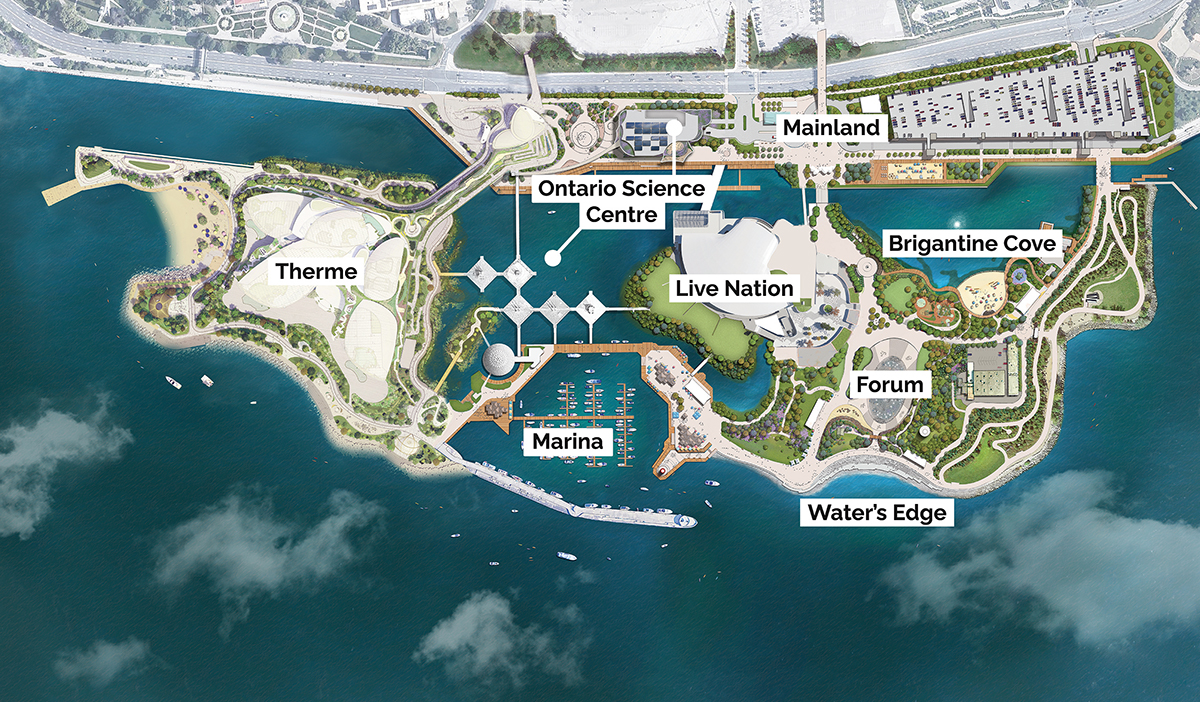
Ontario is working to make Ontario Place a world-class destination that will attract up to six million visitors every year. The reimagined Ontario Place will provide people of all ages with something to enjoy, including enhanced public spaces, playgrounds, trails and parks, increased access to Toronto’s waterfront, an enhanced year-round indoor-outdoor concert and entertainment venue, a family‑friendly waterpark and wellness facility, as well as an all-new and state-of-the-art Ontario Science Centre to be completed as early as 2029. This one-of-a-kind transformation of Toronto’s waterfront will create over 5,700 jobs in the construction and tourism sectors while boosting economic growth across Toronto and the region. Once complete, the redeveloped Ontario Place will be a world-class, international attraction for generations of visitors from near and far, offering a unique opportunity to establish a powerhouse economic driver on Toronto’s waterfront.
Developing Mississauga’s Waterfront
The province is committing $29 million over three years to support the Lakeview Village Cultural Pier Development project, in collaboration with the City of Mississauga, Peel Region and the Lakeview Village development group. The former “Four Sisters” Lakeview Generating Station site is being transformed into a mixed-use community facility, with the pier being repurposed to become a focal point for the new development. This project is intended to significantly enhance Mississauga’s Lake Ontario waterfront and support economic growth, job creation and tourism in the region.
Investing in Destination Wasaga
Wasaga Beach is home to the world’s longest freshwater beach and one of Ontario’s most unique coastal dune ecosystems. With views of the rugged Niagara Escarpment and more than 14 kilometres of white sandy coastline, it welcomes millions of visitors from around the world every year.
The province is continuing to work with the Town of Wasaga Beach to improve the area for residents and visitors, including by making available $2 million in tourism planning support and up to $25 million to redevelop the Nancy Island Historic Site. Ontario will soon begin the process of transferring a portion of the provincially owned beachfront in Wasaga Beach Provincial Park to the town, in order to support its integration into the broader development of Destination Wasaga, under the condition that the beach remain public.
This ongoing work will help better recognize the importance of the area and preserve its history, improve local roads to support future housing and traffic needs and help the town revitalize its downtown area to create a greater sense of community and encourage visitors to return again and again.
Investing in Ontario’s Cultural Institutions
To accommodate its growing collection of modern and contemporary art, the province is committing $35 million over two years to support the Dani Reiss Modern and Contemporary Gallery capital expansion project in the Art Gallery of Ontario (AGO). This initiative represents significant expansion at the AGO, which will help modernize the facility and continue to drive increased attendance and economic impacts for Ontario. Construction is already underway and once completed, the project will enable the AGO to display new and innovative exhibits.
Ontario is also providing $21 million in additional annual operating funding support for the AGO and the Royal Ontario Museum. This investment will help these cultural icons of Ontario continue delivering opportunities for visitors to appreciate and enjoy all that these world-class institutions have to offer.
Supporting Entrepreneurs to Grow and Succeed
Ontario is helping entrepreneurs start and grow their businesses. This is why the government is investing $9.4 million over three years, beginning in 2026–27, to renew grants for the Summer Company and Starter Company Plus programs delivered through the Small Business Enterprise Centres (SBECs) network. To help SBECs meet growing program demand, expand advisory services and support new initiatives, Ontario is also providing an investment of $3 million over three years, starting in 2026–27.
Ontario’s 54 SBEC locations provide a comprehensive range of business support to entrepreneurs, which include one-stop access to advisors, programs and services, along with learning opportunities tailored to small business owners in their region. In 2024–25, Ontario’s SBECs helped start over 8,000 businesses, expand 2,700 businesses and create more than 15,800 jobs.

The government is also continuing to support programs that help entrepreneurs start, grow and scale their businesses by:
- Renewing its support for young entrepreneurs by investing $2 million annually over three years in Futurpreneur, starting in 2026–27. Futurpreneur helps entrepreneurs aged 18 to 39 launch and grow their businesses by providing mentorship, in-person programming, and up to $75,000 in loan capital from Futurpreneur and the Business Development Bank of Canada (BDC);
- Investing $5 million in 2026–27 in the Digitalization Competence Centre to help small businesses modernize and grow through the adoption of digital technologies; and
- Renewing its support for Fédération des gens d’affaires francophones de l’Ontario (FGA) by investing $750,000 over three years, starting in 2026–27, to ensure Francophone entrepreneurs have continued access to dedicated business service supports in French.
Improving Capital Markets
As the global economic order continues to be marked by rapid change, shifting trade flows, demographic pressures and challenges to entrepreneurship, business retention and capital formation, Ontario’s financial services sector remains a cornerstone of stability and an economic engine of Canada.
The Ontario government remains committed to working closely with key partners in the capital markets sector and the Ontario Securities Commission (OSC) to implement innovative reforms, renew focus on reducing regulatory burden, accelerate access to capital and ensure investors remain protected and confident in Ontario’s markets.
The government is exploring opportunities to position Ontario as a global leader in digital asset innovation. To support this, the province will convene targeted stakeholder roundtable discussions in the coming months, to identify the strategic conditions required for effective regulation of digital assets that supports entrepreneurs to launch their ideas and innovate in Ontario. The province is also actively working with the federal government on the Canadian stablecoin regulatory framework. Fostering a supportive environment for innovators is essential to maintaining the province’s leadership in the global financial services industry.
These activities will strengthen Ontario’s position in the emerging financial technologies sector and advance the province’s ambition to become an international hub for entrepreneurial finance — where robust capital formation drives breakthrough innovation, high-value job creation and long‑term economic growth.
Safeguarding Ontario’s Workforce
Ontario’s workers remain the province’s most valuable asset and the government is taking action to protect them against U.S. tariffs and economic uncertainty. Ontario is protecting workers by promoting labour mobility between provinces, giving workers the tools they need to land rewarding, good-paying jobs and making investments to train workers to meet current and future labour market needs.
Protecting Workers by Promoting Labour Mobility
To protect Ontario workers and strengthen Ontario’s economic resilience, the province has implemented historic labour mobility and free-trade regulations that help employers access the skilled Canadian workers they need sooner.
As of January 1, 2026, new “As of Right” labour mobility rules allow in‑demand, certified workers to start working in Ontario within 10 business days following confirmation of their credentials by the appropriate regulator. These historic “As of Right” rules apply across occupations regulated by over 50 non-health regulatory bodies and more than 300 certifications. They promote faster hiring for critical roles, enhance worker mobility across the country and strengthen Ontario’s economic competitiveness.
Ontario is also enhancing access to health care workers by extending “As of Right” labour mobility to 16 additional regulated health professions, supporting workforce growth while upholding regulatory standards. These expanded reforms also include taking the next step toward automatic recognition of physicians and nurses who are registered and in good standing in other provinces and territories, making it faster and easier for them to continue their practice in Ontario.
These historic changes are part of the government’s plan to support Ontario and Canadian workers and build a unified Canadian workforce that can stand up to U.S. tariffs and economic uncertainty.
Investing in Skilled Trades and Construction-Related Talent
To build a strong skilled trades workforce and help safeguard Ontario’s economy during a period of uncertainty, Ontario continues to invest in programs that support and strengthen the skilled trades workforce. Since 2020, Ontario has invested more than $2.1 billion in the skilled trades, with initiatives aimed at reducing stigma, streamlining the apprenticeship system and increasing employer participation.
The province is also strengthening Ontario’s construction workforce by creating additional construction and urban planning seats at colleges, universities and Indigenous Institutes. As announced in the 2025 Budget, the province invested $75 million over three years to train up to 7,800 additional postsecondary students across Ontario for in‑demand construction-related occupations. This investment supports the province’s ability to meet current and future labour needs and advance its ambitious infrastructure agenda.
Creating Resource Development Scholarships for First Nation Students
As announced in the 2025 Budget, the government invested $10 million over three years to create new scholarship opportunities for First Nation students interested in pursuing careers in resource development. These scholarships will equip First Nation students with access to the tools and training needed to succeed as leaders and innovators in this sector. This investment contributes to the government’s plan to protect Ontario and support Indigenous participation, partnership and ownership in Ontario’s critical mineral supply chain.
Modernizing Ontario’s Pension Sector
Ontario workers deserve a modern and robust pension system. This is why Ontario’s government is moving forward with initiatives to enhance retirement income security, provide new options for pension plan members, increase flexibility and simplify pension plan administration. These modernization efforts are designed to respond to the evolving needs of the pension system and its members.
Protecting Plan Beneficiaries Through the Pension Benefits Guarantee Fund
The Pension Benefits Guarantee Fund (PBGF) plays an important role in protecting the 635,000 members of defined benefit, single-employer pension plans (DB SEPPs) in the event of employer insolvency. In its current form, the PBGF tops up the first $1,500 per month of an eligible pension in the event a pension plan is forced to wind up with a shortfall and the sponsor is bankrupt. The PBGF is financed through annual assessments paid by employers sponsoring DB SEPPs and income earned from the investment of the fund. Ontario is the only jurisdiction in Canada to provide this protection for plan beneficiaries.

In the 2025 Ontario Economic Outlook and Fiscal Review, the government announced that it would conduct a review of the PBGF, as required by the Pension Benefits Act, and report back in the 2026 Budget. The previous legislated review of the PBGF, conducted in 2021, resulted in improved reporting requirements for PBGF-eligible plans. The data collected through this enhanced reporting were used, with the assistance of the Financial Services Regulatory Authority of Ontario (FSRA), to inform the review. The 2026 review shows a decline in membership and the number of plans as DB SEPPs continue to close. In addition, plans are aging and include a growing proportion of retirees, who are the most vulnerable to a potential employer insolvency.
However, with $1.3 billion in net assets as of March 31, 2025, the PBGF is in a financially strong position, which can be leveraged to provide additional coverage for plan beneficiaries.
The government proposes doubling the guarantee limit from $1,500 per month to $3,000 per month — the largest increase since the PBGF was created in 1980 — for all eligible plan beneficiaries, at no increased cost to employers or the government. This would help to protect the people of Ontario from employer insolvency as they age, giving them the opportunity to enjoy retirement. The change is proposed to be effective on or after March 26, 2026.
The Ontario government is also supporting public and private-sector employers working to consolidate their pensions with jointly sponsored pension plans (JSPPs), which share risk between employees and employers. Currently, PBGF assessments and coverage end after a plan merges into a JSPP. The government will be consulting on regulations to assist with consolidation into JSPPs by eliminating PBGF premiums paid by sponsors of DB SEPPs, once plan beneficiaries have consented and while the merger is awaiting regulatory approval.
These changes are timely and support workers and retirees during a period of economic uncertainty, while maintaining the health and sustainability of the PBGF.
Providing a New Pension Option Through Variable Life Benefits
The government is proposing legislation to enable certain pension plans — defined contribution plans or plans with additional voluntary contributions — to offer a new option for retirees called a Variable Life Benefit (VLB). If offered, a VLB would be a new alternative to a locked-in account or an annuity that would provide a monthly benefit for life. Similar to a traditional annuity, VLBs help protect retirees from outliving their retirement savings. Since the benefit is provided by a pension plan, VLB assets would be professionally invested, and risk would be pooled among participants, which could result in better outcomes than if managed individually. Payments would be adjusted based on the investment performance of the VLB and the mortality experience of the fund’s retirees.
The VLB framework would require comprehensive disclosure to retirees to ensure transparency and support informed decision-making. The framework would also provide flexibility for plan sponsors to design features that best suit their retirees. Enabling regulations would be required before a pension plan could offer a VLB in Ontario. Proposed regulations would be informed by stakeholder consultations that are planned for later this year. The government is targeting January 1, 2027, as the date when eligible plans could begin to offer VLBs.
Unlocking Pension Funds
When an employee leaves a pension plan, they can transfer their pension funds to a locked-in account offered by a financial institution. Locked-in accounts preserve funds to provide an income throughout retirement. However, the rules for locked-in accounts do not address affordability challenges that people face.
The government is responding to people’s evolving needs by increasing flexibility for locked-in account holders. Account holders who have reached early retirement age under the terms of their pension plan would be able to fully unlock their funds, as would account holders under age 55 whose total locked-in balances are below a prescribed amount ($29,840 in 2026) that would be indexed annually. These changes would provide Ontario’s workers and retirees with more control over their money, allowing them to better balance their short and long-term financial needs while maintaining safeguards to protect retirement security.
Reducing Pension Plan Costs
Pension plans incur unnecessary costs when pension plan administrators cannot locate members of their plan who never collected a pension and have likely been deceased for some time. To address this ongoing issue, the government would relieve pension plan administrators of costs related to unlocatable plan members aged 100 and above. Pension plan administrators would be required to conduct additional searches for these unlocatable members, which would be followed by a prescribed waiting period. Administrators could then apply to FSRA for approval to receive a discharge. This initiative would also benefit pension plan members, as pension plan costs are paid from pension assets.
Chart Descriptions
Chart 1.1: Building Roads to the Ring of Fire
This chart shows two maps of proposed road study areas and routes in the Ring of Fire region. The main map includes towns, First Nation communities, existing roads, winter roads and railway lines. The following study areas and proposed routes are highlighted (note that the following projects do not reflect actual infrastructure routing):
- Webequie Supply Road study area and preferred route;
- Northern Road Link study area;
- Marten Falls Community Access Road study area and preferred route; and
- Anaconda and Painter Lake Roads proposed upgrades study area.
The inset map in the bottom right highlights a region within Ontario indicating the Geraldton Main Street Rehabilitation Project.
Disclaimer: The corridors presented represent study areas only. Any actual final routing of a proposed road within these study areas is subject to completion of an environmental assessment, including satisfaction of the Crown’s duty to consult and other regulatory requirements. Claim information is displayed for illustrative purposes only. Consult the mining claims information database or contact the Provincial Recording Office for the most current information. This map is illustrative only. Do not rely on it as being a precise indicator of routes, locations of features, nor as a guide to navigation.
Projection: Universal Transverse Mercator, NAD 83, Zone 16
Source: Ontario Ministry of Transportation.
Chart 1.2: Supporting Ontario Businesses
The chart shows that Ontario businesses would save nearly $10.0 billion in 2026 through key actions taken since 2018, including $4.4 billion from lowering payroll costs; $2.5 billion from providing income, property, and other tax relief; $1.7 billion from providing electricity and other price relief; and $1.4 billion from cancelling the cap-and-trade carbon tax. Lowering payroll costs includes supporting Workplace Safety and Insurance Board (WSIB) premium rate reductions; increasing the Employer Health Tax (EHT) exemption to $1 million starting in 2020; and changing the minimum wage. Providing electricity and other price relief includes lowering electricity prices through the Comprehensive Electricity Plan; direct savings to businesses from the 5.7 cent per litre cut to the Gasoline Tax and the 5.3 cent per litre cut to the Fuel Tax, making the tax rate 9 cents per litre permanently; the Liquor Control Board of Ontario (LCBO) 10 per cent wholesale price discount for liquor sales to licensed bars and restaurants, big box, convenience and grocery stores, and LCBO Convenience Outlets that ends on March 31, 2026; and effective April 1, 2026, the new LCBO wholesale “cost +” pricing system that provides wholesale mark-up reductions for beer, wine and Ready-to-Drink beverages (RTDs) at or above the level of the previous 10 per cent wholesale discount. Providing income, property and other tax relief includes the proposed reduction to Ontario’s small business corporate income tax rate from 3.2 per cent to 2.2 per cent, in addition to the 2020 reduction from 3.5 per cent to 3.2 per cent, expanding access to this preferential rate and not paralleling the federal tax increase on some small businesses earning passive investment income; paralleling the proposed accelerated writeoff measures announced in the federal 2025 Budget and other announcements; implementing the Regional Opportunities Investment Tax Credit; implementing, enhancing and expanding the Ontario Made Manufacturing Investment Tax Credit; and lowering high Business Education Tax (BET) rates. Totals may not add due to rounding.
Source: Ontario Ministry of Finance.