The government is investing in the most ambitious capital plan in Ontario’s history, with planned investments over 10 years totalling more than $201 billion. This includes building highways, transit and community infrastructure to keep workers on the job, strengthening Ontario’s economy, and ensuring communities thrive for generations to come.
Building Highways
The costs of gridlock are real. Time stuck in traffic is one of the least productive parts of people’s day-to-day lives. It keeps people away from their families and delays the movement of goods for businesses. The Canadian Centre for Economic Analysis estimates that the economic impact of gridlock in Ontario was $56.4 billion in 2024.1 If congestion levels remain unchanged, the annual cost to Ontario’s economy could reach $108 billion by 2044.2
Building Highway 413
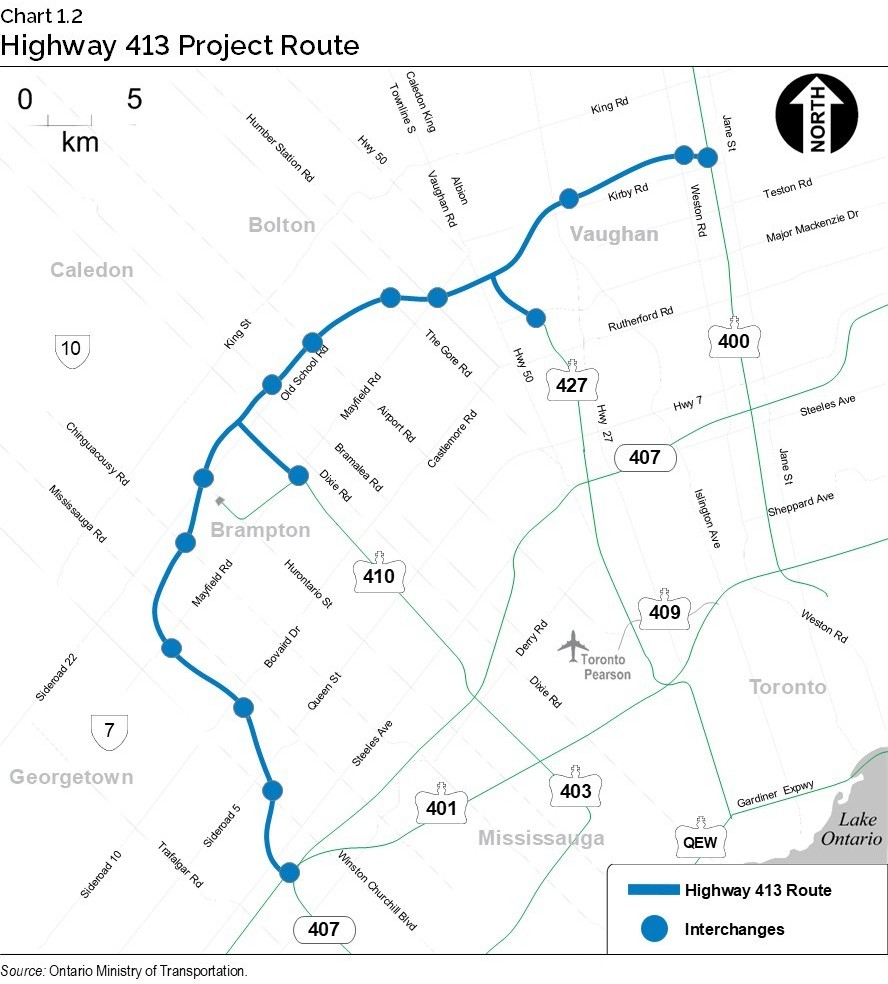
To solidify the province’s position as a leader in moving people and goods efficiently, Ontario has started construction on Highway 413, a new 52-kilometre, 400-series highway, to better connect the transportation network across Halton, Peel and York Regions, and shorten travel times by up to 30 minutes per trip. The corridor will extend from Highway 400 in the east to the Highway 401/407 express toll route (ETR) interchange area in the west. This will include a six-lane 400-series highway and a planned dedicated transitway.
The government has awarded the first two contracts to begin construction of Highway 413, marking a significant milestone in the province’s plan to fight gridlock and get drivers moving. The construction of the highway will support more than 6,000 jobs per year and contribute more than $1 billion to Ontario’s annual gross domestic product (GDP).
This progress builds on the major milestones Ontario has reached for this project, including completing 90 per cent of the preliminary design work. Work is actively underway to acquire the necessary properties for highway construction and transitway protection. Alongside ongoing property acquisition discussions, the government continues to engage impacted landowners to provide project updates and information on the acquisition process. In addition, the government is advancing early works construction projects to get shovels in the ground for this project, including an embankment at the Highway 401 and Highway 407 interchange, the Highway 10 resurfacing and underpass, and the Bovaird Drive underpass.
In late 2025, the government will designate lands needed for Highway 413 as constituting a Controlled-Access Highway under the Public Transportation and Highway Improvement Act. The designation will coincide with a full release of the lands not required for the highway infrastructure.
Advancing Work on the Bradford Bypass
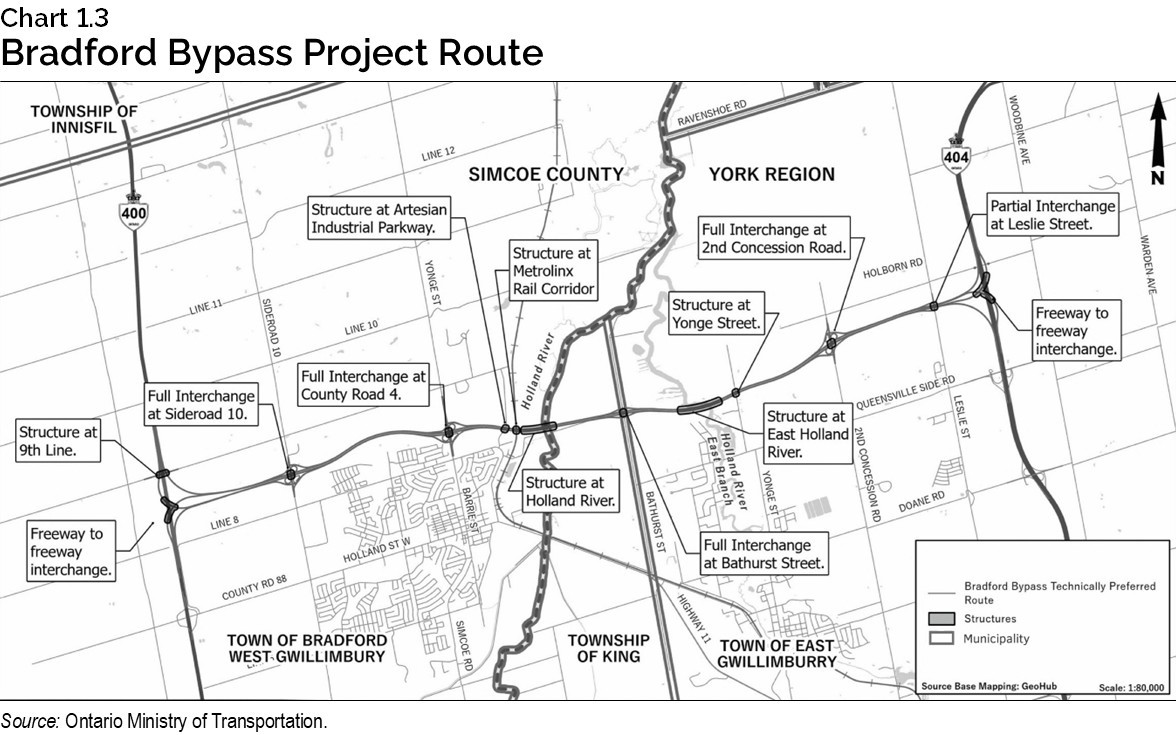
Ontario is helping prepare York Region and Simcoe County for rapid population growth by building the Bradford Bypass, a new four-lane highway to relieve congestion on existing east-west local roads and connect Highways 400 and 404. The new 16-kilometre highway will relieve gridlock, save commuters time, and keep goods moving across the Greater Golden Horseshoe (GGH).
In January 2025, the province issued two requests for proposals to complete detail design work for both the central and east sections of the bypass. This work will include field and archaeology investigations, property acquisitions, fulfilling the government’s duty to consult, and finalizing the preferred design option for these sections. The government expects to award these contracts in fall 2025.
Crews have completed tree clearing along the proposed route of the west section of the Bradford Bypass to streamline utility relocations and clear a path for the bypass. Last year, the province also awarded contracts for detail design work and a construction manager for the west section of the bypass. In addition, a southbound lane on Highway 400 connecting to the Bradford Bypass is currently under construction.
Once complete, the Bradford Bypass will save drivers an estimated 35 minutes in travel time compared to using local roads. During construction, the project is expected to create up to 2,200 jobs per year and contribute up to $286 million to the province’s GDP.
Building the Highway 401 Tunnel Expressway
In addition to the work already being done to upgrade and expand the province’s 400-series highways, the government is exploring innovative options to tackle congestion. This is why the government has launched a feasibility study of a new vehicle and transit tunnel expressway under Highway 401. The feasibility work, being undertaken by a Canadian company, will examine tunnelling options to increase Highway 401 capacity along with complementary congestion relief approaches. The study will analyze the economic benefits both in the short and long term, as well as the project’s impact on reducing gridlock. Additionally, the government has included the Highway 401 tunnel expressway as a proposal to the Major Projects Office, along with the GO 2.0 expansion.
Twinning the Queen Elizabeth Way Garden City Skyway
The Queen Elizabeth Way (QEW) Garden City Skyway Bridge Twinning Project includes construction of a new bridge on the QEW over the Welland Canal, connecting the City of St. Catharines to the Town of Niagara-on-the-Lake. In June 2025, the Ontario government reached a major milestone by awarding a contract for the detail design of the QEW Garden City Skyway Bridge Twinning project. This marks a pivotal step in strengthening the province’s transportation infrastructure, easing gridlock, boosting job creation, and fueling economic growth.
As a vital corridor, this section of the highway supports tourism in Niagara Region and improves access to the Niagara Region’s three international crossings to the rest of Ontario while supporting the flow of over $1.1 trillion in goods annually across the GGH. The new and expanded Garden City Skyway will reduce gridlock and time spent travelling for people in the growing Niagara Region and allow for the repair and upgrade of the existing aging bridge.
Building Highway 7
Construction of the new Highway 7 between Kitchener and Guelph will provide relief to the gridlocked Highway 401 and connect the fast‐growing urban centres of Kitchener, Waterloo and Guelph. The government is advancing the project with activities that include replacement of the Frederick Street Bridge in Kitchener, environmental fieldwork, and other engineering work to support construction of the remainder of the corridor.
Additionally, the province is moving forward with planning and design work for the easterly expansion of Highway 7 from two to four lanes, from west of Reesor Road in Markham to Brock Road in Pickering, to support the development of the City of Pickering’s Innovation Corridor. This will ensure Highway 7 is a continuous four‐lane highway from Markham to Pickering, supporting the movement of goods and people in the region.
Improving Highways 401, 400 and 404
The Highway 401 corridor is a crucial economic link within Ontario, and between Ontario, Eastern Canada and the United States, handling about 11,000 trucks daily with goods valued up to $434 million in Eastern Ontario alone.
The province is taking a significant step towards accommodating the future widening of Highway 401 near Port Hope by replacing the Choate Road Overpass and Ganaraska River Bridge, as well as replacing the Park Road and Cubert Street overpasses in Oshawa. These upgrades will benefit over 50,000 daily drivers and support hundreds of construction jobs, reinforcing the province’s commitment to economic resilience and mobility.
In Eastern Ontario, the province has replaced 20 bridges that will accommodate future widening of Highway 401. Several design studies are also underway for additional bridge replacements and interchange improvements to accommodate the future widening of the highway.
In January 2025, the province also completed major widening projects on Highways 400 and 404 as part of its plan to tackle gridlock and support the safe movement of people and goods in the Greater Toronto Area (GTA). The widening encompassed nine kilometres of Highway 400 from Major Mackenzie Drive to King Road, with the addition of one new general-purpose lane in each direction. Highway 404 has been widened 11 kilometres from Highway 407 to Stouffville Road.
In July 2025, Ontario also took the next step towards widening Highway 400 by replacing the Dunlop Street Bridge in Barrie to accommodate the future 10-lane highway. During construction, the project will create almost 500 good-paying jobs, from engineers to heavy equipment operators and labourers, and will ultimately save time for the more than 100,000 drivers who rely on this stretch of highway every day.
Accelerating Gardiner Expressway Rehabilitation
The government’s $73 million investment in the Gardiner Expressway’s rehabilitation has accelerated progress on one of Toronto’s most critical infrastructure projects. By working with the City of Toronto to enable 24/7 construction, the province has fast-tracked the timeline, with all lanes now expected to reopen before the end of 2025, more than a year ahead of the original schedule. This initiative is part of a broader government strategy to protect Ontario in the face of economic uncertainty, including from U.S. tariffs, by investing in infrastructure to support economic growth, fight gridlock and keep workers on the job.
In addition, the project is delivering substantial economic impact by supporting approximately 500 good-paying jobs through construction and supply chain roles. Once completed, the expressway upgrades are expected to save Ontario’s economy $273 million by reducing congestion and improving travel times by 22 minutes per trip relative to when construction is underway.
Uploading Ottawa Road 174
The agreement between the provincial government and the City of Ottawa includes provisions for a phased plan to explore and assess considerations related to the provincial ownership of Ottawa Road 174. This three-stage due diligence process, which is currently underway, includes an assessment of the road’s condition, a financial review of the infrastructure valuation and a review of related future costs. The results of the assessment will help inform future government decisions regarding all aspects of the road.
In the interim, the province is providing funding to the City of Ottawa to support the rehabilitation and maintenance of Ottawa Road 174 while the three-stage detailed plan is underway. This includes up to $9 million for operating costs and up to $47 million for capital costs.
Connecting Highway 401 to Lauzon Parkway in Windsor
The government is supporting the planning and design for a new interchange connecting Highway 401 to the future Lauzon Parkway extension in Windsor, which will support increased opportunities for trade and improved access to the Windsor–Detroit border.
Building Highways for Northern Ontario
The government is investing in highways in the North to improve road safety, connect communities, and unlock economic opportunities. Projects include:
- Investing nearly $62 million in Geraldton’s Main Street Rehabilitation Project, a critical road infrastructure project in Greenstone that will be the gateway to the Ring of Fire.
- Awarding a contract for the detail design of a new two-lane bridge that will replace the Little Current Swing Bridge on Highway 6 in the Town of Northeastern Manitoulin and the Islands. The planning, preliminary design and Environmental Assessment have been completed, and the project is proceeding with the next steps — property acquisition, right‐of‐way designation and detail design.
- Working to increase passing opportunities on highways in Northeastern Ontario. This includes innovative designs such as a 2+1 highway, which is a three-lane highway with a centre passing lane that changes direction approximately every two to five kilometres.
- Expanding Highway 11/17 from two to four lanes between Thunder Bay and Nipigon, including from east of Highway 587 for 14.4 kilometres and from west of Highway 582 to Coughlin Road for 8.3 kilometres. These two projects are part of a larger series of projects to widen over 100 kilometres of the highway between Thunder Bay and Nipigon.
- Widening Highway 17 between Kenora and the Manitoba border. Section 1, which covered a 6.5‑kilometre segment running easterly from the Manitoba border to Highway 673, was completed in fall 2024. The broader project will widen Highway 17 from two to four lanes for approximately 40 kilometres.
- Supporting renewed partnerships with First Nations to build and improve highway infrastructure that will help connect more First Nation communities to the province’s highway network. This work includes maintenance and upgrades to Highway 584 and Highway 11.
Table 1.1
Recently Completed Highway Projects
Northern
- Replacement of Driftwood River Bridge, east of Smooth Rock Falls on Highway 11.
- Rehabilitation of Turtle and Little Turtle River Bridges on Highway 622, 44 and 79 kilometres south of Highway 17, north of Atikokan.
- Resurfacing of Highway 599 from English River Bridge northerly to Highway 642 at Silver Dollar, north of Ignace.
Eastern
- Highway 416 culvert replacements from Roger Stevens Drive to the Highway 417 interchange and resurfacing of various ramps on Highway 417 between Eagleson Road and Maitland Avenue, Ottawa.
- Highway 41 culvert replacements from Kaladar to Machesney Lake Road.
Southwestern
- Highway 401 and Middlesex Road 32 (Dorchester Road) interchange improvements and bridge replacement, Thames Centre.
- Replacement of McKenzie Creek Bridge on Highway 6, Haldimand County.
- Resurfacing of Highway 401 westbound lanes from Bloomfield Road to Victoria Road,
Chatham-Kent.
Central
- Rehabilitation of QEW and Highway 427 bridges at Evans Avenue and The Queensway.
- Bridge replacements on Highway 401 at Simcoe Street and Albert Street.
- Rehabilitation of Highway 401 westbound express lanes from Avenue Road to Jane Street, including pavement and bridge rehabilitations.
- Resurfacing of QEW from Gilmore Road to Netherby Road.
Source: Ontario Ministry of Transportation.
Building Transit
Building transit alongside new roads and highways is also vital to support the province’s economy and connect more people to jobs and housing. Historic transit investment has not kept up with growth, which is why the government is leading the largest expansion of public transit in North America. But there is more work to be done as Ontario’s cities and towns continue to grow.
Expanding GO Transit Services
To better connect growing communities across the Greater Golden Horseshoe (GGH), the government is continuing to expand, integrate and build better GO train and GO bus services to make it easier and faster for people to get where they need to go. The government continues to deliver on GO Expansion, with Metrolinx rolling out incremental service increases, building new GO infrastructure including new stations, and improving passenger and train capacity at Union Station.
- Kitchener GO Extension: In October 2025, the province reached an Agreement-in-Principle with CN Rail to purchase land to construct dedicated GO tracks on the Kitchener Line, marking a major milestone in the province’s plan to build faster transit between Kitchener and Toronto. The Agreement-in-Principle coincides with additional GO train service that will be added to the Kitchener Line in November, including 18 new weekend trips between Bramalea GO and Union Station, as well as the first-ever weekend service to Kitchener.
- Niagara GO Extension: Ontario is bringing faster, more frequent, two-way, all-day train service between Niagara Region, Hamilton and the GTA. In September 2025, the Ontario government completed construction of the new Confederation GO Station in Hamilton, marking a significant milestone in the province’s Plan to Protect Ontario by investing in key infrastructure that will reduce gridlock and connect more people to jobs and housing. The new station will expand fast, reliable train service across the GO Transit network and generate nearly half a million more rides annually.
- Woodbine GO: In June 2025, construction started at Woodbine GO Station, marking a significant milestone in the province’s plan to provide two-way, all-day service across core segments of the GO Transit network. As part of its agreement with the provincial government, Woodbine Entertainment Group is also providing up to $170 million to support the construction of the new station. The new station located on the Kitchener Line will provide increased capacity and feature new rail platforms. The station will create new links between the Union Pearson (UP) Express and Kitchener GO train, as well as to local bus services, including the TTC, MiWay, York Region Transit and Brampton Transit.
- Bowmanville GO Extension: The Bowmanville GO Extension will extend the Lakeshore East GO rail service nearly 20 kilometres east of the Durham College Oshawa GO Station to Bowmanville. This expanded rail service will provide Durham Region with direct connections to the larger GO Transit network, helping to reduce gridlock in the GGH. Targeted early works construction is underway in 2025 to continue advancing the project.
Advancing GO 2.0
Ontario is taking the next steps to advance planning for GO 2.0. Building on the extensive transit network vision in Connecting the GGH: A Transportation Plan for the Greater Golden Horseshoe, these next steps will help Ontario identify potential new rail corridors and study where new GO stations are needed to respond to network demand. GO 2.0 will build on existing investments to the GO Transit network by delivering two-way, all-day service to Kitchener and Milton.
Ontario is calling on the federal government to provide funding support to help deliver the next generation of passenger rail service for the GGH, and has included the GO 2.0 expansion as a proposal to the Major Projects Office, along with the Highway 401 tunnel expressway.
Building Subways
Work is underway on Ontario’s priority subway projects. The government is closer to providing better travel options, alleviating gridlock on roads and creating thousands of good, local jobs.
- Ontario Line: Ontario has broken ground on the second tunnel launch shaft near the site of the future Gerrard Station on the Ontario Line, marking another milestone in the province’s Plan to Protect Ontario by creating jobs, cutting commute times across the Greater Toronto Area (GTA) and bringing nearly 230,000 more people within walking distance of public transit. In May 2025, excavation work at Queen Station started, marking another milestone in the Ontario Line project.
- Yonge North Subway Extension: Earlier in October, Infrastructure Ontario and Metrolinx took the next major step towards getting shovels in the ground on the project by issuing a Request for Qualifications for the contract to design and build the subway’s five stations. In summer 2025, the government awarded a contract to North End Connectors, which will design and build the twin tunnels for this extension. The contract also includes early works construction of support headwalls for future stations and emergency exit buildings. Once complete, the Yonge North Subway Extension will accommodate over 90,000 daily trips.
- Scarborough Subway Extension: Ontario is breaking ground on the first of three stations for the Scarborough Subway Extension, marking a significant milestone in the province’s plan to fight gridlock and bring rapid transit to tens of thousands of commuters across the GTA. Once complete, the construction of the Scarborough Subway Extension is expected to bring 38,000 people within walking distance of transit.
- Eglinton Crosstown West Extension: In June 2024, the province completed tunnelling on the western underground portion of the Eglinton Crosstown West Extension from Renforth Drive to Scarlett Road, where the Light Rail Transit (LRT) will transition to a 1.5-kilometre elevated guideway, currently under construction. In April 2025, Ontario broke ground on the final tunnel segment of the Eglinton Crosstown West Extension. Once complete, the nine-kilometre line will connect seven new stations to the Eglinton Crosstown LRT, making travel faster and more convenient, while bringing more than 37,500 people within a 10-minute walk of world‑class transit.
- Proposed Sheppard Subway Extension: The government is advancing planning and conducting community consultations on options to extend rapid transit both east and west of the existing TTC Line 4, which would improve transit connections in Toronto’s north end and make it easier and faster for people to get around Toronto and the GTA.
Building Light Rail Transit
The government is bringing fast, reliable transit projects to the people of Ontario to help reduce travel times and create more transit options:
- Eglinton Crosstown Light Rail Transit (LRT): The Eglinton Crosstown LRT will deliver 19 kilometres of rapid transit, with 25 below-grade stations and at-grade stops and links to 54 bus routes, three subway stations (Kennedy, Eglinton and Cedarvale), the Union Pearson (UP) Express and three GO Transit lines (Kitchener, Barrie and Stouffville).
- Finch West LRT: The Finch West LRT will service 18 stops across 10 kilometres of rail along Finch Avenue West from Keele Street to Highway 27 and south to the Humber College North Campus. It will support connections with other Toronto Transit Commission (TTC) lines, as well as connections to Peel and York Region local transit services.
- Metrolinx has now transferred operations for both the Eglinton Crosstown and Finch West LRTs to the TTC, the operator of the LRTs, and has entered the final stages of rigorous testing and commissioning activities to ensure reliability of the LRT systems.
- Hazel McCallion Line LRT: In 2025, the Hazel McCallion Line LRT saw further progress with the installation of girders over the Highway 403 interchange, completion of flood-proofing for Mary Fix Creek, and advances in station construction, particularly at Port Credit.
- Hamilton LRT: In May 2025, Ontario issued a Request for Proposals (RFP) for the first package of civil and utility work for the Hamilton LRT. Submissions are expected by the end of the year from the shortlisted teams, all of which include Canadian contractors. Early works are already underway in the City of Hamilton, including on water mains, sewers, hydro, telecommunications, and gas lines.

Investing in New Subway Cars
Ontario is investing over $758 million to help the TTC purchase 55 new trains for Toronto’s Line 2 subway from Alstom, supporting Ontario workers. This investment made by Ontario, the City of Toronto and the Government of Canada will support the City of Toronto to deliver this critical public transit service.
Bringing Back the Northlander Passenger Rail
Ontario has awarded contracts to deliver train stops along the future Northlander corridor, advancing the government’s plan to bring back safe and reliable passenger rail service between Timmins and Toronto. Most recently, in July 2025, the government awarded a contract to build Timmins-Porcupine Station. Construction is currently underway on the platform, parking area and a passenger waiting area.
In September 2025, Ontario announced the completion of the North Bay Rail Bypass, marking a major milestone in the project. The 982-metre track will improve travel times by 15 minutes to North Bay Station, giving passengers more time with their families and friends while supporting tourism, jobs and economic growth in Northern Ontario.
Provincial Rideshare Framework
Ontario is working to engage with rideshare operators, the taxi sector, and municipalities to explore the standardization of rideshare guidelines across the province. Rules for rideshare programs, such as application fees and driver screening requirements, are currently managed by individual municipalities, resulting in differing standards across the province. By consulting on potential approaches for a provincial rideshare framework, the government continues to support an integrated and efficient transportation network that will improve access for everyone, including rural and remote communities such as those along the Northlander route.
Building Stronger Communities
Increasing Capital for the Building Ontario Fund
Strengthened by the additional $5 billion in funding announced in the 2025 Ontario Budget, the Building Ontario Fund (BOF) has begun delivering on priority investments. The BOF is accelerating its efforts to collaborate with Canadian institutional investors and project proponents to continue growing its pipeline of infrastructure projects that will deliver lasting economic impacts and public benefits.
Guided by the government’s priorities, the BOF has been focusing on advancing projects in long-term care, energy infrastructure, affordable housing, municipal and community infrastructure, and transportation. A new area of focus — critical minerals — has been added to the BOF’s priority sectors to support Ontario’s clean economy transition and supply chain security.
Building on the BOF’s earlier investments with Arch Corporation and Rekai Centres in the long-term care sector, the BOF is contributing up to $1 billion for an equity investment in the Darlington New Nuclear Project (DNNP). DNNP is a project of national significance that will support Ontario’s energy generation capacity and contribute to high-skilled job creation. Ontario and Ontario Power Generation are also pursuing potential opportunities for equity partnership and commercial participation with Williams Treaties First Nations, which would be the first-of-its-kind partnership for nuclear energy generation in Canada.
The BOF is also progressing a pipeline of additional strategic investments across student housing, affordable housing and long-term care. These investments reflect the government’s commitment to unlocking infrastructure that addresses Ontario’s current needs, while laying the foundation for long-term growth and prosperity for communities across the province.
Expanding the Municipal Housing Infrastructure Program to Build More Homes
In August 2025, the government announced an additional $1.6 billion to accelerate construction on housing and critical infrastructure. This funding nearly doubles the Municipal Housing Infrastructure Program (MHIP) to $4 billion. The expanded MHIP provides communities with resources to build roads, bridges and water systems that enable new housing and sustain existing housing. The MHIP is currently comprised of multiple funding streams, with the Housing-Enabling Water Systems Fund recently consolidated into the program.
Since its launch in 2024, the MHIP is now enabling the construction of up to 800,000 homes across Ontario. Combined with the Building Faster Fund, which rewards municipalities for meeting or exceeding housing targets, these investments empower communities to continue delivering results.
Additionally, municipalities can access up to $1 billion in loans, with flexible borrowing terms through the Infrastructure Ontario Loan Program’s Housing-Enabling Water Infrastructure lending stream.

Supporting Ontario’s Shortline Railways
In the 2025 Budget, the government proposed a new temporary tax credit to support Ontario’s shortline railway industry. Ontario’s shortline railways play an essential role in connecting shippers to national railway lines and providing critical “first and last mile” service to rail customers. The government is now introducing detailed legislation to implement the credit.
The proposed Ontario Shortline Railway Investment Tax Credit would provide a 50 per cent refundable corporate income tax credit to qualifying shortline railways on eligible track maintenance and rehabilitation expenditures in Ontario. Eligible expenditures would include investments in labour and capital assets related to railway maintenance, repairs and improvements that are made on or after May 15, 2025, and before 2030.
The credit would provide up to $8,500 per track mile per year to a qualifying corporation, and result in an estimated $23 million in income tax support over three years for Ontario’s shortline railway industry. This support would help ensure a safe and reliable rail network across the province and protect the businesses that rely on a unified rail network for transporting goods and raw materials to customers.
See the Annex: Details of Tax Measures and Other Legislative Initiatives for more information.
Continuing to Build with the Ontario Community Infrastructure Fund
The Ontario Community Infrastructure Fund (OCIF) continues to fund critical infrastructure, including roads, bridges, water and wastewater projects, each year. In September 2025, the government announced $400 million to support 423 small, rural and Northern communities across Ontario in 2026. The minimum grant for municipalities has been raised to $125,000, an increase of $25,000 over last year. The OCIF provides a predictable and reliable source of annual funding for eligible small, rural and Northern communities for their critical infrastructure.
Building with the Community Sport and Recreation Infrastructure Fund
In the 2024 Ontario Budget, Ontario launched the $200 million Community Sport and Recreation Infrastructure Fund to protect jobs and support 94 development and revitalization of sport and recreation infrastructure projects across the province. Some examples of projects include:
- $19.5 million to build a new recreation complex in Cambridge. The government’s investment in the Cambridge Recreation Complex will support the development of a 112,000-square-foot multi-purpose facility.
- $13.7 million to support the development of a new multi-purpose complex in Anishinabe of Wauzhushk Onigum First Nation, along with upgrades to other sport and recreation facilities across Northwestern Ontario.
- $10 million to support the construction of the South Bowmanville Recreation Centre in the Municipality of Clarington. With the capacity to host competitions, this facility will unlock opportunities for Clarington to leverage the fast-growing sport tourism sector, boosting the economy and supporting local businesses.
- $12.2 million to build community infrastructure in Eastern Ontario, including the construction of the new Russell Township Recreation Complex and the revitalization of three other community centres in the region.
- $8 million to support upgrades to Ottawa’s Alexander Community Centre, including the construction of a new gymnasium three times larger than the current one.
- $6.3 million to support the construction of a new multi-season covered outdoor arena in Curve Lake First Nation, increasing opportunities for physical activity and organized year-round programs in the community.
- $3 million to build Canada’s first dedicated goalball court. This will be the first purpose-built goalball court at the Canadian National Institute for the Blind’s Lake Joseph Centre in Muskoka.
Expanding Access to Electric Vehicle Chargers
Through the Electric Vehicle (EV) ChargeON program, the government is investing over $180 million to make it easier to access EV chargers. As part of the initial $91 million investment in the program, Ontario is building over 1,300 new EV charging ports in small and medium-sized communities, marking a major milestone in the province’s plan to increase access to EV chargers outside of large urban centres and support the electrification of transportation across the province. The chargers will be located at 270 sites across the province, such as arenas, carpool lots, hospitals, provincial parks, recreation centres, and rest areas. This includes 190 charging ports in Northern Ontario, providing drivers across the North with more options when travelling.
The additional $92 million approved in the 2025 Ontario Budget will allow for the EV ChargeON program to continue to support the installation of EV chargers, reduce range anxiety and build a more affordable and connected charging network across Ontario. As the province continues to see substantial job creation and investment in the growing EV and EV battery manufacturing sector, these new charging stations will provide critical supporting infrastructure in communities across the province, including for EVs made right here in Ontario.
Furthermore, adoption of EVs supports Ontario’s goal of being future-ready by ensuring that the province’s transportation system is resilient, sustainable and meets the needs of the people of Ontario today and in the future.
Improving the Role of Conservation Authorities
The government is moving forward on its commitment to modernize the role of conservation authorities (CAs) in order to create consistency, reduce costs and drive faster outcomes. Ontario’s CAs play a vital role in watershed management, flood prevention, source water protection, and climate resilience — but the system is fragmented and burdened by inconsistent standards, leading to inefficiencies and delays in decision-making.
To address these challenges, Ontario appointed the first Chief Conservation Executive in June 2025 to lead a multi-phase modernization plan, which will ensure that CAs can safeguard communities from natural hazards and preserve access to recreational opportunities, while continuing to support economic prosperity.
As part of this plan, the government proposes to establish a board-governed agency that would act as a centralized oversight body for Ontario’s CAs. This agency would strengthen the province’s ability to optimize public investments, manage risks and ensure that CAs continue to deliver high‑impact services that protect Ontario’s environment, communities and infrastructure.
Preserving Parks Trails
The government is committed to expanding opportunities for the people of Ontario to enjoy the great outdoors. By protecting green spaces and enhancing access to nature, Ontario is supporting local tourism and economic development across the province. The province is exploring ways to preserve existing recreational trails when lands are added to Ontario’s network of provincial parks and conservation reserves so they remain available to the public and can be enjoyed by local residents and visitors for years to come. This means engaging directly with local recreation clubs, such as those near Charleston Lake Provincial Park, to help ensure existing trails will be preserved when that park is expanded.
Rebuilding Ontario Place into a World-Class Destination
In June 2025, Ontario unveiled the final designs for the new Ontario Place public space, marking a major milestone in the transformation of Toronto’s waterfront. This will create 5,000 jobs in the construction and tourism sectors and boost economic growth across Toronto and the region faster, attracting up to six million visitors annually.
Highlights from the final designs for the Ontario Place redevelopment include:
- A new entrance that will serve as a gathering and transit hub, connecting visitors to the new Exhibition Station on the Ontario Line, lakeside walking, cycle paths and onsite parking.
- A reimagined Brigantine Cove featuring an urban beach, boardwalks and children’s playground, including a multi-level interactive treehouse and turtle-shaped play structure.
- New canoe and kayak launch site and natural stone lookout points throughout the park to provide sunset views across Lake Ontario.
- The Ontario Place marina, a vibrant hub with open-air pavilions, boardwalks and spaces for future programming and amenities.
- A new forum space at the park’s centre to provide ample space for outdoor markets and festivals and showcase a one-acre splash fountain, shaped like Ontario’s iconic trillium.
- An Indigenous Cultural Pavilion on the East Island that offers a dedicated space for community gatherings, workshops and other learning programs.
The province also announced a new, publicly owned parking structure at Ontario Place, which will generate revenue for the province and help the public conveniently access its many attractions, including public beaches, trails and parks, the state-of-the-art Ontario Science Centre, a revitalized year-round amphitheatre, and a family-friendly waterpark and wellness destination.
Chart Descriptions
Chart 1.2: Highway 413 Project Route
The image shows a map of the Highway 413 Route and highway interchanges.
Source: Ontario Ministry of Transportation.
Chart 1.3: Bradford Bypass Project Route
The image shows a map of the Bradford Bypass Project Route. The bypass will run between Highway 400 and Highway 404, passing through the Town of Bradford West Gwillimbury and the Township of King.
Source: Ontario Ministry of Transportation.
Footnotes
[1] Canadian Centre for Economic Analysis (CANCEA), “Impact of Congestion in the GTHA and Ontario: Economic and Social Risks,” Research Report (December 2024), https://rccao.com/news/files/Impact-of-Congestion-in-the-GTHA-and-Ontario-December2024.pdf
[2] Ibid.