The government recognizes the financial challenges faced by many in Ontario, with recent economic pressures and uncertainty driving up prices. This is why the government has consistently acted early to provide relief, by taking steps to provide support and deliver on its objective to make life more affordable across the province.
Supporting Families and Individuals
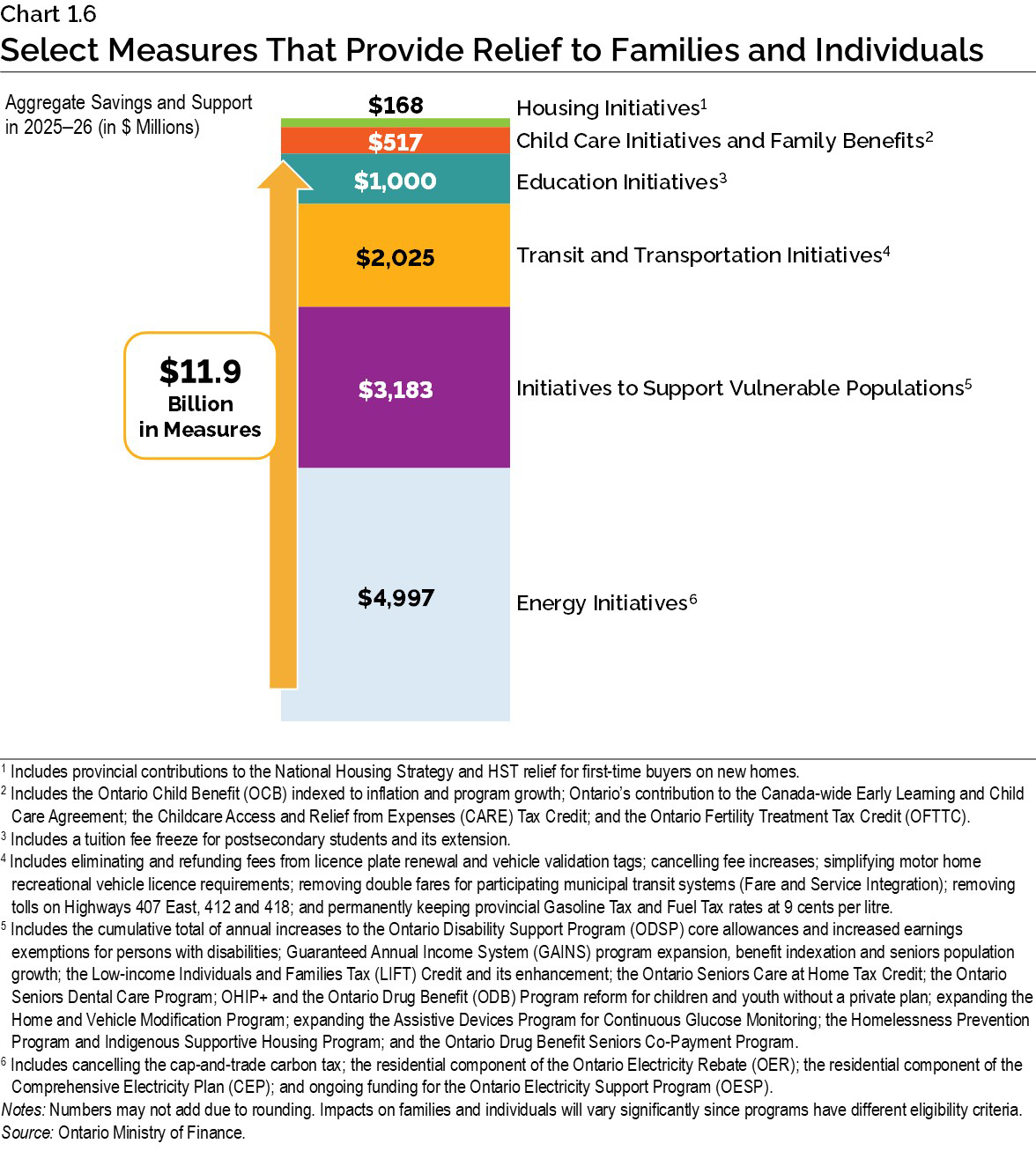
The government committed almost $11.9 billion in support for families and individuals in the 2025–26 fiscal year, as shown in Chart 1.6.

Enhancing Harmonized Sales Tax Relief on New Homes
To better address housing affordability and provide savings for families and individuals, the government is proposing to modernize provincial Harmonized Sales Tax (HST) relief provided to buyers of new homes.
As a first step, the government is proposing to enhance the provincial HST New Housing Rebate and New Residential Rental Property Rebate for one year. This would temporarily remove the full 8 per cent provincial portion of the HST for eligible buyers of new homes valued up to $1 million, providing up to $80,000 savings to an eligible buyer. This maximum rebate amount of $80,000 would be maintained for new homes valued between $1 million and $1.5 million. For new homes valued above $1.5 million, a reduced rebate would be available. Higher-valued new homes that would have qualified for the maximum rebate of $24,000 under the current rules would qualify for at least that amount under this proposed enhancement. This would mean all eligible buyers, including first-time home buyers, could receive the same or more in total provincial relief as announced in the fall for first-time home buyers.
The province will propose that Ontario’s enhanced rebates be available from April 1, 2026 to March 31, 2027. For example, purchasers who acquire the home as their primary place of residence could be eligible if they enter into an agreement of purchase and sale with a builder on or after April 1, 2026 and on or before March 31, 2027. For these purchasers, construction of the home must begin on or before December 31, 2028 and the home must be substantially completed on or before December 31, 2031.
Other eligibility requirements for the New Housing Rebate and New Residential Rental Property Rebate would remain the same as under the current rules, including that the purchaser must be acquiring the new home for use as their primary place of residence or as a residential rental property.
These steps are necessary to help address the affordability of new homes, and as part of a suite of measures the government is taking to support a robust housing industry in the province.
See the Annex: Details of Tax Measures and Other Legislative Initiatives for more information.
Expanding Harmonized Sales Tax Relief for First-Time Home Buyers on New Homes
On October 28, 2025, Ontario announced a proposal to remove the full 8 per cent provincial portion of the Harmonized Sales Tax (HST) for first-time home buyers of new homes valued up to $1 million. This would mirror the federal Goods and Services Tax/Harmonized Sales Tax (GST/HST) First-Time Home Buyers Rebate.
Ontario is now taking steps to align the effective date of the provincial rebate for first-time home buyers with the federal government’s new earlier effective date of March 20, 2025. This change would extend the rebate to purchasers who entered into agreements of purchase and sale on or after March 20, 2025, and before 2031. Ontario will continue working with the federal government on the implementation of the provincial rebate subject to passage of federal regulations that would bring the rebates into force.
Saving on Energy Costs
The Ontario Electricity Rebate (OER) continues to ensure electricity bills remain affordable, stable and predictable by providing rate relief for households, small businesses and farms. Through the OER, the government is currently providing a 23.5 per cent rebate to help keep residential, small business and farm electricity bills low and stable. For a typical residential customer who uses 700 kilowatt-hours (kWhs) of electricity per month, the OER will decrease bills by about $36 each month. The government also provides targeted electricity bill relief for eligible low-income households and on‑reserve First Nation consumers, as well as eligible rural or remote customers. In addition, the Low‑Income Energy Assistance Program (LEAP) provides grants towards electricity or natural gas bills for eligible consumers who are behind on payments and face having their service disconnected. Consumers who meet income eligibility can get up to $650 in emergency assistance for their electricity bills ($780 if their home is heated electrically) and up to $650 for natural gas bills.
The government has also recently expanded its energy savings programs. Under the Home Renovation Savings Program, eligible households can receive rebates of up to $200 for a wide range of energy-efficient appliances and new rebates for attic insulation without needing a home energy assessment. For industrial, municipal, institutional and health care organizations, the Save on Energy XLerate Program has increased the per project incentive from $5 million to $15 million to support large, complex, industrial capital projects that deliver measurable energy savings.
These programs are part of the province’s historic 12-year, $10.9 billion Energy Efficiency Framework, the largest investment in energy-efficiency programs in Canadian history, estimated to result in $23.1 billion in nominal electricity system benefits, thereby saving ratepayers $12.2 billion.
Permanently Reducing the Tax Rates for Gasoline and Fuel
To provide ongoing relief to households and businesses in Ontario, effective July 1, 2025, the government permanently cut the Gasoline Tax rate by 5.7 cents per litre and the Fuel (diesel) Tax rate by 5.3 cents per litre to establish a rate of 9 cents per litre.
To date, this measure has delivered $2.1 billion in Gasoline Tax and Fuel Tax relief to families and individuals since it was first introduced on a temporary basis on July 1, 2022. On average, these cuts are saving households about $115 per year.
Removing Tolls
Effective June 1, 2025, the government permanently removed tolls from the provincially owned portion of Highway 407 East — saving drivers approximately $94 million annually. This initiative will reduce the cost of travel, while increasing convenience and choice, and it is expected to save daily commuters an estimated $7,200 annually.
This was in addition to a number of other measures that the government implemented to put money back in drivers’ pockets, including eliminating licence plate renewal fees, removing tolls on Highway 412 and Highway 418, freezing fees for driver’s licences and Ontario Photo Cards and permanently cutting Gasoline and Fuel Tax rates.
Helping Transit Users Save with One Fare
Building on the success of One Fare, which is saving daily transit users in the Greater Toronto and Hamilton Area (GTHA) up to $1,600 per year, Ontario is extending the program for an additional two years to continue keeping transit costs down for commuters. Since launching in 2024, One Fare has saved the people of Ontario nearly $233 million and enabled nearly 72 million free transfers across participating transit agencies.
One Fare makes cross-boundary travel more affordable and convenient for all transit customers, including students, seniors and low-income riders, by ensuring the customer only pays once when transferring between GO Transit, the Toronto Transit Commission (TTC), Brampton Transit, Durham Region Transit, MiWay (Mississauga), Peel TransHelp and York Region Transit.
In addition, free transfers are offered between GO Transit and participating local agencies including Milton Transit, Grand River Transit, Guelph Transit, Oakville Transit, Hamilton Street Railway, Burlington Transit, Bradford West Gwillimbury Transit and Barrie Transit.
The government is taking further action to make public transit easier and more affordable across municipalities in the GTHA. It is moving forward with legislation, followed by engagement with partners, to explore expanding free transfers, simplifying fares, improving cross-boundary travel and enhancing specialized transit.
Putting Fans and Consumers First
Ontario is taking action to protect fans and promote fairness in the live events marketplace. As part of the government’s plan to Protect Ontario, new consumer protection measures will make it illegal for tickets to concerts, cultural events, sports games, theatre performances and other live events held in Ontario to be resold for more than their original total cost (the face value plus service fees and applicable taxes), plus permitted fees and charges on resale.
These changes are designed to address longstanding concerns about unfair resale practices. Recent high-demand events have highlighted how quickly tickets can be purchased and relisted at significantly higher prices. With demand for live events continuing to rise and resale practices becoming more sophisticated, this is an important moment to strengthen protections and help ensure fans have a fair chance to buy tickets.
By capping resale ticket prices, the government is reducing profit incentives for bulk resellers and helping restore fairness for fans. These measures also provide consumers with a clear, legal standard, making it easier to understand their rights.
In addition, the government will be undertaking a consultation to strengthen protections for consumers who participate in rewards points programs. Ontario is ensuring that consumers are protected and that the live events marketplace operates fairly and responsibly.
Ensuring an Effective Property Assessment and Taxation System
The government continues to make sure that the property assessment and taxation system is working effectively for Ontario businesses and families, while ensuring stability in challenging economic circumstances.
Several initiatives have been implemented, including providing authority for municipalities to reduce their property tax rates on affordable rental housing, ensuring consistent tax treatment for university-operated student housing, allowing municipalities to use Municipal Property Assessment Corporation (MPAC) data more broadly and supporting the digital delivery of MPAC property assessment notices. As part of this work, the government continues to examine policy options aimed at increasing the development of new purpose-built student housing facilities. This ongoing work aims to prioritize infrastructure strategies that support student success and benefit communities across the province.
The government continues to receive feedback on approaches that could make the property assessment and taxation system more effective from a broad range of stakeholders, including residential and business property owners and their affiliated organizations and the professional property tax and assessment sector.
Streamlining Municipal Education Property Tax Remittances
Education Property Tax (EPT) helps fund the elementary and secondary education system in Ontario. Currently, municipalities collect EPT on behalf of Ontario and distribute the funds across 72 school boards. This creates a cumbersome process of remitting EPT revenue several times per year to multiple school boards within each municipality’s jurisdiction.
The government plans to modernize the administration of EPT to ensure resources are directed to frontline student support rather than to unnecessary administrative burden. Planned legislative changes would streamline municipal EPT remittance processes so that beginning in 2028, municipalities would remit EPT directly to Ontario. School boards would continue to receive their full funding but would receive it directly through provincial payments, rather than separate payments from municipalities and the Ministry of Education.
Building on legislative changes announced in the 2025 Ontario Economic Outlook and Fiscal Review to simplify EPT administration, this measure would significantly reduce the number of transactions between municipalities and school boards and thereby lessen both the administrative burden and costs for Ontario, municipalities and school boards.
The government will work closely with municipalities and school boards prior to implementing the new streamlined processes.
Chart Descriptions
Chart 1.6: Select Measures That Provide Relief to Families and Individuals
This chart illustrates select measures that provide relief for Ontario’s families and individuals in 2025–26. Government actions would total $11.9 billion for families and individuals in 2025–26. This includes housing initiatives ($168 million), child care initiatives and family benefits ($517 million), education initiatives ($1,000 million), transit and transportation initiatives ($2,025 million), initiatives to support vulnerable populations ($3,183 million), and energy initiatives ($4,997 million).
Housing initiatives include provincial contributions to the National Housing Strategy and HST relief for first-time buyers on new homes. Child care initiatives and family benefits include the Ontario Child Benefit (OCB) indexed to inflation and program growth; Ontario’s contribution to the Canada-wide Early Learning and Child Care Agreement; the Childcare Access and Relief from Expenses (CARE) Tax Credit; and the Ontario Fertility Treatment Tax Credit (OFTTC). Education initiatives include a tuition fee freeze for postsecondary students and its extension. Transit and transportation initiatives include eliminating and refunding fees from licence plate renewal and vehicle validation tags; cancelling fee increases; simplifying motor home recreational vehicle licence requirements; removing double fares for participating municipal transit systems (Fare and Service Integration); removing tolls on Highways 407 East, 412 and 418; and permanently keeping provincial Gasoline Tax and Fuel Tax rates at 9 cents per litre. Initiatives to support vulnerable populations include the cumulative total of annual increases to the Ontario Disability Support Program (ODSP) core allowances and increased earnings exemptions for persons with disabilities; Guaranteed Annual Income System (GAINS) program expansion, benefit indexation and seniors population growth; the Low-income Individuals and Families Tax (LIFT) Credit and its enhancement; the Ontario Seniors Care at Home Tax Credit; the Ontario Seniors Dental Care Program; OHIP+ and the Ontario Drug Benefit (ODB) Program reform for children and youth without a private plan; expanding the Home and Vehicle Modification Program; expanding the Assistive Devices Program for Continuous Glucose Monitoring; the Homelessness Prevention Program and Indigenous Supportive Housing Program; and the Ontario Drug Benefit Seniors Co-Payment Program. Energy initiatives include cancelling the cap-and-trade carbon tax; the residential component of the Ontario Electricity Rebate (OER); the residential component of the Comprehensive Electricity Plan (CEP); and ongoing funding for the Ontario Electricity Support Program (OESP).
Notes: Numbers may not add due to rounding. Impacts on families and individuals will vary significantly since programs have different eligibility criteria.
Source: Ontario Ministry of Finance.