By protecting the strength of the economy, the government can expand its investments in critical areas such as health care, education and other vital services. A solid economic foundation enables Ontario to enhance service delivery, support communities and businesses, create jobs and enable the conditions for continued success.
Connecting Everyone in Ontario to Primary Care
Ontario is building on the investments it has made to date for a primary care system that is comprehensive, convenient and connected for every single person in Ontario. This is why the government launched the Primary Care Action Plan on January 27, 2025. Through this Budget and sustained operational funding for new and expanded teams, the government is investing an additional $325 million to further expand primary care and connect everyone in Ontario to a family doctor or primary care team by 2029, bringing the four-year investment to $3.4 billion.
As part of the plan, the government has launched a series of initiatives, supported through this $3.4 billion investment, that aim to close the gap for people in need of primary care, including:
- Creating and expanding more than 300 additional primary care teams to connect approximately two million people to primary care, including the investment of more than $250 million in 2026–27 to establish and expand additional primary care teams across the province that will connect 500,000 more people to primary care this year; and
- Investing in primary care teaching clinics across the province, including up to $300 million to support the creation and expansion of 18 clinics that will help connect more people to primary care.
Since the launch of Ontario’s Primary Care Action Plan, the Health Care Connect waitlist as of January 1, 2025, has been reduced by more than 87 per cent as of March 2026 and is on track to be cleared by spring 2026. The new and expanded primary care teams are prioritizing people on the waitlist as they attach new patients to ongoing care.
As part of Ontario’s Primary Care Action Plan, the government is making primary care more accessible and convenient by advancing work on a provincewide electronic medical record for primary care. The Primary Care Medical Record system will form the foundation of a modern digital platform for primary care, replacing thousands of isolated chart systems with an interoperable, secure system that supports clinicians and patients alike. By eliminating the need for patients to repeat their medical history at every visit, primary care clinicians will have timely access to organized, comprehensive health information and the tools they need to make informed decisions, reduce delays in care and avoid unnecessary duplication of tests. This approach will significantly improve the security of patient records, all while connecting patients to more convenient care. To advance this work, the province will begin procurement activities to ensure the Primary Care Medical Record system meets the needs of both patients and clinicians.
Investing in Hospitals
Ontario’s hospitals play an integral role in delivering critical health services. This is why the government is investing over $1.1 billion in additional hospital funding for 2026–27. This investment includes an up to 4 per cent increase in base and targeted hospital funding, which promotes high‑quality care, increased accountability, system efficiency and improved access to life-saving treatments.
This continues Ontario’s historic investment in hospitals for a fourth consecutive year and demonstrates that the government is enhancing hospital services so that the people of Ontario can access the care they need, where and when they need it.
Strengthening Home and Community Care
Home and community care is a foundational part of Ontario’s health system, helping to ensure people receive the right care in the right place. In the 2025 Ontario Economic Outlook and Fiscal Review, the government invested $1.1 billion over three years to connect more patients with home care services, including from nurses, personal support workers and therapists in 2025–26 and to sustain and expand the Hospital to Home (H2H) program. In the 2026 Budget, the government is investing an additional $1.1 billion over three years to support patients with more home and community care services that they need. This will further strengthen the sector by extending services to thousands more patients.
These sustained investments are delivering real and measurable improvements, including more consistency of care for patients, and a 94 per cent reduction in waitlisted patients for home-based personal support services from 2022–23 to 2024–25. These investments will also help to reduce the number of patients awaiting discharge from hospital to more appropriate care settings. To further strengthen this sector, the government is engaging with stakeholders to transform home care.
Expanding Access to Supportive Housing
Ontario is strengthening its supportive housing system to ensure the province’s most vulnerable individuals can access stable housing, mental health and addictions services and comprehensive wrap-around supports. This is why the government is committing nearly $53 million over three years to expand supportive housing initiatives for vulnerable populations and enhance access to critical mental health services and housing supports.
Once fully operational, these investments will enable the operations of over 425 supportive housing units, including new units at LOFT’s Bradford House and various Indwell Community Homes across the province. These initiatives will help vulnerable populations access the community-based services they need to achieve safety, independence and long-term well-being.
Training and Retaining Health Care Providers Across Ontario
The government is building a stronger and more resilient health care workforce throughout the province. Through the Ontario Learn and Stay Grant (OLSG), the government is supporting students with funding to cover the cost of tuition, books and other direct educational expenses for eligible health-related programs in underserved and growing communities in Northern, Southwestern and Eastern Ontario.
The government is continuing to deliver on its commitment to protect the province’s health care system by expanding the OLSG to include two new medical laboratory programs in Northern Ontario. This expansion builds on the thousands of highly trained nurses, paramedic and medical laboratory technologists who have been or will be added to the workforce in high-need regions of the province with the support of the OLSG. Since its launch in 2023, the government has invested more than $174 million to support 12,900 learners across the province. This includes more than $54 million invested in the North to train nearly 4,000 future health care workers.
The OLSG is a critical part of the government’s plan to protect the province’s health care system and highly skilled workforce to ensure people have access to high-quality health care, close to home. As announced in the 2025 Budget, the government is expanding the OLSG to four cohorts of medical school students. The grant will cover 100 per cent of direct educational costs, including tuition and fees, for those who commit to working in the community as family medicine physicians after completing residency anywhere in the province.
Continuing to Invest in Clinical Education for Nurses
Ontario is investing an additional $124.2 million over the next three years for clinical training and education funding to continue supporting the expansion of 2,000 registered nurse and 1,000 registered practical nurse seats at publicly assisted colleges and universities. Clinical education is a mandatory component of nursing education programs and provides students with a range of hands-on and clinical experiences. The continuation of clinical education funding is part of the government’s plan to address health human resource needs and support the growing demand for health care professionals in Ontario.
Building and Expanding Hospitals
The government is investing approximately $64 billion over the next decade in health infrastructure, including approximately $50 billion in capital grants. Ontario’s ambitious plan will support over 50 hospital projects and deliver approximately 3,000 new hospital beds to enhance access to quality care and build a connected, people-first health care system.
Recent milestones include:
- Stevenson Memorial Hospital – Phase 1 Redevelopment (Alliston): Construction began on the 147,100 square foot facility, which will include a new emergency department and birthing suite, as well as expanded diagnostic and surgical services.
- Hamilton Health Sciences – Hamilton General Hospital Emergency Department Renovation Project: Construction is expected to begin in spring 2026 to help relieve space and volume pressures within the hospital, as well as to provide additional space for ambulance off-loading.
- Bluewater Health – Community Addictions Hub Project (Sarnia): The project is expected to be tendered in spring 2026 and includes the Integrated Withdrawal Management Program. This program consists of 24 beds along with other community withdrawal management services, day treatment and wrap-around services.
- Bluewater Health – Rural Health Capital Improvement Project (Petrolia): The project is expected to be tendered in spring 2026 and includes renovations to the emergency room and diagnostic imaging department.
- Sioux Lookout Meno Ya Win Health Centre – Magnetic Resonance Imaging Suite Project: This project is expected to be completed by the end of 2026 and will add approximately 1,900 square feet of new space to accommodate a new magnetic resonance imaging (MRI) machine as well as ancillary items.
- Lake of the Woods Hospital Redevelopment Project (Kenora): A planning grant of $50 million was provided to support the advanced planning of a replacement hospital that will include a culturally safe space for Indigenous communities and expanded medical services.
- Ottawa Civic Hospital: Investing in the building of a state-of-the-art campus, which will serve as the lead acute care centre for Ottawa and Eastern Ontario.
- Scarborough Health Network Dialysis Stations Projects (Toronto): The projects, which are nearing the end of construction, will support the renovation of existing space at Scarborough Health Network to accommodate a total of 27 new hemodialysis stations, including 21 stations at the Centenary site and 6 stations at the General site to meet the ongoing needs of patients and their families.
- New South Niagara Hospital Project (Niagara Falls): The project marked a significant milestone with the raising of the final structure beam in February 2026. Once completed in summer 2028, the project will include 469 beds, which is 156 more than the combined number of total beds in Niagara Health’s Port Colborne, Fort Erie and Niagara Falls sites, while expanding 24/7 emergency, diagnostic, surgical and therapeutic services for patients and families across the region.
Supporting High-Quality Long-Term Care
Ontario continues to strengthen long-term care for residents across the province. This is why the government is providing $139.4 million in additional annual funding to support high-quality, resident-centred and sustainable long-term care.
As part of this funding, the government is investing $95.3 million, starting in 2026–27, to maintain existing services for residents. The government is also investing $44.1 million, starting in 2026–27, to ensure every resident continues to receive an average of four hours of direct care each day from nurses and personal support workers and 36 minutes of care from allied health professionals.
With this funding, Ontario continues to strengthen long-term care, helping ensure residents across the province receive more consistent, high-quality care.
Building Long-Term Care Homes
The government continues to make progress towards its commitment to build 58,000 new and upgraded beds to modern design standards across the province by 2028. As of February 2026, 164 long-term care homes are either open, under construction or are approved to start construction. This includes:
- 61 projects completed, representing 4,054 new beds and 4,297 beds upgraded to modern design standards; and
- 103 projects under construction or approved to start construction, representing 10,337 new beds and 7,205 beds being upgraded to modern design standards.
In July 2025, the government launched a new construction funding support program to ensure long-term care operators and builders have additional flexibility and support to continue Ontario’s historic level of construction. The 2025 Long-Term Care Home Capital Funding Program provides a funding framework that better reflects regional cost variations while addressing diverse operator needs across the sector. In total, the government enabled 120 long-term care homes to start construction between August 2023 and March 2026. Projects underway with support of the Capital Funding Program include:
- Carefirst Campus of Care York Region – building 124 new beds in Richmond Hill;
- Maxville Manor – building 38 new beds and upgrading 122 beds in Maxville;
- Mon Sheong Richmond Hill Long-Term Care Centre – building 288 new beds in Richmond Hill;
- St. Joseph’s Health Centre – building three new beds and upgrading 61 beds in Gore Bay;
- IOOF Seniors Home Inc. – building 64 new beds and upgrading 66 beds in Barrie;
- Belmont House – building 168 new beds in Toronto; and
- Southbridge Ottawa II – building 192 new beds in Ottawa.
In addition, Ontario continues to leverage tools to support financing the development of long-term care beds with the support of the Building Ontario Fund. This will stimulate and sustain more construction starts of long-term care homes across Ontario.
Support for the long-term care sector has enabled significant new investments that will increase health system capacity and help address wait times for placement from the community and hospital settings.
Strengthening Supports to Improve Student Achievement
Ontario is reinforcing its dedication to student success by advancing foundational investments in math and literacy, strengthening graduation outcomes and enhancing student well‑being. These investments will help ensure students develop the skills needed to reach their full potential and contribute to Ontario’s future prosperity.
The government will provide continued funding to strengthen student achievement in the 2026–27 school year, including investments of $95 million to:
- Sustain access to digital math tools that provide anytime access to learning opportunities at home and in the classroom, and to maintain access to math facilitators who work directly with students requiring additional support;
- Continue offering dedicated reading supports for early learners so that every child in senior kindergarten, Grade 1 and Grade 2 benefits from screening;
- Continue delivering a catalogue of high-quality online courses accessible to students; and
- Sustain mental health services for students during summer months and maintain dedicated resources to help students with special education needs navigate the school system and beyond.
There is also a net new investment of over $5 million to develop learning resources that reflect the French language and Francophone culture.
Protecting Children in Child Care with the Liam Riazati Memorial Fund
As announced in December 2025, the government is investing $20 million to launch the Liam Riazati Memorial Fund to help keep children safe in child care by supporting community‑based licensed facilities to install concrete barriers that protect these centres and their outdoor play spaces. This fund honours the life of Liam Riazati, a child who tragically passed away following a motor vehicle collision with a child care centre in September 2025.
The Liam Riazati Memorial Fund supports community-based child care programs, many of which operate in unique spaces such as retail settings, places of worship and other standalone public buildings, where concrete barriers can offer greater peace of mind and add an extra layer of protection.
Investing in Schools and Child Care Spaces
The government is continuing to provide support to growing communities by increasing modern learning spaces for students to drive student success. This is why Ontario is investing about $30 billion over the next 10 years, including over $22 billion in capital grants, to support new and redeveloped schools and child care projects. These investments will help students succeed in their studies and prepare them for the future.

Table 1.2
Projected School Projects Opening for the 2026–27 School Year
Northern
- A new English public elementary and secondary school in Rainy River, which will serve 311 students and include 39 new licensed child care spaces.
- A new English public elementary school in Savant Lake, which will serve 95 students.
Eastern
- An addition to Notre Dame Catholic High School in Carleton Place, with 230 student spaces.
- A new French Catholic elementary school in Orléans, which will serve 412 students and include 49 new licensed child care spaces.
- A new French public elementary school in Orléans, which will serve 354 students and include 49 new licensed child care spaces.
- A new English public elementary school in Ottawa, which will serve 674 students and include 39 new licensed child care spaces.
- An addition to St. Thomas Aquinas Catholic High School in Russell, with 230 student spaces.
Southwestern
- A new joint English public and Catholic elementary school in Cambridge, which will serve 873 students and include 88 new licensed child care spaces.
- A new English public elementary school in Central Elgin, which will serve 507 students.
- A new French public elementary school in Hamilton, which will serve 271 students and include 49 new licensed child care spaces.
- A new English Catholic elementary and secondary school in Kitchener, which will serve 1,400 students.
- A new English public elementary school in Lucan Biddulph, which will serve 531 students and include 88 new licensed child care spaces.
- An addition to St. Joseph’s Catholic High School in Windsor, with 184 student spaces.
Central
- An addition to Holy Trinity Catholic High School in Bradford West Gwillimbury, with 276 student spaces.
- A new English public elementary school in Caledon, which will serve 650 students and include 73 new licensed child care spaces.
- A new French public elementary school in North York, which will serve 412 students and include 73 new licensed child care spaces.
- A new English Catholic elementary school in Tottenham, which will serve 516 students and include 49 new licensed child care spaces.
- A new English public elementary school in Whitby, which will serve 634 students and include 49 new licensed child care spaces.
Source: Ontario Ministry of Education.
Table 1.3
Continuing to Get Shovels in the Ground to Build More Schools
Northern
- A new English public elementary school in Kenora, which will serve 46 students and include 15 new licensed child care spaces.
Eastern
- A new English Catholic elementary school in Amherstview, which will serve 518 students and include 49 new licensed child care spaces.
- A new French public secondary school in Clarence-Rockland, which will serve 414 students.
- A new French Catholic elementary and secondary school in Kemptville, which will serve 417 students and include 49 new licensed child care spaces.
- A new French public elementary school in Ottawa, which will serve 467 students and include 88 new licensed child care spaces.
Southwestern
- A new English public elementary school in Lakeshore, which will serve 582 students.
- A new English Catholic elementary school in Lincoln, which will serve 421 students and include 49 new licensed child care spaces.
- An addition to St. Mary’s Catholic School in Listowel, with 150 student spaces, including 98 new licensed child care spaces.
- A new English public elementary school in London, which will serve 525 students and include 88 new licensed child care spaces.
- A new English Catholic elementary school in Middlesex Centre, which will serve 424 students and include 88 new licensed child care spaces.
Central
- A new French public elementary school in Ajax, which will serve 317 students and include 49 new licensed child care spaces.
- A new English public elementary school in Barrie, which will serve 662 students.
- A new French Catholic secondary school in Brampton, which will serve 410 students.
- A new English public secondary school in Oakville, which will serve 1,338 students and include 88 new licensed child care spaces.
- A new English Catholic elementary and secondary school in Oshawa, which will serve 1,061 students.
- A new English Catholic elementary school in Toronto, which will serve 600 students and include 88 new licensed child care spaces.
Source: Ontario Ministry of Education.
Supporting the Postsecondary Sector’s Long-Term Success and Sustainability
The government is taking decisive action to protect postsecondary students’ access to the education they need to launch successful careers, while building long-term sustainability in the postsecondary sector and supporting the world-class research being conducted at Ontario universities and colleges.
The province is establishing a new long-term funding model that will bring an additional $6.4 billion into the sector over four years and raise annual operating funding to $7 billion, a 30 per cent increase and the highest level in the province’s history. It will also fund 70,000 more in-demand seats, while better meeting the needs of small, rural, Northern, French-language colleges and universities and Indigenous Institutes. This investment builds on the over $2 billion in additional funding for colleges, universities and Indigenous Institutes since 2024, which included $750 million to support the delivery of Science, Technology, Engineering and Mathematics (STEM) programs, funding up to 20,500 STEM seats per year. The government is also introducing an updated tuition framework and a stronger, more sustainable Ontario Student Assistance Program (OSAP) system, which will ensure financial assistance remains available for future generations, while maintaining one of the lowest rates of tuition increase in Canada.
The government is also investing $6 million over three years to provide competitive scholarships for Ontario postsecondary students through the Queen Elizabeth Scholars program, administered by the Rideau Hall Foundation. This investment will strengthen the province’s talent pipeline and international competitiveness.
These initiatives will support students and protect access to the education they need to land rewarding, in-demand careers and ensure the province’s world-class institutions can continue producing one of the most competitive workforces in the G7 for generations to come.
Expanding Services for Children and Youth with Autism
The government is taking further action to improve services for children and youth on the autism spectrum by providing $965 million to the Ontario Autism Program in 2026–27, including $186 million in new funding.
This new investment will enable more children and youth to access core clinical services while further strengthening sector capacity across the province. It also builds on the government’s ongoing work to modernize and enhance the Ontario Autism Program to better meet the needs of families.
Enhancing Social Assistance to Help Manage Rising Costs
The government is helping people with a disability who rely on social assistance to manage the rising cost of living. This is why Ontario continues to index Ontario Disability Support Program (ODSP) rates and Assistance for Children with Severe Disabilities (ACSD) to inflation. In July 2025, recipients received a 2.8 per cent increase to their monthly basic needs and shelter amounts, bringing the maximum support for a single person to $1,408 per month and $655 per month for ACSD. Since 2022, rates have increased by 20 per cent and the next annual inflationary increase will take effect in July 2026.
The province also introduced a measure in May 2025 to strengthen income security across social assistance programs by exempting the Canada Disability Benefit as income for social assistance recipients. This change allows recipients of ODSP, Ontario Works and Assistance for Children with Severe Disabilities (ACSD) to receive their maximum entitlement under the federal benefit, without any reduction to their provincial supports.
Strengthening Community Organizations to Support People
The government is investing an additional $407 million over three years to help community organizations manage rising operational costs and continue delivering vital services to people who need them. This investment strengthens supports for individuals with special needs and developmental disabilities, as well as for survivors of gender-based violence or human trafficking.
Boosting Supports to Help Women Build Skills and Advance Their Careers
The government is taking action to improve the lives of women across the province by advancing women’s economic security, supporting survivors of violence and human trafficking and building safer and more resilient communities.
Building on existing programs, the government is providing $5.5 million in 2026–27 for the Women’s Economic Leadership and Legacy (WELL) Fund. The WELL fund will create more opportunities for women to gain skills, grow their careers and take on leadership roles. It will also support Indigenous women and help survivors of human trafficking rebuild their lives.
Working closely with community and Indigenous organizations, the WELL fund will support initiatives that help women prepare for and connect to jobs in high-demand sectors. These investments will also strengthen the province’s economy by expanding the talent pool, boosting labour force participation and supporting growth in key sectors.

Advocating for a Fair and Sustainable Federal Transfer System
Flexible, adequate, fair and sustainable federal–provincial transfers are critical to ensuring sustainable public services in Ontario. To address ongoing challenges in health care, education and other services faced by Ontario, it is important for the federal government to ensure long-term, predictable funding for initiatives that federal, provincial and territorial governments have worked together to implement.
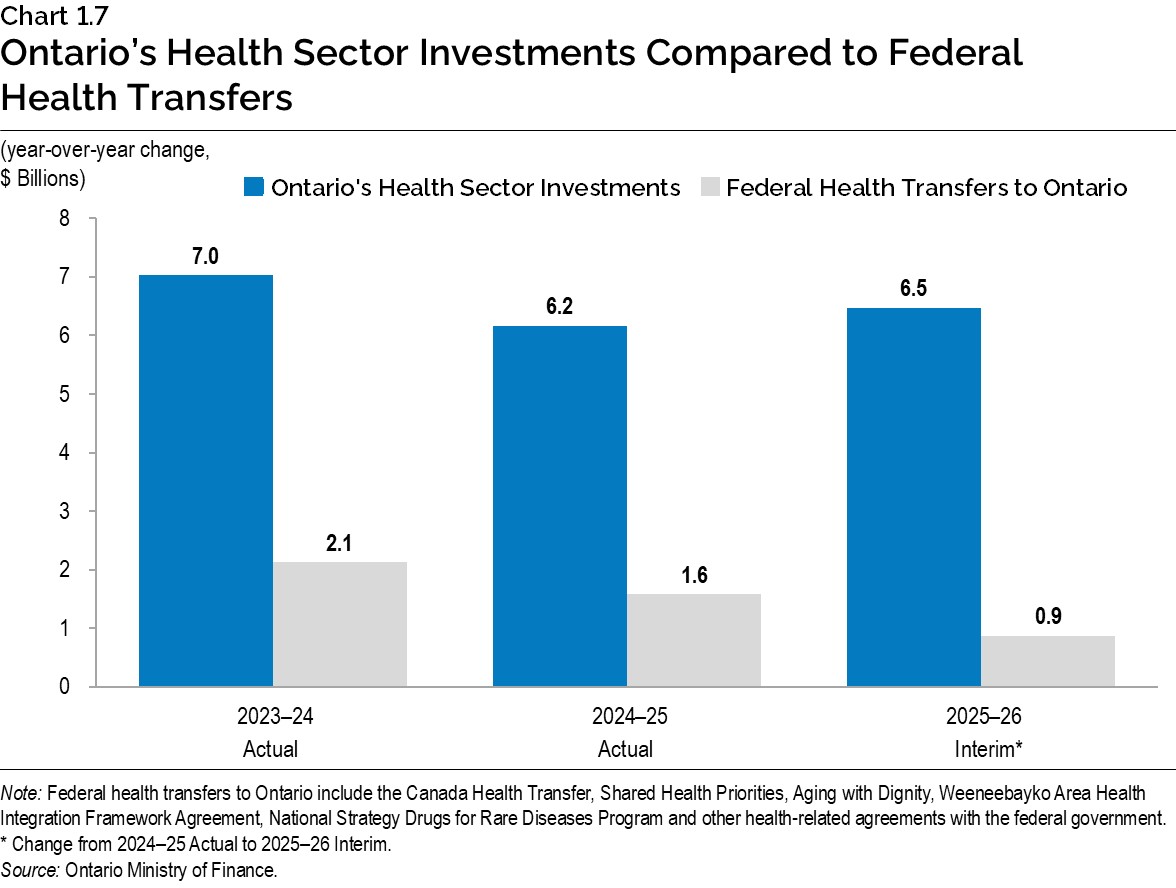
Provincial budgets continue to face pressures due to rising health care expenses. As shown in Chart 1.7, in recent years, Ontario’s incremental investments in the health sector far exceed increases in federal health funding. This trend will continue without additional federal support.
This is why Ontario, along with other provinces and territories, continues to call on the federal government to make permanent the temporary 5 per cent minimum growth rate guarantee for the Canada Health Transfer that ends in 2027–28. Ontario is also advocating for additional health funding, and for the renewal of expiring time-limited agreements to ensure the continuation of essential programs and services, including funding to support mental health and addictions programs as outlined in the Roadmap to Wellness, home and community care and long-term care.
Ontario continues to call on the federal government to advance the achievement of shared housing outcomes, including increasing support under the current National Housing Strategy, and working with other provinces and territories on a long-term federal commitment beyond its expiry in 2027–28.
Protecting Ontario with Stronger Safeguards for Public Information
After nearly four decades without any major updates, Ontario’s current privacy and access laws are no longer reflective of today’s technology or responsible modern governance. To address these gaps, the province is taking a number of actions to improve digital government and privacy, including enhanced cybersecurity rules for the broader public service, stronger safeguards for children’s information and modernized Freedom of Information (FOI) timelines and processes. This includes changes to the FOI process for cabinet ministers, parliamentary assistants and their offices, that will more closely align Ontario with other jurisdictions in Canada, supporting more cost-efficient government administration and helping ensure a more modern and secure Ontario.
Allowing Retail Stores to Open on Family Day and Victoria Day
The government is proposing amendments that will remove the requirement for retail businesses to close on Family Day and Victoria Day, while maintaining the authority of municipalities to set their own retail closure by‑laws. These changes modernize provincial standards to better reflect the evolving needs of retailers, workers and consumers, while ensuring that municipalities retain flexibility to address their own local priorities.
To ensure a consistent experience for consumers and a level playing field for retail businesses across Ontario, the proposed legislative amendments would include removing the authority of municipalities — including the City of Toronto — to pass or maintain local by-laws requiring retail business establishment closures on these two holidays.
Our government would be modernizing out of date rules, while maintaining strong protections for employees who would continue to benefit from public holiday rights under the Employment Standards Act.
Public Services Delivered More Efficiently
The people of Ontario expect their services to be efficient, effective and relevant. To deliver on its plan, the government committed, in the 2025 Ontario Economic Outlook and Fiscal Review, to explore and apply new ways to responsibly harness technology and modern solutions. This will help to save time, streamline government operations and make the best use of resources. Ultimately, this means key public services will involve fewer steps that take less time for businesses and the public.
Ontario’s prudent management of the public-sector workforce has resulted in an Ontario Public Service (OPS) that is a national leader in modern, efficient and focused frontline service delivery. Since 2018, this management has included a hiring freeze on non-essential positions, leaning out processes that have reduced the need for staffing increases, redeploying staff to advance key government priorities without increasing overall staffing numbers and back-office efficiencies that have redirected the ratio of front-office to back-office staff from 50:50 in 2019–2020 to 60:40 in 2025–2026. As a result, Ontario’s public service size relative to population is leaner than that of the federal government or any other province or territory, at 519 public servants for every 100,000 residents of Ontario in 2025. Ontario also has the fewest public servants per $1 billion of base government spending on services and transfer payments at 388.3 public servants for every $1 billion, again, better than any other public service in Canada.
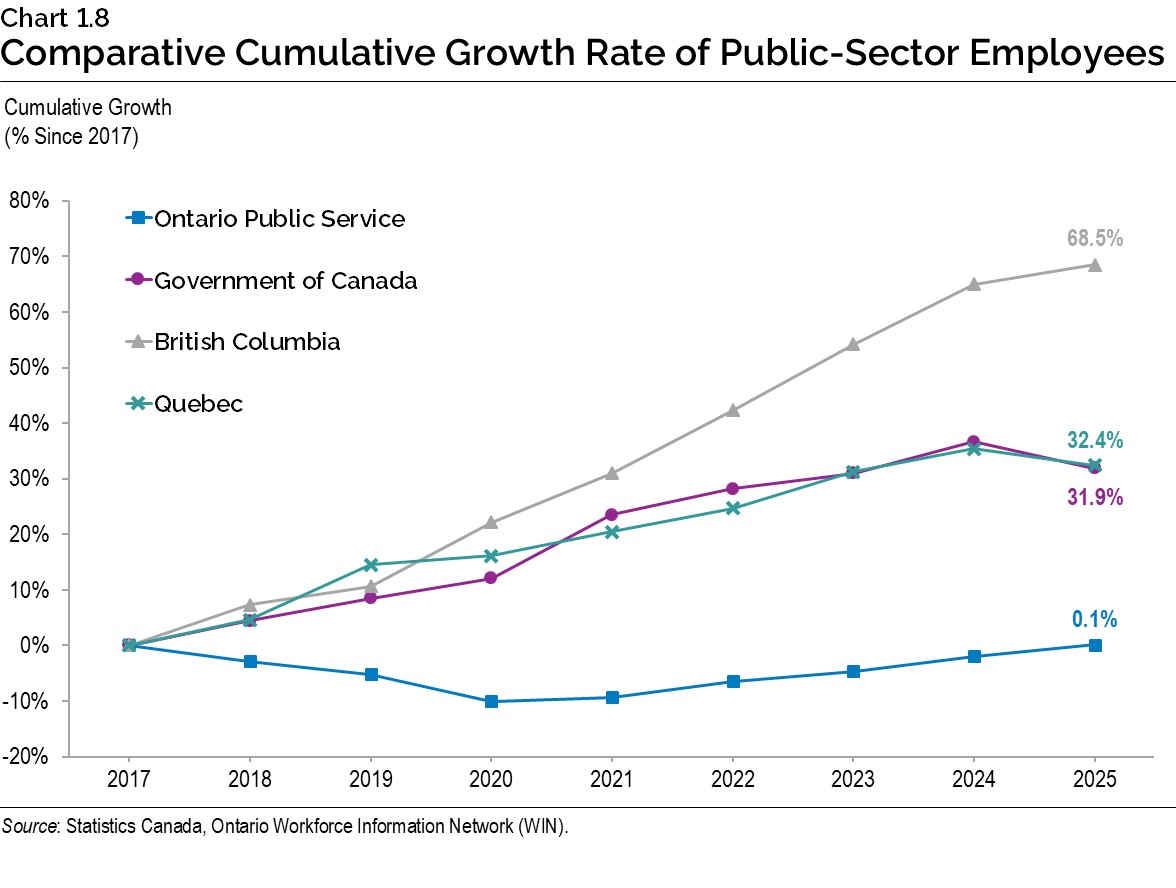
This responsible management means that since 2018, Ontario’s public-service growth rate has been substantially lower than that of the federal government and other provinces and territories, several of which are now cutting their public services after years of rapid growth. Ontario’s proactive approach to date has helped avoid the need for these rapid cuts, although the government will always pursue efficiencies while maintaining high-quality service delivery, including by maintaining strict control over the growth of the OPS.
Building on this proven approach, the government is now focused on applying this discipline to Ontario government agencies, boards and commissions, which have grown at a much faster rate than the OPS. In September 2025, the government imposed a hiring freeze, which is projected to avoid costs to the public of close to $300 million. This action builds on Ontario’s progress in modernizing public services — including reducing the number of provincial agencies from 191 to 137 since 2018 — to create a more accountable, sustainable system that delivers better value and better services for the people of Ontario.
Strengthening Public Services for a Sustainable and Prosperous Future
In response to global economic challenges, Ontario has continued to judiciously manage its finances to build a more resilient and self-reliant economy and secure long-term prosperity. The government is rising to these challenges by pursuing opportunities to modernize programs and address areas where there have been rising pressures. By reducing bureaucracy and administrative costs and ensuring programs are delivered in the most efficient and cost-effective way possible, the government is freeing up resources to deliver better frontline services to those who need them most.
Examples of actions taken to date include:
- Updating the postsecondary tuition framework, which will support the sector’s long-term sustainability while maintaining one of the lowest rates of tuition increase in Canada;
- Strengthening the long-term sustainability of OSAP by bringing eligibility for grants and loans in line with that of other provinces;
- Seeking new technology solutions to enhance the efficiency of government services such as using automation to renew vehicle permits so the people of Ontario no longer need to visit ServiceOntario counters;
- Streamlining the province’s approach to conservation management by establishing the new Ontario Provincial Conservation Agency, which will support work to standardize service delivery, introduce digital permitting tools and dedicate more resources to frontline services;
- Finding internal efficiencies across the OPS by applying Lean Six Sigma management techniques; and
- Continuing to strengthen and sustain public services.
Taking actions like these will help ensure that Ontario has the enhanced fiscal capacity to invest in better frontline services for those who need them most, and that it can invest in strategic priorities that put more money back in people’s pockets and unleash the economy. The government will continue to consider opportunities to ensure programs are providing the best value for money for the people of Ontario. For example, the government will:
- Review provincial infrastructure investments and electricity rate relief programs to reduce duplication and streamline program delivery;
- Consider options to reduce the incidence of Ontario Health Insurance Plan (OHIP) fraud and enhance the program integrity of Ontario Works;
- Continue to review Ontario’s business support programs to identify opportunities to streamline programs and ensure they are successful in attracting investments while achieving good value for taxpayer dollars; and
- Continue to work with health care partners to ensure accountable and improved service delivery, without impacting frontline workers.
These initiatives will help modernize Ontario’s services and ensure the province is providing lasting, high-impact results for businesses and people.
Modernizing Ontario’s Alcohol Sector
The Ontario government is increasing choice and convenience for Ontario consumers by modernizing the alcohol marketplace. Today, customers across Ontario can shop for beer, wine, cider and ready-to-drink (RTD) beverages in over 6,600 licensed convenience and grocery stores.
Sales of Ontario alcohol products have grown by approximately 22 per cent, with local craft products up by about 35 per cent and Vintners Quality Alliance (VQA) wine sales increasing by roughly 52 per cent.1 In response to consumer demand, the LCBO continues to promote and prioritize small producers and Ontario-made products to help these businesses contribute further to Ontario’s economy.
As of April 1, 2026, the LCBO will become the exclusive wholesaler for all retailers, bars and restaurants selling alcohol to the public. To help with this transition, the government is reducing wholesale mark-ups by about $200 million to support producers and retailers succeed in the expanded marketplace. The new wholesale pricing model will streamline and simplify wholesale pricing, providing a more level playing field for all market participants.
To help support a more dynamic and competitive beverage alcohol marketplace, the government is also simplifying and reducing alcohol taxes by $60 million. In addition, this summer, the government will be consulting with stakeholders on a progressive alcohol tax and mark-up system.
Improving Choice and Convenience
By July 1, 2026, the LCBO will have implemented a fully open listing process. The process will provide retailers and producers with access to the LCBO’s product catalogue, bringing new products to the market in a timely manner. This will help foster competition and improve consumer choice and convenience.
Reducing Red Tape for Producers and Retailers
Ontario is further enhancing the LCBO Direct Delivery Program. Starting July 1, 2026, all Ontario distillers will be able to deliver spirits-based RTD beverages directly to eligible licensees (for example, bars and restaurants), providing local distillers with opportunities to grow their businesses further. This builds on recent changes to the program for producers of 100 per cent Ontario non-VQA wine.
The government is also providing additional flexibility for suppliers to recover delivery costs from wholesale customers when directly delivering their products. This change is expected to foster more competition among suppliers and provide new opportunities for other businesses to deliver products in the expanded marketplace.
Ontario is making it easier for retailers and producers to manage their logistics more efficiently. Later this summer, convenience stores will have more options on how they use distributors, including third parties, to get beverage alcohol to their stores. Eligible retailers will also be able to fulfil online orders from their distribution centres for consumers who want to order alcohol with their groceries. Retailers will also be able to transfer products between their licensed affiliated locations.
The government is working with the LCBO to allow domestic beer manufacturers, who have facilities in Ontario, to ship their products directly to their final destination in the province. By removing Ontario’s restrictions, the government is taking steps towards allowing retailers to temporarily hold alcohol products in neighbouring provinces before bringing them back into Ontario for sale.
These changes will support a more dynamic and responsive expanded marketplace.
Improving Ontario’s Mortgage Broker Industry
The report of the third legislative review of the Mortgage Brokerages, Lenders and Administrators Act, 2006 was delivered in February 2026. The report’s recommendations centre on three key themes: reinforcing professionalism of mortgage experts, reducing regulatory burden and strengthening consumer protection.
The report was delivered by Member of Provincial Parliament Michelle Cooper, Parliamentary Assistant to the Minister of Finance, and its recommendations were informed by extensive stakeholder consultations led by the previous appointees, Minister Stephen Crawford and Associate Solicitor General Zee Hamid.
The government will work with the regulator, the Financial Services Regulatory Authority of Ontario (FSRA), on implementing the recommendations. These include proposals for regulatory change, such as allowing mortgage agents to work with additional lenders, enabling more modern options for delivery of orders and notices and allowing the use of team names within a brokerage. As part of implementation, the government will continue to engage the sector, including lenders, borrowers and investors, to ensure the sector can better serve the people of Ontario.
Protecting Consumers in the Life and Health Insurance Sector
To strengthen consumer protection and recognize the role that Managing General Agents (MGAs) play in Ontario’s life and health insurance sector, the government created a new licensing framework for these MGAs in fall 2024, following earlier consultations.
Since then, FSRA has actively engaged in consultations with the sector on associated framework rules, in support of a June 1, 2026 launch date for the framework.
The government has decided to postpone this launch date to allow for sufficient time to assess stakeholder feedback received during the consultation period with FSRA. The government will continue to engage with the sector as next steps on the framework are determined.
Chart Descriptions
Chart 1.7: Ontario’s Health Sector Investments Compared to Federal Health Transfers
The bar chart illustrates the year-over-year change in Ontario’s health sector investments as compared to changes in federal health transfers from 2023–24 through 2025–26*. Ontario’s health sector investments increased by $7.0 billion in 2023–24, $6.2 billion in 2024–25, and $6.5 billion in 2025–26. In comparison, federal health transfers to Ontario increased $2.1 billion in 2023–24, $1.6 billion in 2024–25, and $0.9 billion in 2025–26.
Note: Federal health transfers to Ontario include the Canada Health Transfer, Shared Health Priorities, Aging with Dignity, Weeneebayko Area Health Integration Framework Agreement, National Strategy Drugs for Rare Diseases Program and other health-related agreements with the federal government.
* Change from 2024–25 Actual to 2025–26 Interim.
Source: Ontario Ministry of Finance.
Chart 1.8: Comparative Cumulative Growth Rate of Public-Sector Employees
The line chart illustrates the cumulative growth since 2017 in the public service of Ontario as compared to the public services of the Government of Canada, British Columbia and Quebec. Since 2017, the Ontario Public Service has grown by 0.1 per cent. In comparison, Government of Canada has grown by 31.9 per cent, British Columbia has grown by 68.5 per cent and Quebec has grown by 32.4 per cent.
Sources: Statistics Canada, Ontario Workforce Information Network (WIN).
Footnotes
[1] Based on April 1, 2025 to January 31, 2026 sales data from the Liquor Control Board of Ontario (LCBO).