The government recognizes that many people in Ontario continue to face rising costs, economic pressures and continued global uncertainty. The government is delivering on its objective to make life more affordable by taking steps to lower costs and provide relief to families and individuals in Ontario.
Supporting Families and Individuals
The government continues to take action to help the people of Ontario manage affordability challenges amid ongoing economic uncertainty, along with trade and tariff pressures. In response to the financial strain these conditions place on families and individuals, the government has consistently taken early action to deliver relief and support, while remaining focused on its commitment to making life more affordable and protecting taxpayer dollars.
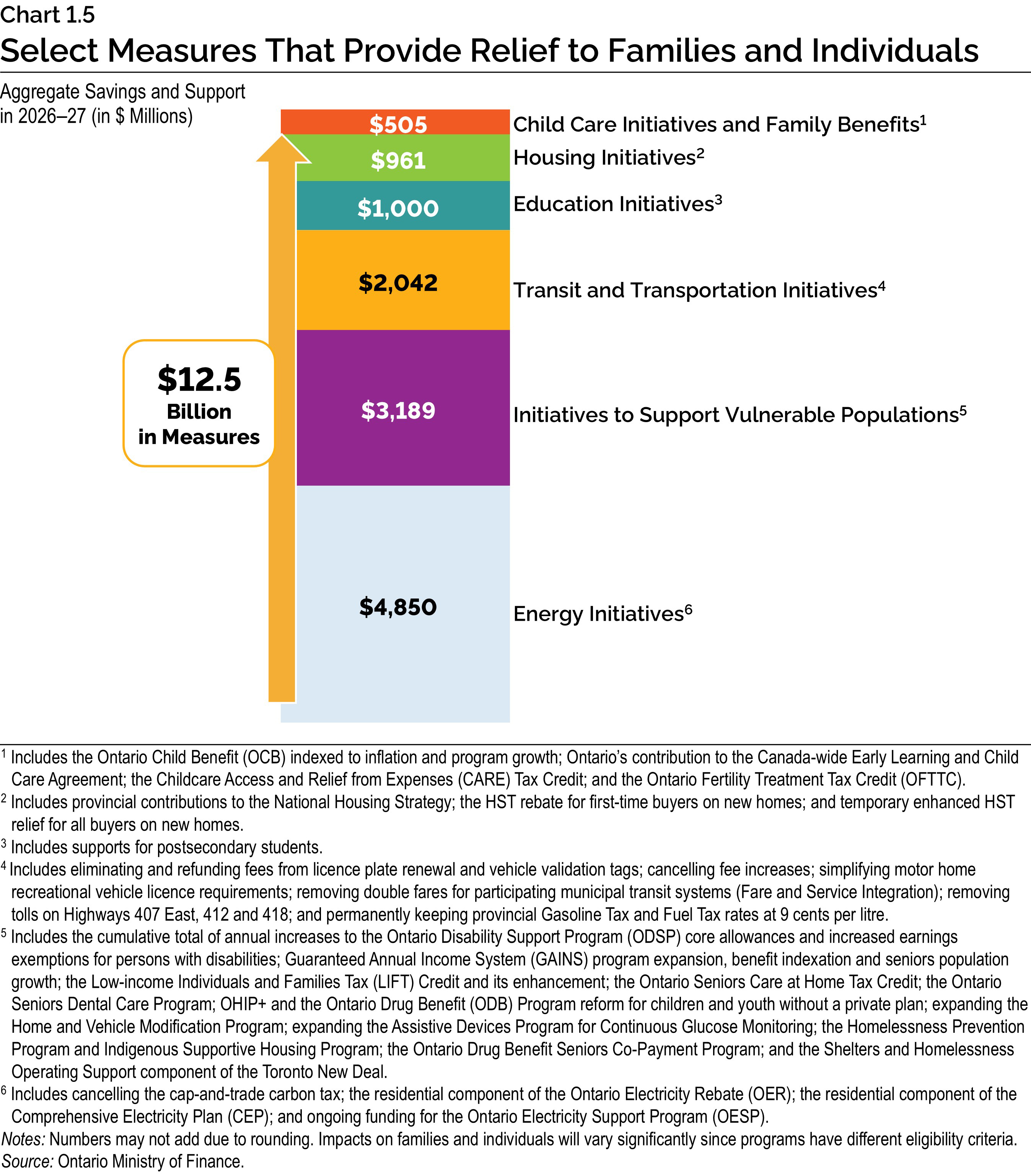
The government committed over $12.5 billion in support for families and individuals in the 2026–27 fiscal year, as shown in Chart 1.5.

Taking Action on Housing
The government is working to make housing more affordable and speed up the construction of homes. This includes providing Harmonized Sales Tax (HST) relief on new homes, partnering with municipalities to build more housing-enabling infrastructure and reducing development costs so homes can be built faster and more affordably.
Building Together Through Federal–Provincial Partnerships
In March 2026, Ontario and the federal government signed the historic Canada–Ontario Partnership to Build (COPB) to support shared goals, including making housing more affordable, getting shovels in the ground on key transit projects and supporting economic development that will protect jobs and help communities grow, despite the impact of tariffs and economic uncertainty.
The agreement includes $8.8 billion over 10 years in federal and provincial funding, flowing through the Provincial-Territorial (PT) stream of the Build Communities Strong Fund (BCSF), to support housing-enabling infrastructure investments for Ontario municipalities to reduce development charges (DCs). It also includes cooperation on, and financial support for, a number of major transit projects, and funding for enhanced relief on the full 13 per cent of the HST for eligible buyers of new homes valued up to $1 million.
For more details on how Ontario is working with other levels of government to build more homes faster and make housing more affordable, see the sections below.
Providing Harmonized Sales Tax Relief for New Homes
The Ontario government is continuing to lower costs and help families realize the dream of homeownership through temporary relief on the full 13 per cent HST for eligible buyers of new homes valued up to $1 million. The measure provides up to $130,000 in relief to eligible buyers. Applications for relief are open through the Canada Revenue Agency (CRA). The relief on the full 13 per cent HST is generally available for the purchase of a home from a builder between April 1, 2026, and March 31, 2027.
The measure consists of two components. The first component comprises the Ontario Enhanced New Housing Rebate (ENHR) and the Ontario Enhanced New Residential Rental Property Rebate (ENRRPR), both of which are administered by the CRA. These rebates provide up to $80,000, equivalent to up to 100 per cent of the 8 per cent provincial portion of HST on a new or substantially renovated home.
The second component is the Ontario New Home Affordability Payment (ONHAP). This provides top-up relief of up to $50,000, equivalent to up to 100 per cent of the 5 per cent federal portion of HST on a new or substantially renovated home. Eligibility for the ONHAP is based on eligibility for the ENHR or ENRRPR, as applicable. The ONHAP is administered by Ontario, with payments expected to begin in early 2027.
Together, these two components provide temporary relief of the full 13 per cent HST on eligible new homes valued up to $1 million, for up to $130,000 per eligible new home. This $130,000 maximum is maintained for new homes valued between $1 million and up to $1.5 million.
As a separate measure, on October 28, 2025, Ontario announced that it would remove the full 8 per cent provincial portion of the HST for first-time home buyers of new homes valued up to $1 million. This mirrors the federal Goods and Services Tax/Harmonized Sales Tax (GST/HST) First‑Time Home Buyers’ Rebate. The Ontario First-Time Home Buyers’ Rebate is now in effect, and eligible buyers can start applying to the CRA. To qualify for the rebate, the purchaser must be acquiring the new home for use as their primary place of residence, and agreements of purchase and sale must be entered into on or after March 20, 2025, and before 2031.
Building More Homes Through the Development Charge Reduction Program
Ontario, in partnership with federal and municipal partners, continues to take action to help increase the supply of affordable homes and lower housing costs while creating good-paying jobs for workers. These efforts are helping communities access the support they need to speed up homebuilding, expand critical infrastructure, support economic growth and keep costs down over the long term.
Through the Development Charge Reduction Program (DCRP), funding will support housing‑enabling infrastructure projects in Ontario. Funding will be prioritized for municipalities that reduce and maintain reductions on development charges (DCs) by 30 per cent or more.
High DCs can add significant costs to new housing projects, which may ultimately be passed on to homebuyers and renters. By helping municipalities offset the forgone revenue impacts associated with these reductions, the DCRP will support investments in critical infrastructure such as roads, water and wastewater systems, and other services needed to facilitate new housing development. This program will help lower barriers to homebuilding, encourage private-sector investment, unlock additional housing supply and create more attainable housing options for Ontario families while supporting strong and sustainable community growth.
Municipalities will also be expected to support DC reductions, so that all three levels of government are supporting increased housing supply and affordability. These strategic investments will encourage new home construction and help more people realize the dream of homeownership.
Building More Homes for Non-Development Charging Municipalities
In August 2026, through the Canada–Ontario Partnership to Build, Ontario and Canada announced an investment of $1 billion to support municipalities that do not levy development charges. The new Non‑Development Charge Municipalities Stream (Non-DC Stream) of the Municipal Housing Infrastructure Program will provide funding for critical infrastructure, including roads, bridges, and water systems, to enable housing construction, preserve existing housing supply and help lower housing costs for Ontario families. The initiative recognizes the infrastructure needs of municipalities that have chosen not to use development charges as a revenue tool.
The funding commitment includes $500 million from Ontario through the Municipal Housing Infrastructure Program and $500 million from the Build Communities Strong Fund (BCSF). The Non‑DC Stream complements broader housing affordability measures under the Canada–Ontario Partnership to Build, including development charge reduction initiatives and enhanced HST relief on new homes, which together aim to reduce housing costs and accelerate housing supply across the province. Applications for the Non-DC Stream opened for eligible municipalities in October 2026, with additional intakes to be announced later.
This investment builds on the province’s previous expansion of the Municipal Housing Infrastructure Program (MHIP), providing municipalities and Indigenous communities with the resources required to deliver housing-enabling infrastructure faster and at greater scale.
Together with the province’s Building Faster Fund and broader housing affordability measures, these investments are helping to lower costs, accelerate housing supply and keep the dream of homeownership within reach for Ontario families.
Promoting Innovation and Investment in University Student Housing
The government continues to support the development of new purpose-built university student housing facilities by introducing a new property tax treatment to capture a broader range of partnerships between universities and developers. While university-operated student housing will continue to be treated as tax exempt, this change would provide partial property tax relief to student housing facilities on university land operated by third parties. Qualifying facilities would be granted an education property tax exemption and a discounted municipal tax through the new Multi-Residential Property subclass. This would further incentivize universities to join forces with developers to take advantage of innovative student housing partnership models, while also promoting clarity and consistency in the tax treatment of such facilities.
Supporting Municipalities
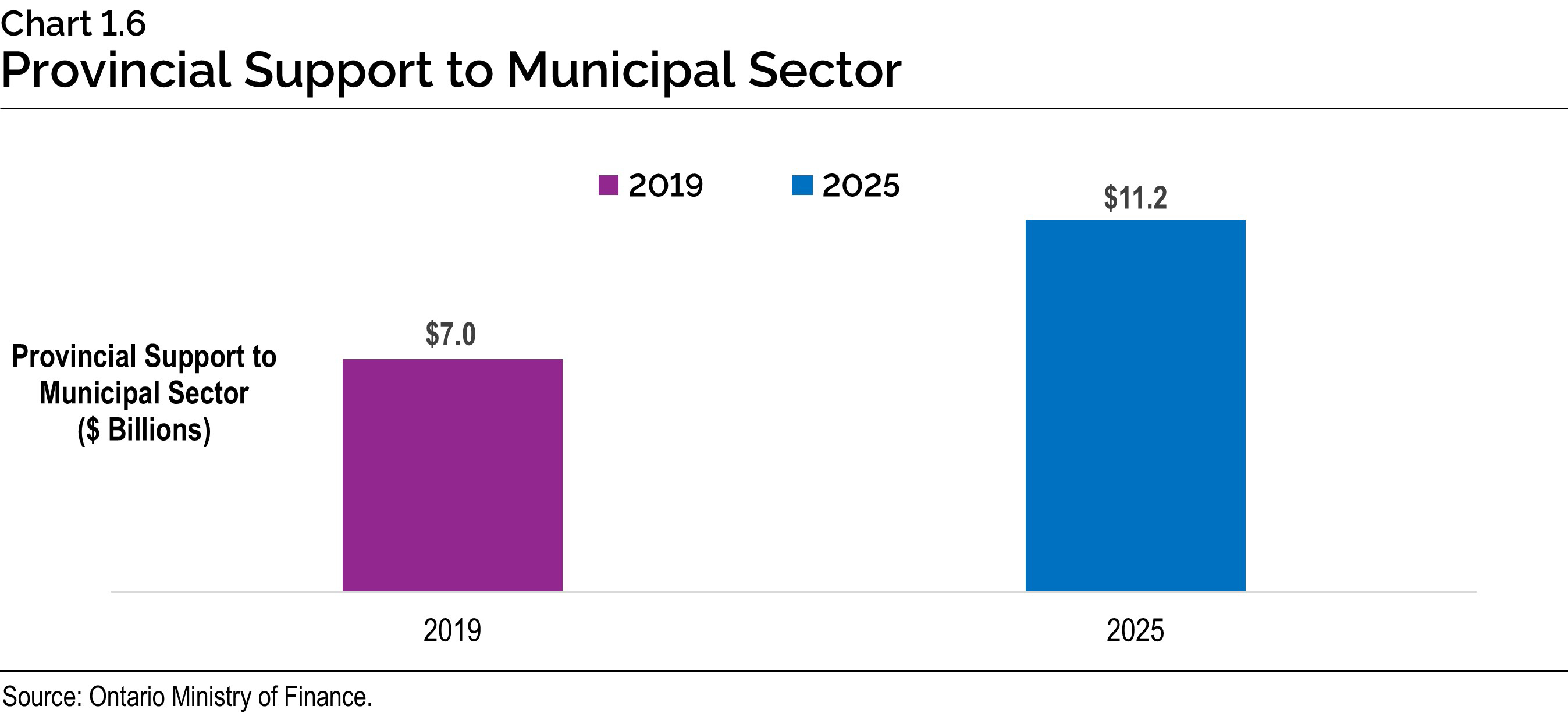
Ontario’s municipalities are an essential part of the province’s overall economic strength and resilience, and the province has taken meaningful actions to support and strengthen local communities with record investments in the municipal sector. In fact, from 2019 to 2025, key provincial support to municipalities grew by over 60 per cent. In 2025 alone, the government provided more than $11 billion through key transfers.
The government is continuing to support municipalities across the province through the Development Charge Reduction Program and the Non-Development Charge Municipalities Stream under the Canada–Ontario Partnership to Build, as well as through other investments, such as:
- Launching the next round of the Community Sport and Recreation Infrastructure Fund (CSRIF);
- Completing the third intake of the Rural Ontario Development Program. This program provides cost-shared funding for projects that attract investment, strengthen workforce capacity and build long-term growth in rural communities across Ontario;
- Increasing the Ontario Municipal Partnership Fund (OMPF) program by $100 million, bringing the total funding envelope to $600 million in 2026; and
- Increasing annual funding for Connecting Links from $30 million to $45 million to support municipalities in addressing eligible connecting link road or bridge improvement needs to extend the life cycle of their assets and continue with local developments.
Looking ahead, the government will continue to work with municipalities to build more housing, support economic growth, and further strengthen Ontario’s communities.
Saving on Energy Costs
In 2025, the Ontario government launched the Energy Efficiency Framework, the largest investment in energy-efficiency programs in Canadian history. The government also recently expanded its offerings under the $10.9 billion, 12-year framework. Under the new Peak Performance Program, eligible commercial and institutional properties can receive financial incentives for reducing heating, ventilation and air conditioning (HVAC) use during periods of high demand. By delivering up to 100 megawatts of peak demand reduction in 2026 and scaling up to 230 megawatts in 2027, this change will protect the reliability of Ontario’s electricity grid and reduce costs for consumers and businesses.
To maintain affordability and ensure sustainability of the Ontario Electricity Rebate (OER), effective May 1, 2027, the government’s continued monthly credit will be capped at 1,200 kilowatt-hours (kWh) for residential customers. The average residential consumer in Ontario uses approximately 700 kWh per month. Small businesses and farms are excluded from this change. In addition, the government will continue to provide credits on top of the OER aimed at lowering energy costs for Northern and rural residents.
The government also provides targeted electricity bill relief for eligible low-income households and on-reserve First Nation consumers, as well as for eligible rural or remote customers. For example, the Ontario Electricity Support Program (OESP) provides a monthly on-bill credit to assist low‑income households in managing their electricity costs.
Lowering the Cost of Commuting
Permanently Reducing the Tax Rates for Gasoline and Fuel
To provide ongoing relief to households in Ontario, effective July 1, 2025, the government permanently cut the Gasoline Tax rate by 5.7 cents per litre and the Fuel (diesel) Tax rate by 5.3 cents per litre to establish a reduced rate of 9 cents per litre. This measure delivered $2.3 billion in Gasoline Tax and Fuel Tax relief to families and individuals since it was first introduced on a temporary basis on July 1, 2022. On average, these cuts save households about $115 per year.
Removing Tolls
Effective June 1, 2025, the government permanently removed tolls from the provincially owned Highway 407 East, saving drivers approximately $94 million annually. This reduces the cost of travel while increasing convenience and choice.
This toll removal was in addition to a number of other measures that the government implemented to put money back in drivers’ pockets, including eliminating licence plate renewal fees, removing tolls on Highway 412 and Highway 418, freezing fees for driver’s licences and Ontario Photo Cards, and permanently cutting Gasoline Tax and Fuel Tax rates.
Helping Transit Users Save with One Fare
Since launching in 2024, One Fare has saved the people of Ontario more than $300 million and enabled nearly 100 million free transfers across participating transit agencies.
The One Fare program ensures transit customers only pay once when transferring between the Toronto Transit Commission (TTC) and GO Transit, Brampton Transit, Durham Region Transit, MiWay (Mississauga), Peel TransHelp and York Region Transit.
One Fare makes cross-boundary travel more affordable and convenient for all transit customers, including students, seniors and low-income riders.
Chart Descriptions
Chart 1.5: Select Measures That Provide Relief to Families and Individuals
This chart illustrates select measures that provide relief for Ontario’s families and individuals in 2026–27. Government actions would total over $12.5 billion for families and individuals in 2026–27. This includes child care initiatives and family benefits ($505 million), housing initiatives ($961 million), education initiatives ($1,000 million), transit and transportation initiatives ($2,042 million), initiatives to support vulnerable populations ($3,189 million), and energy initiatives ($4,850 million).
Child care initiatives and child benefits include the Ontario Child Benefit (OCB) indexed to inflation and program growth; Ontario’s contribution to the Canada-wide Early Learning and Child Care Agreement; the Childcare Access and Relief from Expenses (CARE) Tax Credit; and the Ontario Fertility Treatment Tax Credit (OFTTC). Housing initiatives include provincial contributions to the National Housing Strategy; the HST rebate for first-time buyers on new homes; and temporary enhanced HST relief for all buyers on new homes. Education initiatives include supports for postsecondary students. Transit and transportation initiatives include eliminating and refunding fees from licence plate renewal and vehicle validation tags; cancelling fee increases; simplifying motor home recreational vehicle license requirements; removing double fares for participating municipal transit systems (Fare and Service Integration); removing tolls on Highways 407 East, 412 and 418; and permanently keeping provincial Gasoline Tax and Fuel Tax rates at 9 cents per litre. Initiatives to support vulnerable populations include the cumulative total of annual increases to the Ontario Disability Support Program (ODSP) core allowances and increased earnings exemptions for persons with disabilities; Guaranteed Annual Income System (GAINS) program expansion, benefit indexation and seniors population growth; the Low-income Individuals and Families Tax (LIFT) Credit and its enhancement; the Ontario Seniors Care at Home Tax Credit; the Ontario Seniors Dental Care Program; OHIP+ and the Ontario Drug Benefit (ODB) Program reform for children and youth without a private plan; expanding the Home and Vehicle Modification Program; expanding the Assistive Devices Program for Continuous Glucose Monitoring; the Homelessness Prevention Program and Indigenous Supportive Housing Program; the Ontario Drug Benefit Seniors Co-Payment Program; and the Shelters and Homelessness Operating Support component of the Toronto New Deal. Energy initiatives include cancelling the cap-and-trade carbon tax; the residential component of the Ontario Electricity Rebate (OER); the residential component of the Comprehensive Electricity Plan (CEP); and ongoing funding for the Ontario Electricity Support Program (OESP).
Notes: Numbers may not add due to rounding. Impacts on families and individuals will vary significantly since programs have different eligibility criteria.
Source: Ontario Ministry of Finance.
Chart 1.6: Provincial Support to Municipal Sector
The bar chart shows the increase in provincial support for the municipal sector from 2019 to 2025, with two bars. The 2019 bar shows support at $7.0 billion, while the 2025 bar shows support at $11.2 billion.
Source: Ontario Ministry of Finance.