Ontario is fortifying and building on its industrial base to protect workers and attract the good‑paying jobs of the future in sectors including defence, artificial intelligence, energy, agriculture and agrifood, critical minerals and more.
Making Ontario More Competitive and More Productive Than Ever
Ontario is enabling this growth by cutting red tape to increase certainty for businesses; lowering taxes to attract investment; investing in workers and students to build the skilled workforce of the future; and leading the nation in tearing down internal trade barriers while opening up new markets for Ontario goods and services around the globe. Together, these actions are helping businesses grow, attracting investment and creating jobs across the province, while strengthening Ontario’s economic resilience and positioning Ontario to be more competitive than ever.
Cutting Red Tape to Enhance Certainty and Confidence for Investors
Ontario continues to help unlock the province’s full economic potential by removing red tape to accelerate investment and deliver modernized systems that work better for people and are smarter for businesses. In October 2026, the government introduced the Building Ontario Faster Act, 2026 as part of its Fall 2026 Red Tape Reduction Package. If passed, the legislation and associated measures would advance economic growth and innovation, increase efficiency through regulatory modernization and streamline permitting to accelerate investment and infrastructure development. The package also contains measures to support industrial businesses and workers and further modernize permitting processes and approvals.
Since the introduction of the Building a More Competitive Economy Act, 2025, Ontario has made significant progress in addressing key business permitting issues, including reducing and streamlining permits, simplifying system navigation and improving accountability. In less than a year, the review process is already more than 50 per cent complete. Ontario is cutting the time the province spends processing permits by nearly 220,000 days. By the end of 2026, over 190 permits will have been reviewed.
Since 2018, Ontario has taken approximately 700 actions to reduce regulatory burdens. The province has saved businesses, individuals and the broader public sector more than $1.3 billion in annualized compliance costs, and has delivered 1.8 million hours in savings since 2023. Ontario’s proven track record of cutting red tape is sending a clear signal to the world that the province is ready to compete for and advance major projects.
Streamlining Environmental Assessments
The government is modernizing environmental assessments so that important projects can get built faster, while strong environmental protections stay in place. Ontario is focusing assessments on complex projects while cutting long and unnecessary delays on the rest, so communities can get shovels in the ground faster for the infrastructure they need.
Species at Risk Changes
The government has fundamentally reformed Ontario’s species at risk rules to replace years of delays with clear, predictable rules. Most projects can now move forward as soon as they register, provided they follow clear rules that protect species and their habitat. Ontario has also paired this with strong new enforcement measures, and more than quadrupled the funding for species at risk, bringing the total to $20 million each year.
Improving the Role of Conservation Authorities
The government continues to strengthen the province’s approach to watershed management through the newly established Ontario Provincial Conservation Agency (OPCA).
The OPCA is working with conservation authorities and municipal partners to consolidate Ontario’s 36 conservation authorities into nine regional conservation authorities, in order to provide watershed management and conservation programs and services.
Following the recruitment of an expert leadership team to guide the regional transition planning process, progress is already underway to establish the new regional conservation authority structure, by early 2027, to support flood management, erosion control and drinking water protection.
Dedicated funding continues to support the transition to system-wide improvements, including enhanced digital and technical resources that support housing, infrastructure, economic growth and watershed management. These actions will strengthen the role conservation authorities already play in managing watersheds and protecting communities.
Fast-Tracking Mining Investments with One Project, One Process
In the past, Ontario’s outdated and fragmented permitting system contributed to delays that held back investment, job creation and access to critical and strategic minerals. In October 2025, the government implemented the One Project, One Process framework to speed up approvals for advanced exploration, mine development and mine expansion projects.
This new framework streamlines government approvals into one process, coordinated by Ontario’s Mine Authorization and Permitting Delivery Team. By acting as a single point of contact to coordinate all necessary provincial approvals, this team will help to reduce government review times by 50 per cent. This strategic shift will provide the certainty and predictability needed to get new mines open faster and secure Ontario’s position as a top destination for global mining investment.
Since its launch in October 2025, three major projects have been designated through the One Project, One Process framework, including: Frontier Lithium’s PAK Lithium Project (announced in October 2025), Canada Nickel Company’s Crawford Nickel Project (announced in January 2026) and Kinross Gold’s Great Bear Project (announced in February 2026).
Building a Stronger, More Competitive Economy Through a Multi-Year Tax Action Plan
The government is protecting Ontario businesses, workers and families impacted by the ongoing uncertainty and rising costs caused by U.S. tariffs. Through its multi-year Tax Action Plan, the government is helping make Ontario the most competitive economy in the G7 and is delivering on its plan to build a stronger, more resilient and self-reliant economy.
Building on key actions taken since 2018 to provide significant tax relief, the government launched a multi-year Tax Action Plan in 2025. Since then, the government has acted swiftly to build a more competitive tax environment that attracts investments, creates good-paying jobs for Ontario workers and helps lower costs for families. This includes cutting the small business Corporate Income Tax rate by over 30 per cent, lowering business costs through paralleling federal measures that would allow businesses to accelerate writeoffs of certain capital investments, and providing temporary relief on the full 13 per cent Harmonized Sales Tax (HST) for eligible buyers of new homes valued up to $1 million, helping more families realize the dream of homeownership.
However, there is more work to be done. To respond in this moment of trade uncertainty, the government is proposing a suite of tax measures to provide the stability, resilience and economic prosperity that people and businesses in Ontario deserve. This includes:
- Planning to lower the cost of capital investments even further by providing more than $8 billion in additional tax relief over five years to allow businesses to accelerate writeoffs of an extended list of capital investments, subject to passage of federal legislation;
- Providing more than $50 million in additional tax support over the next three years to help lower the cost of research and development (R&D) for about 700 businesses; and
- Transitioning the Ontario Computer Animation and Special Effects (OCASE) tax credit to a producer-based tax credit to make it more accessible for the film and television industry.
The government will continue to update Ontario’s tax framework in a prudent and fiscally responsible manner to improve competitiveness, lower costs, provide relief and protect Ontario in the years and decades to come.
Lowering the Cost of Capital Investments in Ontario
The government remains focused on making Ontario the most competitive place in the G7 to invest and do business. Improving Ontario’s competitiveness for business investment is a key cornerstone of this priority. In the 2026 Budget, the government committed to lowering the cost of capital investments by allowing businesses to accelerate the income tax deduction for the cost of depreciable assets, in parallel with changes introduced by the federal government in its Budget 2025 and related announcements.
The government intends to lower the cost of capital investment even further, providing over $8 billion in additional Ontario tax relief to qualifying businesses over five years, from 2026–27 to 2030–31. These proposed measures, which parallel recently announced federal measures, would lower the cost of business investment by permanently allowing businesses to immediately write off 100 per cent of the value of a wide range of assets, including fibre-optic cable, software, aircraft and certain vehicles, patents, rail track, bridges and roads. These measures would take effect following the passage of federal legislation. Combined with the accelerated writeoff measures included in the 2026 Budget, this would bring the total Ontario tax relief to more than $12 billion, over five years.
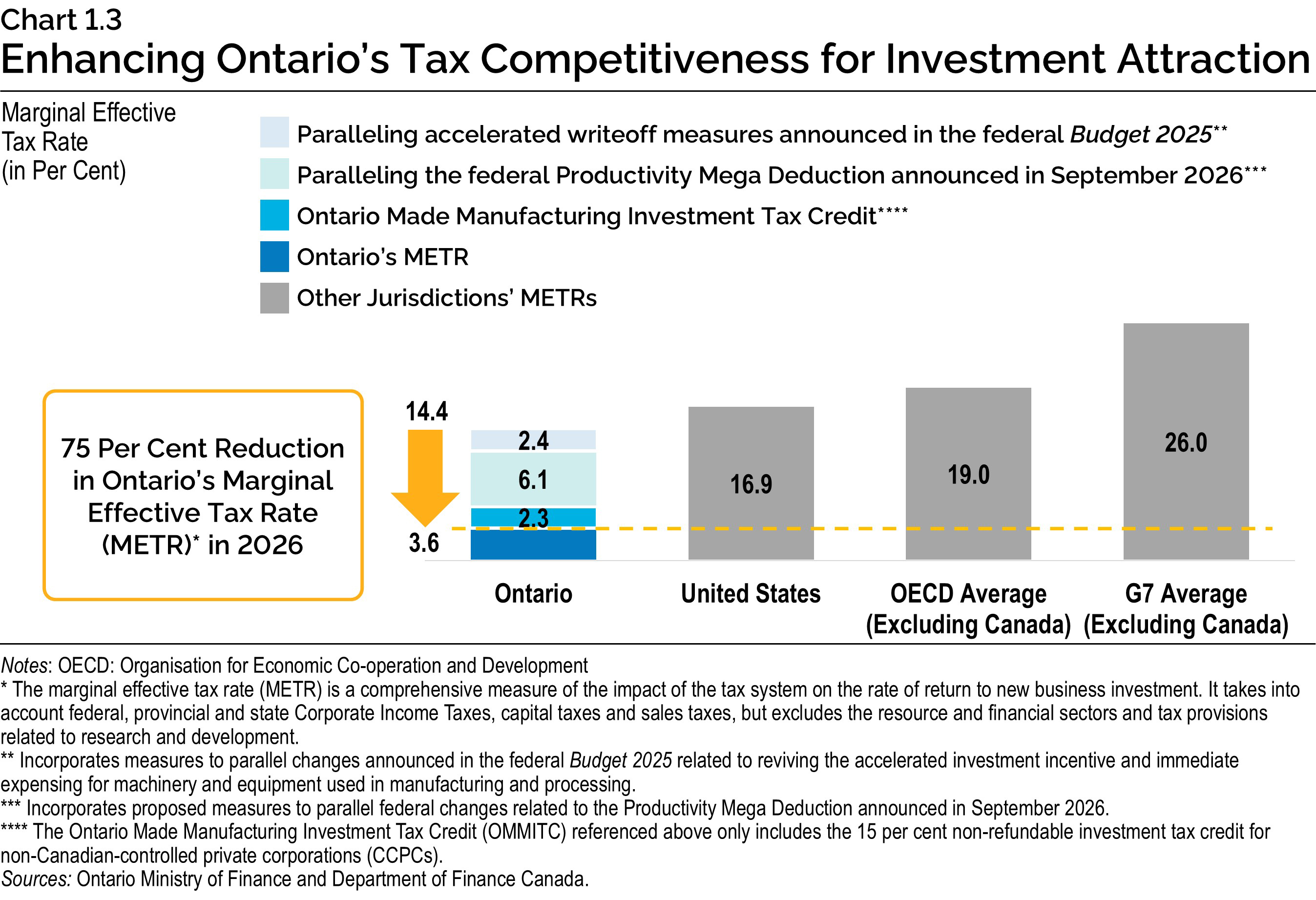
Paralleling the new federal measures would also improve Ontario’s tax competitiveness compared to the United States, the G7 and the Organisation for Economic Co-operation and Development (OECD). These new capital investment measures are estimated to reduce Ontario’s Marginal Effective Tax Rate (METR), a comprehensive measure of the tax burden on new business investment, by 6.1 percentage points. In addition, these enhanced investment incentives are estimated to attract at least $11 billion in additional capital investment to the province, creating 30,000 new jobs and adding $6 billion to the GDP.
See the Annex: Details of Tax Measures and Other Legislative Initiatives for more information.
Enhancing Support Through Ontario’s Research and Development Tax Credits
Research and development (R&D) is an important driver of productivity, innovation and growth through the development, adoption and commercialization of new technologies and processes. This is why Ontario provides over $500 million a year through its R&D tax credits.
Ontario will parallel recent federal enhancements to the Scientific Research and Experimental Development tax incentive program by restoring capital expenditures as eligible expenditures under the Ontario Research and Development Tax Credit and the Ontario Innovation Tax Credit. This change would allow eligible businesses to claim capital expenditures on items such as tools to test software or hardware, high-performance computers, prototyping equipment, and property or lease costs, alongside eligible labour expenditures, used to support important R&D activity in Ontario. As a result, the government is estimated to provide more than $50 million over the next three years in additional tax support, helping to lower the cost of R&D for about 700 businesses.
See the Annex: Details of Tax Measures and Other Legislative Initiatives for more information.
Updating Eligibility for the Ontario Computer Animation and Special Effects Tax Credit
Ontario’s film and television sector is an important driver of economic activity, including for the province’s animation and special effects industry. To help streamline support and simplify access, the government is proposing to transition eligibility for the Ontario Computer Animation and Special Effects (OCASE) Tax Credit to eligible film and television producers only.
OCASE is an 18 per cent refundable corporate income tax credit available to qualifying corporations that undertake computer animation and special effects activities on eligible film and television productions in Ontario. Transitioning eligibility for this credit to film and television producers only would help improve accessibility for production companies looking to invest in Ontario and support the competitiveness of Ontario’s film and television sector. This proposed approach would more closely resemble the approach used in other Canadian jurisdictions and continue to support special effects and animation activity in Ontario.
Further details, including proposed legislative amendments, would be available as part of the 2027 Budget and the accompanying Budget bill.
Lowering Costs to Build a More Competitive Investment Environment
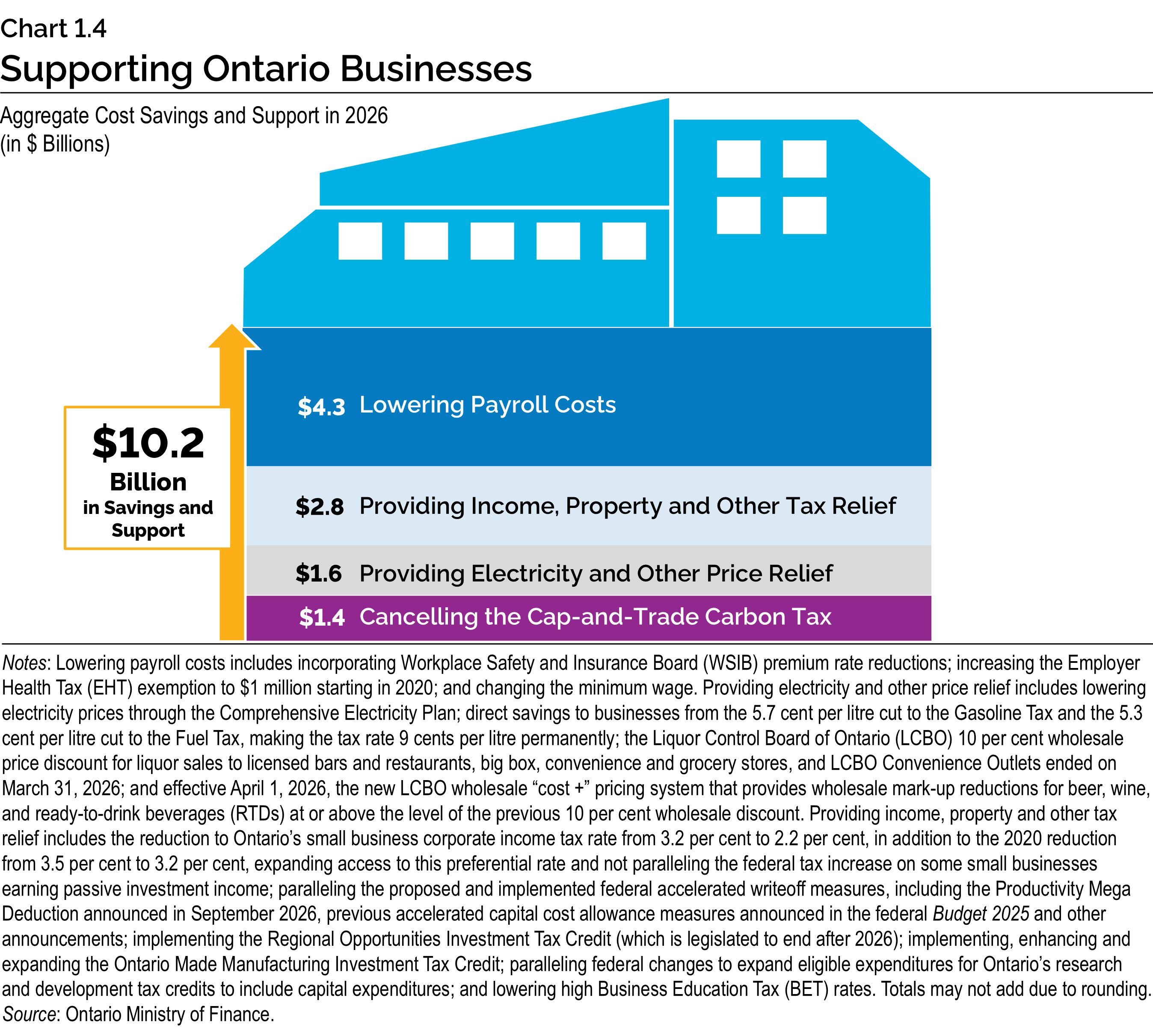
The government has helped to create the conditions for businesses to choose Ontario when making investment decisions to start and grow their operations. Since 2018, Ontario has attracted over $235 billion in investment from international and domestic companies. Key government actions taken since 2018 have helped create these conditions. These actions would enable $10.2 billion in estimated cost savings and support for Ontario businesses in 2026, of which $4.8 billion would go to small businesses. Some of these actions include:
- Cutting the small business Corporate Income Tax (CIT) rate to 2.2 per cent, which provides up to $5,000 in additional tax relief each year, building on actions already taken to cut the rate from 3.5 per cent to 3.2 per cent and expanding access to this preferential rate;
- Implementing and temporarily enhancing and expanding the Ontario Made Manufacturing Investment Tax Credit, which provides businesses up to $3 million in annual tax support for manufacturing or processing investments in the province;
- Cutting the Gasoline Tax by 5.7 cents per litre and the Fuel Tax by 5.3 cents per litre, to help reduce the cost of gas and fuel for Ontario businesses;
- Incorporating savings from a further reduction of the Workplace Safety and Insurance Board (WSIB) average premium rate to $1.23 per $100 of insurable payroll, the lowest level in more than 50 years;
- Increasing the Employer Health Tax (EHT) exemption from $490,000 to $1 million. The EHT exemption increase helps businesses by reducing the tax for eligible private-sector employers;
- Cancelling the cap-and-trade carbon tax to remove its cost impact from items such as gasoline, diesel fuel and natural gas;
- Lowering high Business Education Tax (BET) rates in 2021, providing $450 million in annual savings for over 200,000 employers, or 95 per cent of all business properties in Ontario;
- Lowering business costs by providing corporate income tax relief through paralleling proposed and legislated federal measures that would allow businesses to accelerate writeoffs of certain capital investments;
- Implementing the Comprehensive Electricity Plan in January 2021, which is lowering electricity costs by an estimated average of 9 to 13 per cent in 2026 for medium-sized and larger industrial and commercial customers, respectively;
- Extending the Liquor Control Board of Ontario (LCBO) wholesale discount of 10 per cent from the retail price on beverage alcohol wholesaled to bars and restaurants, big box, grocery and convenience stores from December 31, 2025, to March 31, 2026; and
- Reducing LCBO wholesale mark-ups by about $200 million per year to help support producers and retailers to succeed in the expanded alcohol marketplace, effective April 1, 2026.
Building New Trade Opportunities for Ontario
Since 2025, U.S. tariffs have disrupted Ontario businesses, created significant economic uncertainty and prompted an urgent need to diversify trade. The government continues to break down internal trade barriers and help businesses reach new markets, both internationally and across Canada.
Enhancing Free Trade Within Canada
Ontario has taken steps to promote free trade across Canada by removing internal trade barriers that have been holding back trade between the provinces and territories. Ontario is the first and only province to unconditionally remove all the province’s Party-Specific Exceptions under the Canadian Free Trade Agreement (CFTA). In June 2025, Ontario took a leadership role by passing the Protect Ontario Through Free Trade Within Canada Act, 2025, which set the foundation for mutual recognition and labour mobility.
In December 2025, Ontario took the next steps towards implementing mutual recognition of goods and services from other reciprocating Canadian jurisdictions by publishing draft regulations under the Ontario Free Trade and Mobility Act, 2025. Implementation work in this area continues. In January 2026, Ontario implemented historic labour mobility regulations that break down interprovincial barriers for workers and businesses.
Since April 2025, Ontario has signed Economic Cooperation Memoranda of Understanding (MOU) with 10 provinces and territories. These memoranda will foster economic cooperation between jurisdictions by supporting efforts to eliminate red tape, cut costs for businesses and open new pathways for skilled workers to move more freely across the country.
Launching Direct-to-Consumer Alcohol Sales
The government has fulfilled its commitment to implement interprovincial direct-to-consumer (DTC) alcohol sales and continues to work to remove internal trade barriers. Building on Ontario’s first-of-its-kind DTC agreement with Nova Scotia, on July 21, 2026, Ontario and eight other provinces signed a landmark pan-Canadian agreement to expand DTC alcohol sales across participating jurisdictions.
Expanding and Diversifying International Trade Links
Ontario is working to strengthen the province’s presence in global markets by expanding trade and investment relationships in high-growth markets beyond the United States. In April 2026, the government hosted a roundtable discussion on trade diversification and investment attraction. The roundtable brought together 16 senior diplomatic representatives from countries across Europe, Asia and South America, including jurisdictions that have seen a significant expansion in two-way trade with Ontario over the past year, as well as key partners with strong potential for increased trade and investment.
Ontario has also placed a renewed focus on business export and trade missions. In 2026–27, the province will lead more than 60 targeted export missions across 27 countries, helping Ontario businesses access new markets, establish business-to-business partnerships and generate new sales opportunities. Ontario is also increasing the number of defence and aerospace missions to 11, further supporting growth in a strategic and high-growth sector.
Ontario maintains a global network of 15 Trade and Investment Offices (TIOs), as well as an office in Washington, D.C., located in markets with significant potential for export growth and investment attraction. These offices help Ontario companies connect with new customers, markets and supply chains while attracting high-value investment that supports workers across the province. They also play a vital role in promoting Ontario’s strengths in life sciences, advanced manufacturing, automotive manufacturing, clean technology and digital innovation.
By expanding the province’s opportunities in global markets and strengthening internal trade across Canada, Ontario is creating new opportunities for businesses, workers and communities while building a more resilient economy for generations.
Protecting the People of Ontario as Part of a United Team Canada
Ontario continues to protect workers and communities and build the strongest, most resilient and competitive economy in the G7. The province is also consulting with, and advancing economic opportunities for, Indigenous communities along with the federal government to build a more competitive environment that attracts investments and creates good-paying jobs.
Ontario’s key priorities and sectors will help drive Canada’s economic growth and sovereignty objectives, including auto and steel companies facing U.S. tariffs, as well as other manufacturers whose industrial capacities will be essential to building emerging sectors, such as defence, needed to support Canada’s future economic growth.
Ontario and the federal government must continue to work together to:
- Ensure that federal–provincial cost-sharing arrangements for future strategic economic development investments reflect each government’s fiscal capacity and the distribution of economic benefits arising from these projects, and that federal contributions to projects align with their anticipated fiscal returns;
- Provide greater visibility into federal funding processes to support effective coordination and the achievement of shared economic objectives; and
- Ensure Ontario receives its fair share of remission revenue from Canadian retaliatory tariffs, reflecting the disproportionate impact of tariffs on Ontario’s auto, steel and other manufacturing sectors.
Canadians expect their governments at all levels to stand together in the face of tariffs and economic threats. Ontario has consistently demonstrated that commitment and will continue to work with the federal government to defend Canadian workers, businesses and communities from these unjustified tariffs and economic uncertainty. By continuing to build long-term resiliency and lower costs on businesses and to make life more affordable for Canadian families, Ontario and Canada can stand up to U.S. tariffs and build the most competitive and resilient economy in the G7.
Protecting Ontario’s Workforce
The government is continuing to take action to protect Ontario’s world-class workforce, the province’s most valuable asset, against U.S. tariffs and economic uncertainty. Ontario is protecting workers by promoting labour mobility between provinces and making investments to train workers to meet current and future labour market needs.
Improving Labour Mobility to Strengthen Workforce and Economic Resilience
As part of its plan to strengthen Ontario’s economy, support workers during economic uncertainty and respond to U.S. tariffs, the province has implemented first-in-Canada labour mobility and free‑trade measures that accelerate access to skilled workers from across Canada.
Ontario’s new “As of Right” labour mobility framework for non-health professions enables certified professionals from other Canadian jurisdictions to begin working in the province within 10 business days. The framework applies across more than 50 non-health regulatory authorities and over 300 certifications. Ontario is also advancing streamlined recognition pathways for physicians and nurses who are registered and in good standing elsewhere in Canada. These measures will help address workforce needs, improve labour mobility and strengthen the province’s economic competitiveness.
Supporting the Skilled Trades to Meet Growing Labour Market Demand
Ontario is continuing to invest in programs that support and strengthen the skilled trades workforce through initiatives aimed at reducing stigma, streamlining the apprenticeship system and increasing employer participation. These investments help more workers gain the skills to land rewarding careers in the skilled trades and ensure Ontario has the workforce it needs to build homes, highways, hospitals, schools and critical infrastructure.
As announced in the 2026 Budget, the government is investing an additional $64.2 million over three years in the In-Class Enhancement Fund. This funding helps up to 4,000 more apprentices access training and advance toward certification each year. In 2025–26, the In-Class Enhancement Fund provided 41,914 apprentices training opportunities in their trade, of which 40,866 apprentices completed the class for a 97 per cent New Class Completion Rate. The province also continues to invest in a range of apprenticeship and skilled trades initiatives, including the Pre‑Apprenticeship Training Program, Apprenticeship Capital Grant, Ontario Youth Apprenticeship Program and Tools Grant.
Protecting and Training Workers for In-Demand Careers
The government is working to protect Ontario by ensuring that skilled workers across the province have the training they need to enter rewarding careers in priority sectors through the Skills Development Fund (SDF) Training Stream. The fund helps organizations deliver practical skills training to prepare workers for in-demand careers, ensuring Ontario has the skilled workforce it needs to stay competitive and resilient. Through Rounds 1–5, the SDF Training Stream has helped more than 120,000 participants across Ontario find employment within 60 days of completing their program, supported more than 1,000 training projects, and aimed to help over 700,000 workers train for in‑demand sectors. The new SDF Training Stream Round 6 projects have been evaluated and selected, and are now being delivered through a strengthened program that is responsive to recommendations from the Auditor General’s 2025 program review. Above and beyond the Auditor General’s recommendations, the government also implemented new tools for risk management and due diligence, including analyzing individuals and organizations associated with the applications.
Expanding and Modernizing Training Facilities
Ontario is continuing to ensure that the next generation of skilled workers has access to world‑class training through the SDF Capital Stream. To date, Ontario has committed $146.1 million through the fund to expand and modernize training facilities across the province. This funding expands workforce development capacity to build a more competitive, resilient economy and helps equip workers with the skills they need to deliver Ontario’s plan to build homes, highways, hospitals, schools and other critical infrastructure.
Supporting a Sustainable Postsecondary Sector and Stronger Talent Pipeline for Ontario
Ontario continues to make targeted investments that align postsecondary education and training with labour market needs and support access to in-demand careers across the province. As announced earlier this year, Ontario’s new funding model will provide an additional $6.4 billion over four years and raise annual operating funding at publicly assisted colleges, universities and Indigenous Institutes to $7 billion, a 30 per cent increase and the highest level in the province’s history.
Through the new funding model, Ontario is investing $1.7 billion to support 70,000 additional seats in high-demand fields at publicly assisted colleges and universities, including health care; science, technology, engineering and mathematics (STEM); education; and the trades, with seats available for student enrolment as early as the fall 2026 academic year. Colleges and universities have worked with their local communities and industries to identify programs that will prepare students for in-demand jobs and meet regional labour market needs. Ontario evaluated proposals based on local industry needs and student demand to ensure the greatest impact on workforce development and economic growth. By expanding access to labour market-responsive education and training opportunities, the province is helping students prepare for rewarding careers, while supporting the long-term competitiveness, resilience and prosperity of Ontario’s economy.
Investing in New Opportunities to Drive Growth
The government is building a resilient economy that can compete on the world stage by cultivating an environment where businesses looking for opportunities to grow can invest with confidence. Creating the conditions for growth will help support good-paying jobs while strengthening Ontario’s long-term competitiveness.
Strengthening Ontario’s Investment Pipeline Through Invest Ontario
Through Invest Ontario, the province’s investment attraction agency, the government continues to identify new investment opportunities and partners that will strengthen Ontario’s role in the global economy. Invest Ontario offers investors one-window access to expertise and tailored services, as well as financial support through the $1.3 billion Invest Ontario Fund, helping to enhance Ontario’s competitiveness and economic resilience. To date, Invest Ontario has announced over $15.6 billion in investments, supporting the creation of more than 14,000 jobs across the province.
Supporting Manufacturing Businesses and Workers
Ontario’s manufacturing sector is responsible for nearly 75 per cent of the province’s international merchandise exports and is a driving force behind Ontario’s economic strength and global competitiveness.
Ontario offers several key programs to strengthen and grow manufacturing in the province, such as the following:
- The Ontario Made Manufacturing Investment Tax Credit (OMMITC), which provides businesses up to $3 million in annual tax support for manufacturing or processing investments to help manufacturers lower their costs, innovate, and become more competitive;
- The Advanced Manufacturing and Innovation Competitiveness (AMIC) stream of the Regional Development Program (RDP). The AMIC stream helps manufacturers invest in equipment, advanced technologies, and a skilled workforce. To date, through the AMIC stream, the government has announced investments of over $55 million in more than 55 companies and organizations. This has leveraged $700 million in investments from industry and created more than 1,300 jobs;
- The Eastern Ontario Development Fund (EODF) and Southwestern Ontario Development Fund (SWODF) of the RDP. These regional business and community economic development programs support established businesses, municipalities and economic development organizations located within those regional boundaries. To date, Ontario has announced more than $200 million in investments in over 175 companies and organizations. This, in turn, has leveraged more than $2.2 billion in investment from industry, creating more than 4,800 jobs;
- The Protect Ontario Financing Program, which provides financial assistance to Ontario businesses facing tariff-related disruptions, including many businesses in the manufacturing sector;
- The Ontario Together Trade Fund (OTTF), which helps small and medium-sized Ontario manufacturers respond to trade disruptions by investing in advanced equipment and technologies, expanding domestic production capacity, strengthening local supply chains and diversifying into new markets;
- The Ontario Vehicle Innovation Network (OVIN), which enables small and medium-sized enterprises (SMEs) to develop, test, validate and demonstrate automotive and mobility technologies through co-investment and strategic partnerships. To date, the program has supported over 860 Ontario SMEs, created or retained over 8,560 jobs, and enabled over $1 billion in investments for Ontario companies;
- The Ontario Automotive Modernization Program (O-AMP), which supports small and medium‑sized businesses in the automotive supply chain to become more competitive and resilient. Since its inception in 2019, O-AMP has supported 276 projects, created over 1,000 jobs, retained nearly 19,500 jobs and leveraged over $74 million in private‑sector investment; and
- The Invest Ontario Fund, which provides financial support for strategic investments in key sectors including advanced manufacturing.
Supporting Entrepreneurs to Grow and Succeed
With nearly 500,000 businesses representing 98 per cent of all employer businesses in the province and employing roughly 2.5 million people, Ontario’s small businesses are vital to the success and growth of Ontario’s economy.
Helping Small Businesses Adopt Digital Technologies
In May 2026, the Ontario government announced that it is continuing to deliver on its plan to protect workers and support small and medium-sized businesses with an additional $5 million to expand the Digital Competence Centre (DCC), building on the $20 million invested in the program to date. The DCC is a provincewide initiative delivered in partnership with the Ontario Centre of Innovation (OCI) to help nearly 450 businesses adopt digital tools, modernize operations and improve productivity so that they can continue to grow and stay competitive. Since its launch in 2022, the DCC has provided more than 800 grants to Ontario businesses that are expected to generate up to $600 million in increased sales revenue and support approximately 3,000 new and existing jobs.
Supporting Young Entrepreneurs
Ontario is making it easier for young people to start and grow businesses across the province. In June 2026, the government announced that it is investing an additional $6 million in Futurpreneur, which will give nearly 1,000 entrepreneurs between the ages of 18 and 39 access to collateral-free loans, one‑on‑one mentorship, networking opportunities and business planning tools to grow their businesses and create jobs. This investment will support more than 3,800 future jobs and accelerate long-term economic growth across the province. Through its flagship Core Startup Program, Futurpreneur has helped grow over 1,700 businesses to date, creating more than 7,300 jobs across Ontario.
Chart Descriptions
Chart 1.3: Enhancing Ontario’s Tax Competitiveness for Investment Attraction
Bar chart showing Ontario’s marginal effective tax rate (METR) on business investment under different policy scenarios. The METR is a comprehensive measure of the impact of the tax system on the rate of return to new business investment. It takes into account federal, provincial and state Corporate Income Taxes, capital taxes and sales taxes, but excludes the resource and financial sectors and tax provisions related to research and development. Prior to policy changes to parallel federal accelerated writeoff measures announced in the federal Budget 2025, Ontario’s 2026 METR was 14.4 per cent. Paralleling these federal Budget 2025 measures would reduce Ontario’s METR by 2.4 percentage points. Paralleling the proposed Productivity Mega Deduction announced in September 2026 would reduce it by a further 6.1 percentage points, and the non-refundable Ontario Made Manufacturing Investment Tax Credit reduces it by an additional 3.6 percentage points. Together, these measures lower Ontario’s METR by 75 per cent. In comparison, the METR is estimated to be 16.9 per cent in the United States, 26.0 per cent for the G7 average, and 19.0 per cent for the Organisation for Economic Co-operation and Development (OECD) average excluding Canada.
Sources: Ontario Ministry of Finance and Department of Finance Canada.
Chart 1.4: Supporting Ontario Businesses
The chart shows that Ontario businesses would save nearly $10.2 billion in 2026 through key actions taken since 2018, including $4.3 billion from lowering payroll costs; $2.8 billion from providing income, property and other tax relief; $1.6 billion from providing electricity and other price relief; and $1.4 billion from cancelling the cap-and-trade carbon tax. Lowering payroll costs includes incorporating savings from the Workplace Safety and Insurance Board (WSIB) premium rate reductions; increasing the Employer Health Tax (EHT) exemption to $1 million starting in 2020; and changing the minimum wage. Providing electricity and other price relief includes lowering electricity prices through the Comprehensive Electricity Plan; direct savings to businesses from the 5.7 cent per litre cut to the Gasoline Tax and the 5.3 cent per litre cut to the Fuel Tax, making the tax rate 9 cents per litre permanently; the Liquor Control Board of Ontario (LCBO) 10 per cent wholesale price discount for liquor sales to licensed bars and restaurants, big box, convenience and grocery stores, and LCBO Convenience Outlets ended on March 31, 2026; and effective April 1, 2026, the new LCBO wholesale “cost +” pricing system that provides wholesale mark-up reductions for beer, wine, and ready-to-drink beverages (RTDs) at or above the level of the previous 10 per cent wholesale discount. Providing income, property and other tax relief includes the reduction to Ontario’s small business corporate income tax rate from 3.2 per cent to 2.2 per cent, in addition to the 2020 reduction from 3.5 per cent to 3.2 per cent, expanding access to this preferential rate and not paralleling the federal tax increase on some small businesses earning passive investment income; paralleling the proposed and implemented federal accelerated writeoff measures, including the Productivity Mega Deduction announced in September 2026, previous accelerated capital cost allowance measures announced in the federal Budget 2025 and other announcements; implementing the Regional Opportunities Investment Tax Credit (which is legislated to end after 2026); implementing, enhancing and expanding the Ontario Made Manufacturing Investment Tax Credit; paralleling federal changes to expand eligible expenditures for Ontario’s research and development tax credits to include capital expenditures; and lowering high Business Education Tax (BET) rates. Totals may not add due to rounding.
Source: Ontario Ministry of Finance.