By maintaining a strong economic foundation, Ontario can continue making investments in health care, education and other essential services. Through these investments, Ontario is strengthening communities, supporting a skilled workforce and enhancing the services people rely on every day.
Connecting Everyone in Ontario to Primary Care
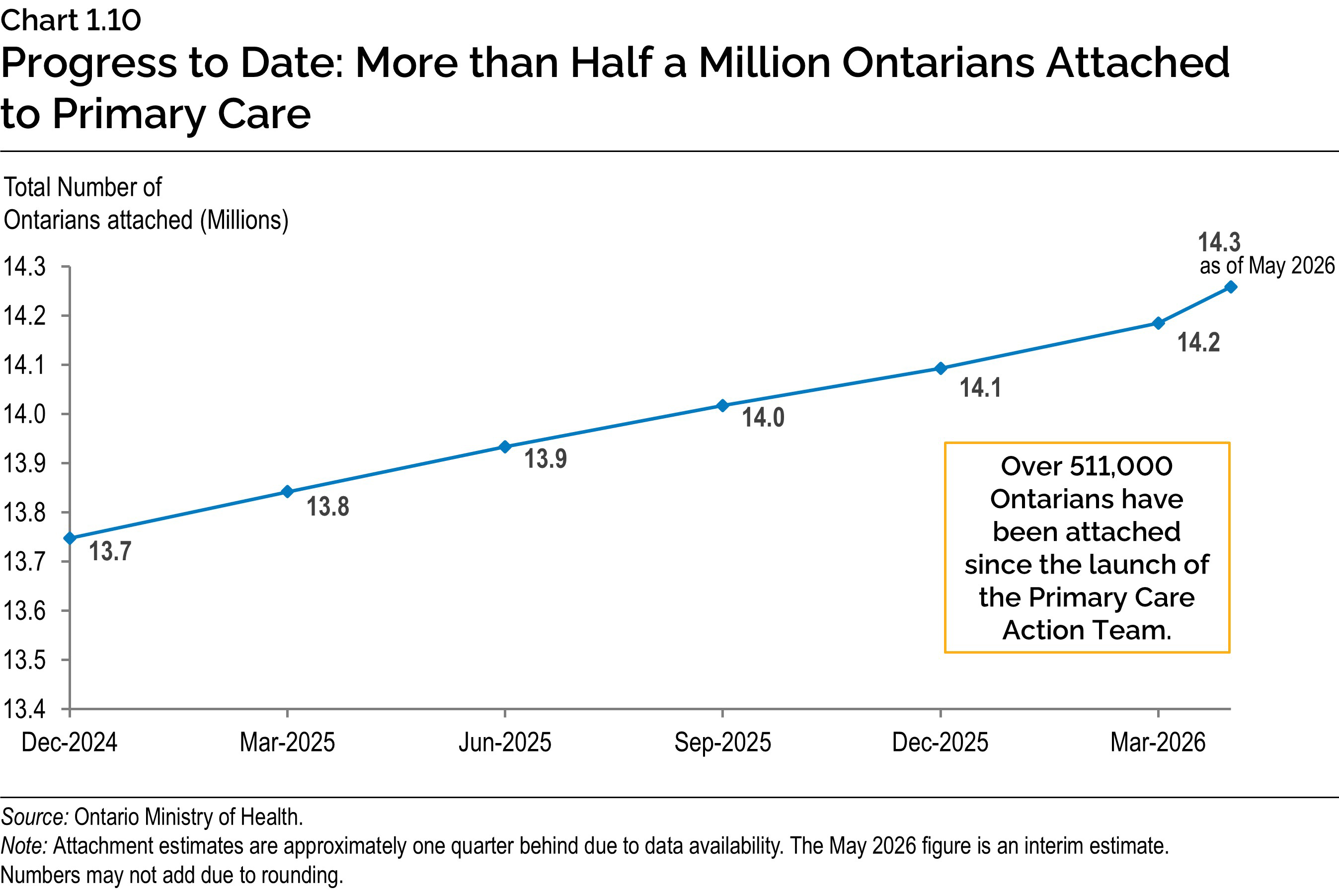
Ontario is building a primary care system that is comprehensive, convenient and connected for everyone in the province. This is why the government launched the Primary Care Action Plan. Through the 2026 Budget, the government announced it is investing an additional $325 million to further expand primary care and connect everyone in Ontario to a family doctor or primary care team by 2029, bringing the four-year investment to $3.4 billion.
As part of the plan, the government has launched a series of initiatives that aim to close the gap for people in need of primary care, including:
- Creating and expanding more than 300 primary care teams to connect approximately two million people to primary care. This includes an investment of more than $250 million in 2026–27 to establish and expand additional primary care teams across the province, which will connect 500,000 more people to ongoing primary care this year; and
- Investing in primary care teaching clinics across the province, including up to $300 million to support the creation and expansion of 18 primary care teaching clinics, including two new clinics at Toronto Metropolitan University.
Since the launch of Ontario’s Primary Care Action Plan, 511,000 people have been connected to primary care. As of October 2026, 99.7 per cent of the Health Care Connect waitlist from January 1, 2025, had been cleared. Ontario is also improving services by advancing a new provincewide Primary Care Medical Record system to integrate patient records, reduce administrative burden for family doctors or primary care providers, and improve the quality and coordination of care. With these investments, Ontario is on track to achieving its goal of connecting everyone to primary care by 2029, with 88.7 per cent of the people of Ontario already assigned to a primary care provider.
Training and Retaining Health Care Providers Across Ontario
The government is building a stronger and more resilient health care workforce throughout the province. Through the Ontario Learn and Stay Grant (OLSG), the government is supporting students with funding to cover the cost of tuition, books, and other direct educational expenses for eligible health-related programs in underserved and growing communities in Northern, Southwestern and Eastern Ontario. Since its launch in 2023, the government has provided more than $182 million to support over 13,000 future nurses, nurse practitioners, paramedics and medical lab technologists in high-need areas of the province.
Starting in fall 2026 and based on an investment of $220 million over four years, the government is expanding the OLSG to provide funding to medical students in postgraduate family medicine residency programs who commit to practising comprehensive primary care as a family medicine physician anywhere in Ontario for five years. This expansion will support more than 2,000 future family medicine physicians and help ensure people and their families have access to high-quality health care, close to home.

Supporting Access to Over-the-Counter Hearing Aids
Ontario is continuing to advance innovative solutions that improve patient care. The government is proposing changes that, if passed, would allow the sale and use of over-the-counter (OTC) hearing aids, providing an additional option for people with mild to moderate hearing loss.
Currently, hearing aids in Ontario require a prescription from a regulated health professional. Under current regulations, companies that manufacture in-ear headphones and earbuds with built-in hearing aid capabilities (OTC hearing aids) are not permitted to activate those capabilities in Ontario.
If the proposed changes are passed, OTC hearing aids would provide a distinct, prescription-free option for hearing support, offering people in Ontario greater choice and convenience. By reducing barriers to care for people with mild hearing loss, this initiative would help improve access to hearing support while advancing the adoption of innovative health technologies. These changes would have no impact on the province’s current model of care, and people in Ontario would continue to be able to receive funding support from the Assistive Devices Program for prescribed hearing aids.
Calling for Fair and Sustainable Federal Funding for Health Care
Ontario welcomes the confirmation of ongoing funding for the National Strategy for Drugs for Rare Diseases announced on October 16, 2026 and looks forward to further discussions on long-term health care funding. The government also recognizes the federal government’s one-year extension of the expiring 10-year agreement to support mental health and addictions programs and home and community care announced on October 14, 2026. While this temporary extension is a positive first step, sustainable and predictable federal funding is essential to sustaining public services.
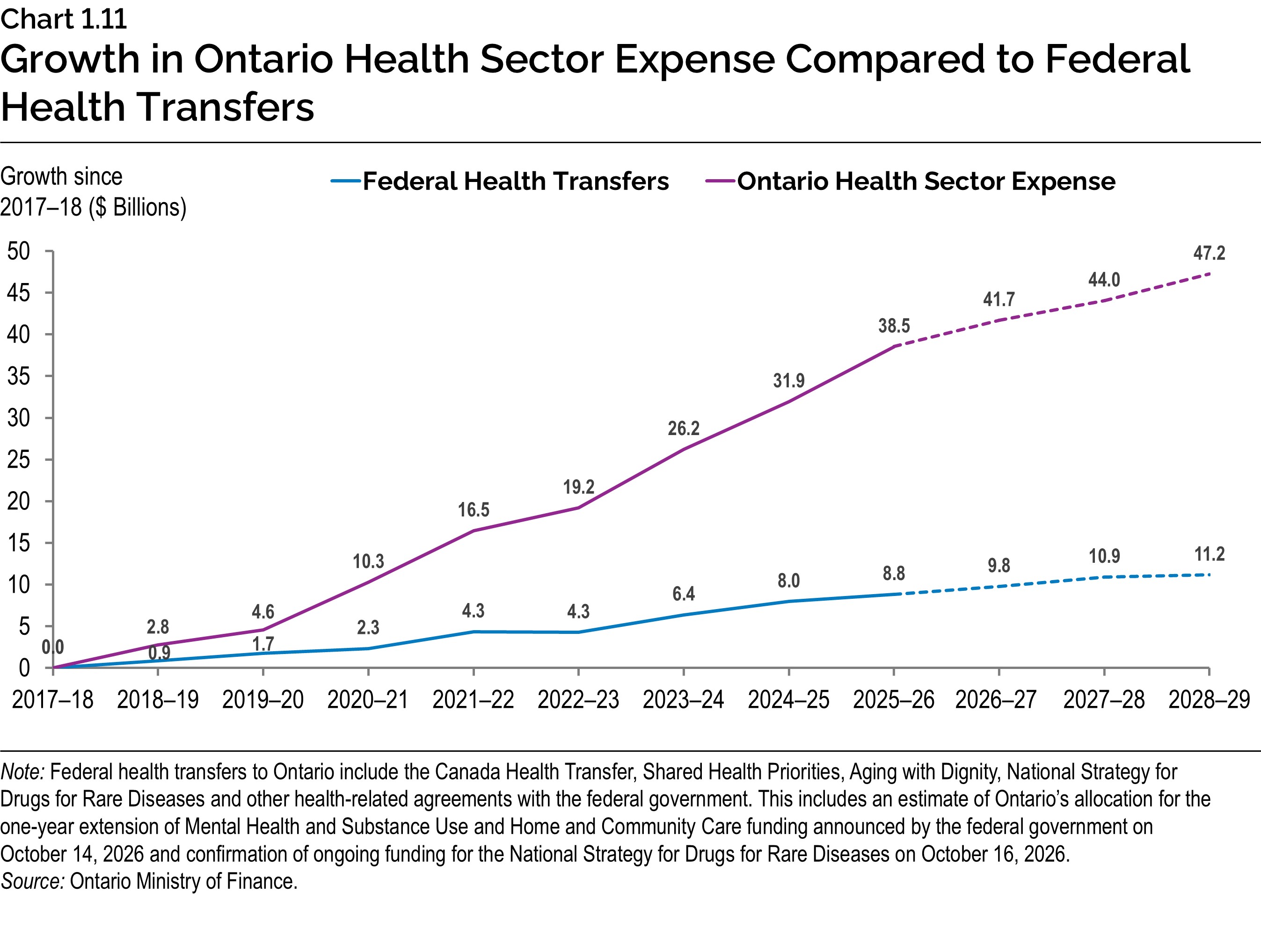
The current level of federal funding for health care does not adequately meet the needs of provincial and territorial health care systems. As shown in Chart 1.11, from 2017–18 to 2025–26, Ontario’s health sector expense has increased by $38.5 billion, while federal funding for health care has only grown by $8.8 billion, creating a gap between Ontario’s health sector needs and federal support.
In the coming years, this gap could grow even larger. All provinces and territories, including Ontario, are projecting that health expenses will continue to grow above inflation. Meanwhile, if the federal government does not extend the estimated $2.4 billion in annual health care funding set to expire by fiscal year 2028–29, this will create a fiscal cliff for provinces and territories, which would represent the largest federal health care funding cut in a generation.
In Ontario, this means that hospitals, health care providers and families would be forced to contend with the impact of an almost $1 billion annual cut in federal health care funding by 2028–29. Failing to extend this funding long-term would put critical health care programs and services at risk, including access to mental health services, supportive housing and mobile crisis response programs. It could also result in patients losing access to home care, job losses, and increased wait times and hospitalizations across Ontario.
This is why Ontario, joined by other provinces and territories, is calling for the federal government to make permanent the 5 per cent minimum growth rate guarantee for the Canada Health Transfer that is set to end after 2027–28 and provide long-term health care funding to support mental health and addictions programs, home and community care, long-term care, and other essential programs.
The federal government must maintain its investments in health care and continue to work with provinces and territories to improve care, manage growing demand and ensure families in Ontario and across Canada are able to continue accessing the high-quality health care they expect and deserve.
Building and Expanding Hospitals
The government is investing approximately $64 billion in health infrastructure, including nearly $50 billion in capital grants over the next 10 years. This ambitious plan will support over 50 hospital projects and deliver approximately 3,000 new hospital beds to enhance access to quality care and build a connected, people-first health care system.
Recent milestones include:
- Halton Healthcare Services – Regional Hub Investments: Construction began in 2026 on renovations that will add more than 110 inpatient beds and approximately 79,000 square feet of acute care space at Oakville Trafalgar Memorial Hospital. These investments will allow the hospitals to provide regional access to acute care beds, thereby connecting more patients and families in Halton and surrounding communities to faster, more convenient, high-quality acute care closer to home. The government is also supporting renovations at the Milton District Hospital, which, once completed, will make room for 12 additional inpatient beds;
- Hamilton Health Sciences – Hamilton General Hospital Emergency Department Expansion: The expanded emergency department, which broke ground in July 2026, will add 8,500 square feet of emergency care space, including an enhanced triage/rapid assessment and observation area and a larger ambulance off-loading area, which is expected to be completed by 2030;
- Unity Health Toronto – St. Michael’s Hospital Ambulatory Care Centre: The new ambulatory care centre, opened in May 2026, will serve more than 70,000 walk-in patients annually and includes a dedicated walk-in entrance, private exam rooms, and a confidential discharge suite;
- Geraldton District Hospital – Upper Floor Redevelopment Project: Early planning is underway to redevelop and renovate the hospital’s upper floor, supporting the future expansion of programs and services to better meet the growing needs of the community;
- Brant Community Healthcare System – Brantford General Hospital Emergency Department Expansion: Opened in September 2026, the new and expanded emergency department is over 7,000 square feet larger than the previous facility and includes expanded treatment rooms, mental health safe rooms, and an Indigenous Family Space, helping to reduce wait times and improve emergency care for more than 50,000 annual visits;
- Windsor Regional Hospital – Fancsy Family Hospital Project: The approximately two million‑square-foot, state-of-the-art facility will bring expanded acute care services together under one roof. The new hospital will deliver 100 additional beds, to bring the total to nearly 600, a new 24/7 emergency department and world-class cancer care. Ground was officially broken in July 2026; and
- University Health Network – West Park Reactivation Care Centre: Renovation and repurposing of the former West Park Healthcare Centre will expand reactivation care services and help relieve hospital bed pressures. Phase 1 was completed in summer 2024, which enabled the transfer of up to 94 patients, while phases 2 and 3 are expected to increase capacity to a total of 188 net new beds in fall 2026, allowing smoother transitions from hospital to community-based care.

Building Long-Term Care Homes
The government continues to make progress towards its commitment to build 58,000 new and upgraded beds to modern design standards across the province. As of July 2026, 165 long-term care homes are either open, under construction, or are approved to start construction. This includes:
- 70 projects completed, representing 5,063 new beds and 5,170 beds upgraded to modern design standards; and
- 95 projects under construction or approved to start construction, representing 9,664 new beds and 6,524 beds being upgraded to modern design standards.
In July 2025, the government launched a new construction funding support program to ensure long-term care operators and builders have additional flexibility and support to continue Ontario’s historic level of construction. The 2025 Long-Term Care Home Capital Funding Program provides a funding framework that better reflects regional cost variations while addressing diverse operator needs across the sector. In total, the government enabled 121 long-term care homes to start construction between September 2022 and June 2026. Projects underway with support from the Capital Funding Program include:
- Carveth Care Centre – upgrading 104 beds in Gananoque;
- Maxville Manor – building 38 new beds and upgrading 122 beds in North Glengarry;
- Southbridge Ottawa II – building 192 new beds in Ottawa;
- IOOF Seniors Homes Inc. – building 64 new beds and upgrading 66 beds in Barrie;
- Carefirst Campus of Care York Region – building 124 new beds in Richmond Hill;
- Mon Sheong Richmond Hill Long-Term Care Centre – building 288 new beds in Richmond Hill; and
- Belmont House – building 168 new beds in Toronto.
In addition, Ontario continues to leverage tools to support financing the development of long‑term care beds with the support of the Building Ontario Fund. This will stimulate and sustain more construction starts of long-term care homes across Ontario.
Support for the long-term care sector has enabled significant new investments that will increase health system capacity and help address wait times for placement from the community and hospital settings.
Investing in Schools and Child Care Spaces
As part of the government’s continued commitment to ensure growing communities are provided with healthy learning environments and modern spaces to help students achieve success, Ontario is investing about $30 billion over the next 10 years, including approximately $22 billion in capital grants, to build new and redeveloped schools and child care spaces.
For the 2026–27 school year, 35 new schools and additions have opened, including six French‑language school projects, creating over 18,300 new student spaces and 1,130 licensed child care spaces.
Table 1.1
School Projects Opening for the 2026–27 School Year
Northern
A new joint French and English junior kindergarten to Grade 12 public school in Blind River, which will serve 72 French-language students, 381 English-language students and include 64 new licensed child care spaces.
Eastern
- A new French Catholic elementary school in Orléans, which will serve 412 students and include 49 new licensed child care spaces.
- An addition to Earl of March Secondary School in Ottawa, with 575 student spaces.
- An addition to St. Philip Catholic Elementary School in Ottawa, with 282 student spaces.
- A new French public elementary school in Stittsville, which will serve 475 students and include 49 new licensed child care spaces.
Southwestern
- A new English public elementary school in London, which will serve 655 students and include 88 new licensed child care spaces.
- A new English Catholic secondary school in London, which will serve 700 students.
- An addition to Glenwood Public School in Windsor, with 184 student spaces.
- An addition to Roseland Public School in Windsor, with 184 student spaces.
Central
- A new English public elementary school in Bowmanville, which will serve 769 students, and include 73 new licensed child care spaces.
- A new English Catholic elementary school in Bradford, which will serve 516 students and include 49 new licensed child care spaces.
- A new French Catholic elementary school in Mississauga, which will serve 294 students and include 73 new licensed child care spaces.
- A new French public elementary school in North York, which will serve 412 students and include 73 new licensed child care spaces.
- An addition to St. Kateri Tekakwitha Catholic School in Oshawa, with 138 student spaces.
Source: Ontario Ministry of Education.
Table 1.2
Continuing to Get Shovels in the Ground to Build More Schools
Northern
- A new English public elementary school in Kenora, which will serve 409 students and include 49 new licensed child care spaces.
- A new English public elementary school in Thessalon, which will serve 222 students and include 64 new licensed child care spaces.
Eastern
- An addition to St. Gregory Catholic School in Carleton Place, with 164 student spaces.
- An addition to the Cambridge Public School in Embrun, with 427 student spaces.
- A new French Catholic secondary school in Ottawa, which will serve 826 students.
- A new French public secondary school in Ottawa, which will serve 713 students.
- A new English Catholic elementary school in Picton, which will serve 354 students.
- A new French public elementary school in Russell, which will serve 268 students and include 49 new licensed child care spaces.
Southwestern
- An addition to École élémentaire catholique Sainte-Marguerite-Bourgeoys in Brantford, with 24 new licensed child care spaces.
- A new English public elementary school in London, which will serve 934 students and include 88 new licensed child care spaces.
- A new English Catholic elementary school in London, which will serve 400 students and include 88 new licensed child care spaces.
- A new English Catholic secondary school in Owen Sound, which will serve 1,012 students.
Central
- An addition to Emma King Elementary School in Barrie, with 184 student spaces.
- A new French Catholic elementary school in Cobourg, which will serve 259 students and include 49 new licensed child care spaces.
- An addition to École élémentaire catholique Saint-René-Goupil in Guelph, with 138 student spaces.
- A new English Catholic elementary school in Toronto, which will serve 600 students and include 88 new licensed child care spaces.
- A new English public elementary school in Tottenham, which will serve 426 students.
- A new English Catholic secondary school in Wasaga Beach, which will serve 1,008 students and include 49 new licensed child care spaces.
Source: Ontario Ministry of Education.
Expanding Services for Children and Youth with Autism
As announced in the 2026 Budget, the government is taking further action to improve services for children and youth on the autism spectrum by providing $965 million to the Ontario Autism Program in 2026–27, including $186 million in new funding.
This investment will enable more children and youth to access core clinical services while further strengthening sector capacity across the province. It also builds on the government’s ongoing work to modernize and enhance the Ontario Autism Program to better meet the needs of families.
Respecting Taxpayer Dollars
Ontario has a plan to advance efficient and reliable public services while ensuring responsible stewardship of public resources. Efforts are focused on simplifying processes, reducing administrative burden, improving decision-making, strengthening oversight and ensuring government resources are directed to highest-value activities.
Ontario has made progress in reviewing priority areas to identify efficiencies, manage cost pressures, and improve program and service delivery. For example, the government has made progress on:
- Identifying opportunities to reduce incidents of error, waste, abuse and fraud across government-funded programs, while strengthening program integrity, oversight, and compliance;
- To maintain affordability and ensure sustainability of the Ontario Electricity Rebate (OER), effective May 1, 2027, the government’s continued monthly credit will be capped at 1,200 kilowatt-hours (kWh) for residential customers. The average residential consumer in Ontario uses approximately 700 kWh per month. Small businesses and farms are excluded from this change. In addition, the government will continue to provide credits on top of the OER aimed at lowering energy costs for Northern and rural residents;
- Reviewing Ontario’s business support programs to identify opportunities for greater efficiency, stronger investment outcomes, and improved value for taxpayer dollars; and
- Continuing to work with sector partners to ensure accountable and improved service delivery, without impacting frontline workers.
The progress made will reinforce momentum and support the long-term, sustainable delivery of public services.
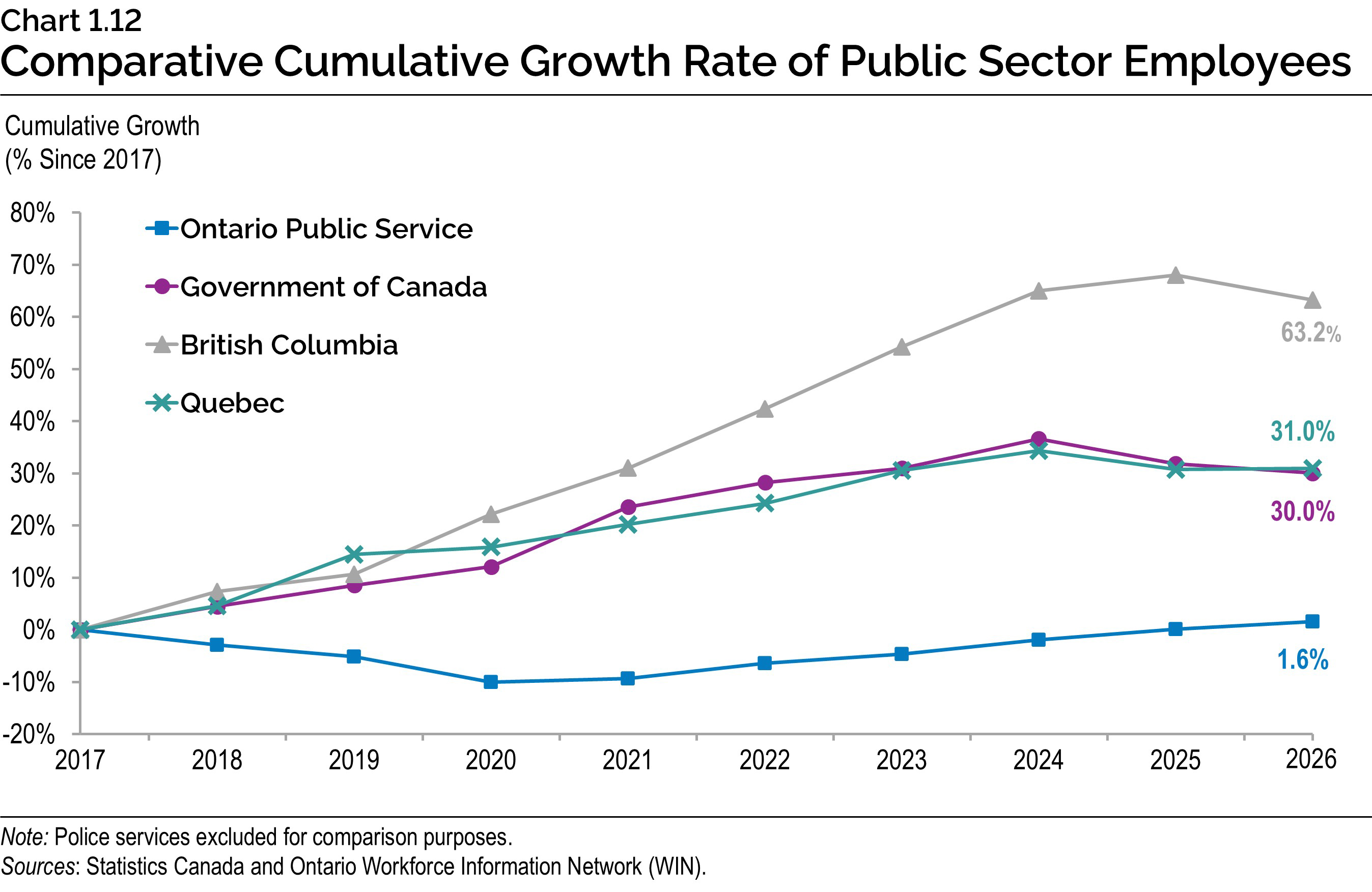
As well, since 2017, Ontario’s public service has grown by only 1.6 per cent, substantially lower than that of the federal government and other provinces and territories. Several jurisdictions that experienced rapid public-service growth over this period are now undertaking workforce reduction efforts.
Ontario has reduced the need for staffing increases by redeploying employees to support key government priorities that matter most to people in Ontario, including critical frontline services such as community safety, corrections, border security, capital project delivery, and other key government priorities, while improving efficiencies and shifting investments in the front line from 50 per cent in 2019–20 to 60 per cent in 2025–26.
The government is always looking for efficiencies to improve service delivery. Prudent management is an ongoing effort, and Ontario continues to explore opportunities to create capacity to advance government priorities and manage growth pressures.
In addition, the government has taken action to strengthen oversight and cost management across the provincial agency sector. These actions build on the provincial agency hiring freeze, which has helped stabilize staffing growth and avoid nearly $300 million in costs. The province has launched reviews of nine key public agencies: Metrolinx, Workplace Safety and Insurance Board, Workplace Safety and Insurance Appeals Tribunal, Supply Ontario, Liquor Control Board of Ontario, Ontario Cannabis Retail Corporation, Legal Aid Ontario, Agricorp, and the Alcohol and Gaming Commission of Ontario to assess operational efficiency, financial performance and long-term sustainability. The reviews will focus on efficiency, governance and productivity to ensure value for taxpayer dollars, including optimizing digital modernization initiatives, reducing reliance on external consultants through greater use of internal capacity and expertise, and allocating more resources to improving core services for the people of Ontario.
The government will also seek to further decrease and streamline political staff offices to encourage comparable savings across the enterprise. Earlier this year, the Premier’s Office headcount was reduced by 10, resulting in annual savings of over $1 million, and this same rigour will be implemented across political offices.
The government will continue to demonstrate shared commitment to respecting taxpayer dollars.
Reducing Error, Waste and Abuse
Ontario operates in an increasingly complex risk environment. Organized fraud networks, cyber‑enabled criminal enterprises, and other threat actors are leveraging artificial intelligence, automation, synthetic identities, and advanced data tools to target vulnerabilities in payment, claims, and service delivery systems. As these capabilities evolve, governments and other large organizations face growing exposure to fraud, error, waste, abuse and improper payments.
Ontario is strengthening its stewardship of public funds through a coordinated enterprise-wide approach to fraud, error, waste, abuse, and improper payments. Building on evidence from major expenditure and claims-based programs, the government is advancing stronger controls, risk-based oversight and modern technology-enabled capabilities to improve the detection, prevention, and management of payment integrity risks. Sustaining and expanding these efforts will require further targeted investments in data, technology, and specialized expertise.
Initial efforts are focused on high-value programs where the greatest opportunities exist to strengthen accountability and value for money, with successful approaches designed for reuse across ministries over time. By shifting from a primarily recovery-focused model toward earlier detection and prevention, Ontario aims to improve program integrity, protect taxpayer dollars and create a sustainable enterprise capability that supports better outcomes and fiscal stewardship across the Ontario Public Service.
Ontario administers approximately $50 billion in annual payments across health, social assistance, and other major programs, representing hundreds of millions of transactions each year with continued growth in both health and social services expected. A strategic investment in enterprise integrity capabilities could conservatively prevent $500 million to $1.25 billion in losses annually within five years, while establishing the foundation for longer-term savings and cost avoidance.
Advancing Digital Credentials
The government is making life easier for people in Ontario by exploring digital credentials as part of its commitment to enhancing government services. Digital credentials would offer a modern, secure, private, convenient and optional way for people in Ontario to access and present identification while maintaining physical credentials for those who prefer them.
By enabling individuals to securely store and present credentials on their mobile devices, digital credentials would provide greater user control of personal information, as well as flexibility and convenience, to support broader service enhancement efforts.
Chart Descriptions
Chart 1.10: Progress to Date: More than Half a Million Ontarians Attached to Primary Care
Since the launch of the Primary Care Action Plan on January 1, 2025, over 511,000 Ontarians have been attached to a primary care provider. Starting from 13.7 million Ontarians attached to a primary care provider on December 1, 2024, this number has risen to approximately 14. 3 million, as of May 2026.
Note: Attachment estimates are approximately one quarter behind due to data availability. The May 2026 figure is an interim estimate. Numbers may not add due to rounding.
Source: Ontario Ministry of Health.
Chart 1.11: Growth in Ontario Health Sector Expense Compared to Federal Health Transfers
Since 2017–18, Ontario’s health care expenses have grown by $38.5 billion as of 2025–26 and the total increase is expected to reach $47.2 billion by 2028–29, while federal transfers for health care have grown by $8.8 billion as of 2025–26 and the total increase is expected to reach $11.2 billion by 2028–29.
Note: Federal health transfers to Ontario include the Canada Health Transfer, Shared Health Priorities, Aging with Dignity, National Strategy for Drugs for Rare Diseases and other health-related agreements with the federal government.
Source: Ontario Ministry of Finance.
Chart 1.12: Comparative Cumulative Growth Rate of Public Sector Employees
The line chart illustrates the cumulative growth since 2017 in the public service of Ontario as compared to the public services of the Government of Canada, British Columbia and Quebec. Since 2017, the Ontario Public Service has grown by 1.6 per cent. In comparison, the Government of Canada has grown by 30.0 per cent, British Columbia has grown by 63.2 per cent and Quebec has grown by 31.0 per cent.
Sources: Statistics Canada and Ontario Workforce Information Network.
Note: Police services excluded for comparison purposes.