Ontario faces a rapidly changing and uncertain global economy. In addition, the United States, Ontario’s top trading partner, continues to threaten the province’s businesses and workers. To protect Ontario, the government remains focused on its ambitious plan to make the province the most competitive place to invest, grow and succeed in the G7.
Ontario has what the world needs, including reliable nuclear energy, abundant critical minerals, advanced manufacturing, cutting-edge technology, world-class financial institutions and a highly skilled workforce. Leveraging these domestic advantages, the government is accelerating new opportunities for investment, which will strengthen economic resilience, enhance self-reliance, support long-term prosperity for businesses and keep workers on the job.
Unleashing Ontario’s Critical Minerals Advantage
Critical minerals are essential inputs in major growth sectors. They are needed to make technologies and products, ranging from cell phones and defence equipment to electric vehicles and medical devices. Global demand for critical minerals is expected to increase significantly by 2030, and Ontario possesses one of the richest and most diverse concentrations of critical minerals in the world.
The province has the mining experience and ability to help meet this demand, with more than 37 active mines; the sector supports over 28,000 mining jobs and an additional 46,000 minerals processing and mining supply and service jobs across engineering, equipment manufacturing, construction, environmental services and technology. Ontario continues to streamline approvals and speed up permitting and is recognized as a premier location to build new mining capacity. In the Fraser Institute’s Annual Survey of Mining Companies, 20251, Ontario was ranked the most attractive jurisdiction in Canada for mining investment and the second most attractive jurisdiction globally.
In March 2026, Ontario released a forward-looking vision paper: Fortifying Ontario’s Economy: A Plan to Accelerate Responsible Resource Development to overhaul and modernize the Critical Minerals Strategy that was launched in 2022. Through this vision paper, Ontario has invited feedback on key priorities to unlock the province’s critical minerals wealth, and this will help ensure that the next phase of the strategy can respond to a rapidly changing world.
Ontario’s new strategy will be shaped by input from industry, Indigenous partners, communities and the public. It will focus on strengthening domestic supply chains, ensuring economic and national security, accelerating responsible development and building an economy that can withstand today’s pressures and capture tomorrow’s opportunities.
Building Ontario’s Critical Minerals Processing Capacity
Ontario is working to help ensure that minerals mined in Ontario will be processed and refined in Ontario. The Critical Minerals Processing Fund (CMPF) is a $500 million program delivered by Invest Ontario that provides strategic financial support to accelerate the province’s critical minerals processing capacity, helping to meet growing demand and strengthen domestic supply chains. The CMPF will support Ontario’s efforts to unlock the economic potential of Ontario’s mineral resources sector by helping existing critical minerals processing facilities maximize their production and supporting the construction of new operations.
Investing Through the Critical Minerals Innovation Fund
Ontario is supporting investments to strengthen Ontario’s critical minerals sector through the Critical Minerals Innovation Fund (CMIF). This fund supports projects involving research, development and commercialization of innovative technologies, techniques, processes and solutions for critical minerals. In June 2026, Ontario announced nearly $8 million in funding for 18 innovative projects through the CMIF. Since its launch in 2022, the CMIF has invested in 47 strategic projects that are transforming Ontario’s mining and minerals sector from extraction to processing and advanced manufacturing.
Investing in the Future Generation of Canadian Mines Through the Ontario Junior Exploration Program
Junior exploration companies face significant challenges in attracting investment, particularly when operating in remote areas with difficult terrain and high upfront costs. However, as the world looks for stable, responsible sources of critical minerals, Ontario is supporting prospectors and mining companies to unlock new economic opportunities and investment across Northern Ontario to advance projects that can drive long-term economic growth and strengthen the province’s mining sector. In May 2026, Ontario announced that it is investing $10 million in the newly overhauled Ontario Junior Exploration Program (OJEP), which will launch an Advanced Exploration Stream next year.
This investment will help junior exploration companies and licensed prospectors find future mines by covering eligible costs for mineral exploration and development. To date, OJEP has committed nearly $45 million in funding to 280 companies, 201 of which are exploring for critical minerals, leveraging approximately $80 million in additional investment from industry.
Strengthening Allied Supply Chains by Securing a Critical Minerals Agreement with the United Kingdom
Access to critical minerals has become essential to economic and national security, with the global race for critical minerals reshaping economies and redefining geopolitical partnerships. It is critical for Ontario to work with trusted partners to reduce dependence on unreliable foreign sources and build resilient supply chains.
In June 2026, Ontario and the United Kingdom signed a Statement of Intent (SOI) that will facilitate both jurisdictions working together to build secure, resilient and integrated critical minerals supply chains. Through this agreement, Ontario will work collaboratively with the United Kingdom to create investment opportunities, advance research and innovation, and develop resilient supply chains.
Unlocking the Economic Potential of the Ring of Fire
Northern Ontario is home to one of the most promising mineral development opportunities in the world, known as the Ring of Fire. This region covers approximately 8,000 square kilometres and is rich in minerals, such as nickel, copper, platinum group elements and chromite.
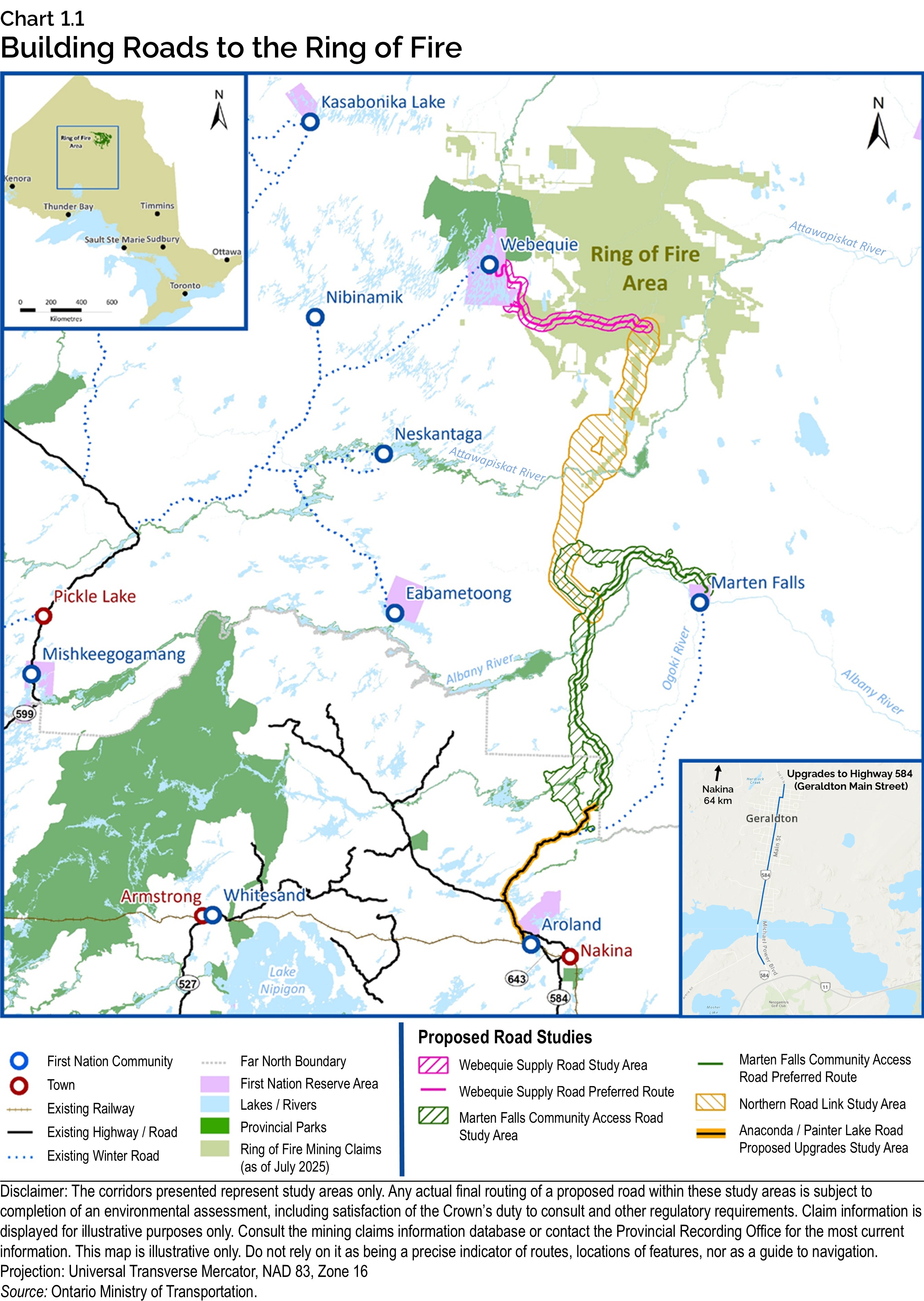
In partnership with First Nations, Ontario continues to work on its plan to unlock the economic potential of the Ring of Fire by supporting the development of key infrastructure. In 2025, Ontario signed historic Community Partnership Agreements with Webequie First Nation and Marten Falls First Nation, as well as a Shared Prosperity Agreement with Aroland First Nation, to advance shared economic and community priorities and support critical infrastructure across the region. These agreements will not only help accelerate the construction of the all-season Webequie Supply Road (WSR) and the Marten Falls Community Access Road (MFCAR), but will also advance major upgrades to the Anaconda and Painter Lake roads. As work moves forward, Ontario remains committed to meeting its duty to consult.
In March 2026, Ontario released a plan to accelerate construction of the all-season roads to the Ring of Fire, with roads beginning to open in November 2030, five years ahead of schedule. This summer, construction started at three points along the more than 500-kilometre (km) corridor, including at both ends, so crews are now building toward each other, with more milestones to come as the government works to help finish these roads a full five years ahead of schedule. Construction milestones include:
- In June 2026, the government, along with local First Nations partners, municipal leaders and industry representatives, announced the groundbreaking of the Geraldton Main Street Rehabilitation project. The government is investing $81.3 million in the project, which is the first segment on the road network to the Ring of Fire and will connect Highway 11 at the south end to Highway 584 at the north end and the Trans-Canada Highway;
- In August 2026, Ontario and Aroland First Nation celebrated that work had commenced on major upgrades to the Anaconda and Painter Lake roads. The roads are scheduled to be open by November 2030, two years ahead of schedule;
- In August 2026, the government and Marten Falls First Nation celebrated the start of construction on the Marten Falls Community Access Road. The Marten Falls Community Access Road is scheduled to open by November 2031, four years ahead of schedule;
- In September 2026, Ontario awarded a construction manager contract for the Webequie Supply Road. The 107-km all-season road is scheduled to open by November 2030, four years ahead of schedule; and
- Pending all necessary approvals and consultation, the Northern Road Link is scheduled to start construction in spring 2028 and open by November 2031, five years ahead of schedule.
All-season road access from these projects would reduce transportation costs, facilitate access to key services and improve economic conditions in these communities, while increasing business development and job opportunities. Developing resources in the Ring of Fire region has the potential to generate approximately $22 billion in economic activity over 30 years, creating over 70,000 jobs in industries across the province.
Powering Ontario’s Economy
The province is making record investments in energy infrastructure to build a more self‑reliant economy, protect jobs, support workers and secure Ontario’s future as an energy superpower.
Positioning Ontario as a Global Leader in Nuclear Energy
Ontario is championing nuclear expansion and is leveraging its nuclear advantage to advance opportunities at home and globally to create 150,000 new job opportunities and add over $800 billion to Canada’s economy.
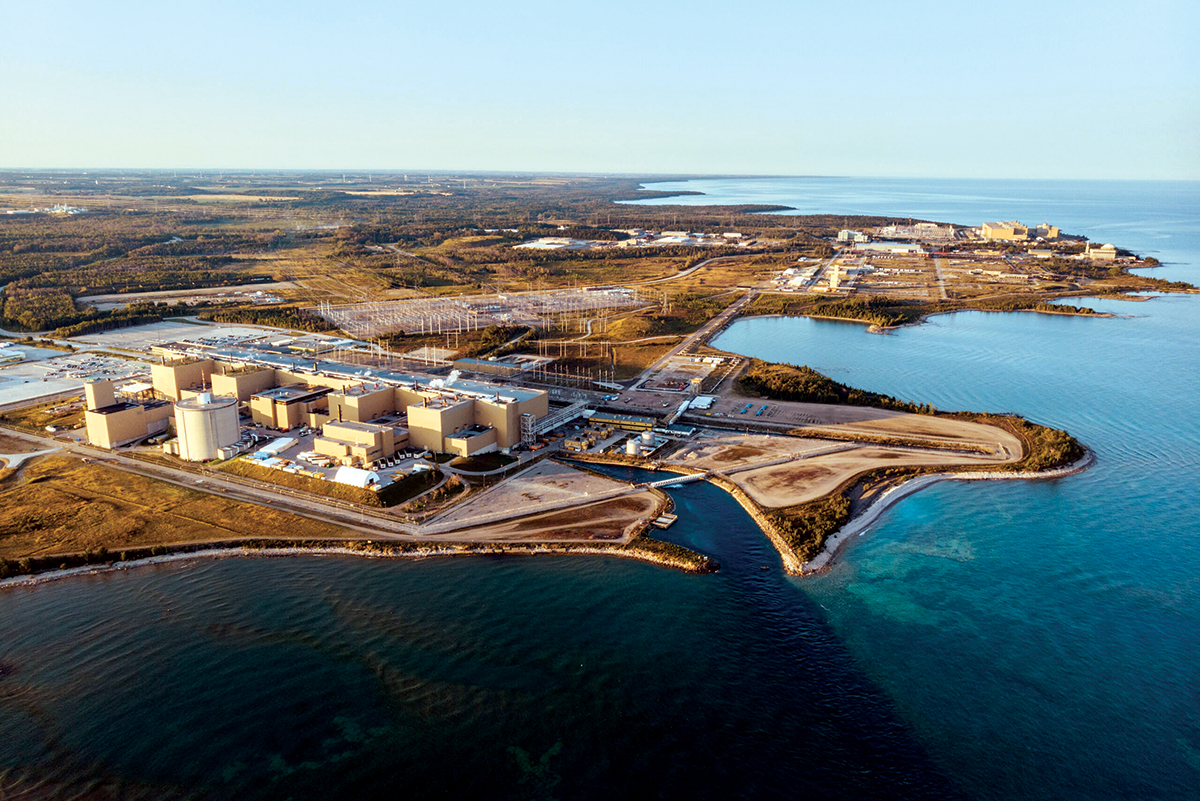
Refurbishment of the Darlington Nuclear Generating Station was completed $150 million under budget and nearly five months ahead of schedule, followed by Bruce Power’s Major Component Replacement of the Unit 3 reactor seven months ahead of schedule, saving ratepayers $150 million. Ontario Power Generation (OPG) has also started construction on the Pickering Nuclear Generating Station refurbishment. The project will extend the life of the station by up to 38 years, creating approximately 30,500 jobs during construction and 7,500 jobs across Canada over the station’s lifespan. The refurbishment is expected to contribute $41.6 billion to Canada’s GDP, with more than 90 per cent of project spending staying in Ontario and Canada.
The government continues to advance early-stage planning for new large-scale nuclear energy generation at OPG’s Wesleyville site in Port Hope. The project is expected to support 10,500 jobs across Ontario, including 1,700 new, good-paying jobs in Port Hope, while contributing $235 billion to Ontario’s GDP over its lifespan. Ontario also directed the Independent Electricity System Operator (IESO) to enter into a cost-sharing and recovery agreement to enable Bruce Power to move forward with critical activities to support the Bruce C Nuclear Project. The proposed project is expected to inject $238 billion into Canada’s GDP, and create 18,900 jobs during construction and 6,700 jobs once operational.
At the Darlington New Nuclear Project (DNNP), work continues to build the first of four small modular reactors (SMRs) with the project reaching a major construction milestone when the 2.1‑million-pound Basemat module was installed in April this year. The province is making a historic investment of $1 billion in the project through the Building Ontario Fund (BOF). Ontario’s SMRs will create up to 18,000 Canadian jobs during construction, sustaining approximately 3,800 jobs during the project’s life cycle, while contributing $38.5 billion to Canada’s GDP over 65 years.
Exploring New Electricity Generation
In August 2024, the province launched the largest competitive public procurement to secure new power in Ontario’s history. As announced in April and June 2026, the IESO executed on that direction in the first window of the procurement, competitively procuring more than two terawatt-hours (TWh) of new annual electricity energy supply at 73 per cent lower cost than the previous Feed-in-Tariff contracts, and 640 megawatts (MW) of new electricity capacity at 36 per cent lower cost than the battery storage procured through the government’s earlier 2023 capacity procurement.
As part of its plan to build a stronger, self-reliant electricity grid, Ontario is building the next generation of made‑in-Canada energy. The government announced OPG is investing $500,000 in growth readiness funding for each of Haldimand County and St. Clair Township to explore opportunities for new electricity generation at OPG’s Nanticoke and Lambton sites.
Accelerating Electricity Transmission Expansion
Earlier this year, the government declared the Red Lake transmission line a priority project. The new 162-km, double-circuit 230-kilovolt (kV) transmission line connecting through Dryden, Ear Falls and Red Lake is critical infrastructure that will help power one of the most promising mining regions in Canada and enable major new investments across the North, while supporting 5,800 jobs and $830 million in GDP.
The new Etobicoke Greenway project came into service on time and under budget, delivering a new 230-kV line running 6.5 kilometres, bringing 300 MW of electricity to the region, enough to power 300,000 homes. During construction, the project supported 100 jobs and was completed on time and $10 million under budget.
The Ontario government is also advancing the Toronto Third Line (TTL), a major transmission project identified to meet the region’s rapidly growing electricity needs. Once built, this first‑in‑the‑province underwater high-voltage transmission line will deliver up to 900 MW to Toronto’s downtown core to ensure the city has the power it needs to support new homes, economic growth and major infrastructure such as transit.
Strengthening Indigenous Partnerships
In June 2026, Ontario announced a $700 million investment from the Williams Treaties First Nations (WTFN) in the Darlington New Nuclear Project (DNNP). For the first time in Canadian history, through the creation of a first-of-its-kind commercial partnership initiated by the province, First Nations are full equity partners in a nuclear project. The WTFN investment is supported by a provincial guarantee through the Indigenous Opportunities Financing Program (IOFP) in conjunction with a loan guarantee provided by the Canada Indigenous Loan Guarantee Corporation (CILGC).
The government is investing $25 million through the Indigenous Energy Support Program (IESP) managed by the IESO to support Indigenous-led energy initiatives that strengthen community participation in Ontario’s growing energy sector. Funding is provided across three areas: capacity building, economic development, and energy resiliency and monitoring.
The IOFP, administered by the BOF, seeks to advance economic reconciliation and prosperity by enabling the financial participation of Indigenous partners in infrastructure projects. In May 2026, Ontario provided a provincial guarantee of up to $75 million through the IOFP to support increased First Nations ownership of the 450-kilometre, 230-kV East-West Tie transmission line, from 3.5 per cent to 20 per cent.
Securing Canadian Energy Sovereignty
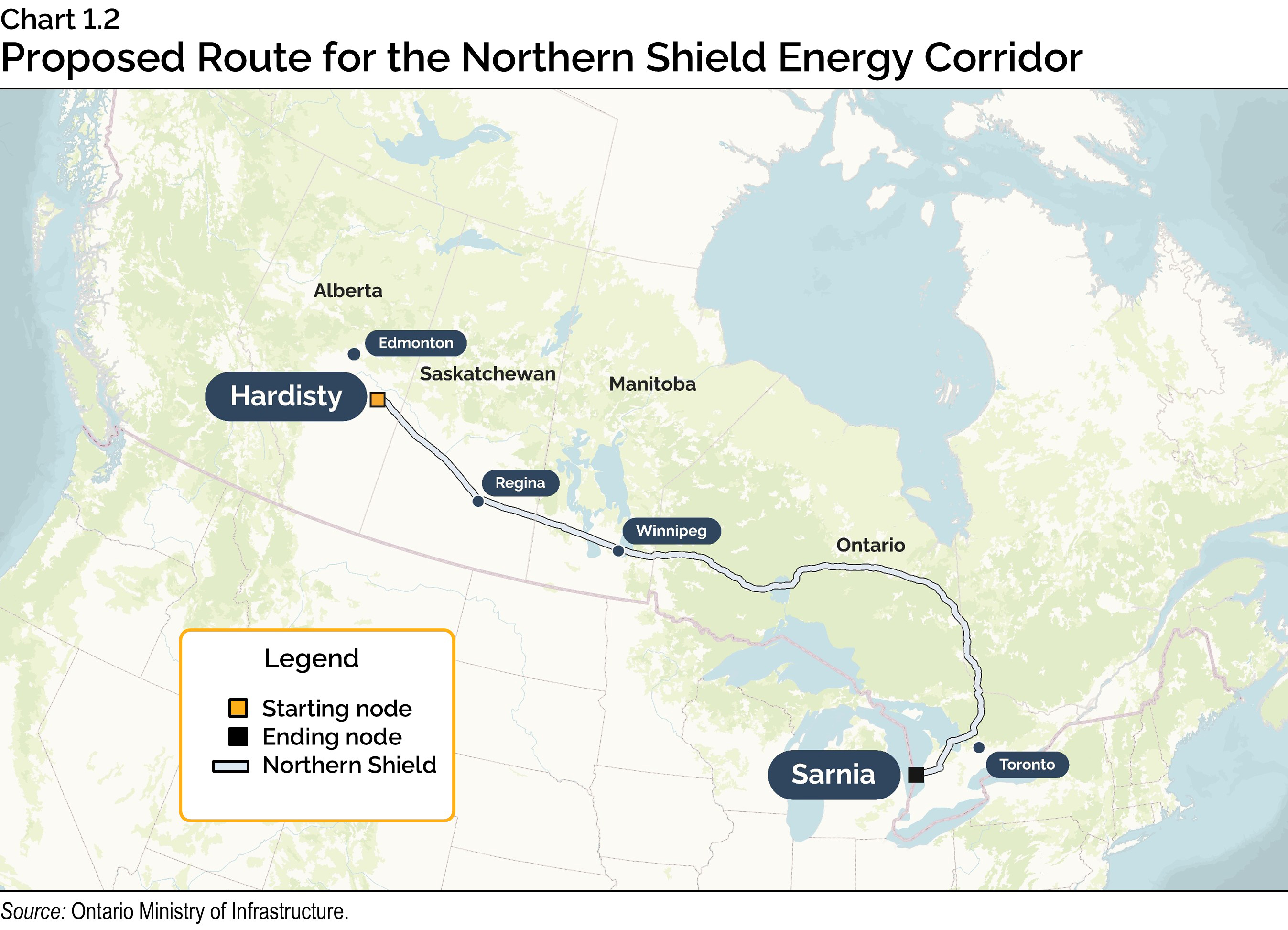
In July 2026, the province unveiled a proposed route for a Northern Shield Energy Corridor. When built, the corridor would be a transformational nation-building project that would strengthen Canada’s energy security, create good-paying jobs and unlock new economic opportunities across the country. The proposed 3,300-kilometre corridor would deliver up to 500,000 barrels of Canadian crude oil per day from Hardisty in Alberta to Sarnia in Ontario, with potential capacity to expand to 800,000 barrels per day, reducing reliance on foreign energy infrastructure while enhancing domestic supply chains and national resilience. Ontario continues to evaluate pipeline extensions to new and existing ports to bring Alberta oil to new tidewater and new markets, as this would provide a secure, domestic, and sovereign channel for resources like diesel, gasoline and jet fuel.
The proposed plan, which aims to build the potential energy corridor with Canadian steel, would leverage Ontario’s refining infrastructure, support manufacturing and energy-sector growth, and help Canada deliver energy resources to domestic and new international markets.
Ontario is advancing feasibility work and exploring complementary investments, including strategic petroleum reserves and ongoing partnerships with Alberta, Saskatchewan and other jurisdictions, to help secure long-term prosperity and economic growth for workers and families across Canada.
This is in addition to the partnership agreement between Ontario and Yukon to share knowledge related to nuclear energy, develop and implement effective energy policies and share best regulatory practices, and the interprovincial–territorial partnership agreement with other Canadian provinces and territories, initiated by Ontario, to build transmission infrastructure needed to power the country’s next generation of growth.
Attracting Jobs of the Future in Artificial Intelligence
Ontario is home to one of North America’s largest technology sectors, with nearly 450,000 technology workers, more than 1,600 artificial intelligence (AI)-related companies and a growing AI innovation ecosystem. The province is well positioned to capitalize on the next wave of AI-driven growth by building on its existing strengths in research, talent, innovation and digital infrastructure.
To help unlock the economic potential of AI, the government is developing an AI Industrial Strategy. The strategy will focus on supporting investment, accelerating AI commercialization, advancing digital sovereignty and strategic supply chains, and supporting AI adoption across businesses and key sectors of the economy. It will also focus on strengthening digital, computing and energy infrastructure, equipping workers with the skills they need to succeed in an AI-driven economy, and promoting safe, secure and responsible use of AI.
Supporting Economic Growth by Securing Strategic Data Centre Investments
Ontario is working to attract data centre investments that drive economic growth, ensure Canadians’ data remain in Canada and deliver significant and meaningful benefits to local communities.
In August 2026, the government launched a proposed framework for its Data Centre Playbook. The Playbook ensures data centres pay the full cost of electricity they use, meaning data centres will pay for the cost of their impact on the electricity system and electricity bills will not be increased for the people of Ontario. This will include proposed measures to encourage projects to build their own power generation and to establish a separate rate class for large new data centres. These projects will help advance Ontario’s and Canada’s digital sovereignty to protect critical data and safeguard people’s information. Canadians’ data will stay in Canada.
Using modern data centre technology, Ontario will only advance data centre projects that meet Ontario’s strict environmental standards, prioritizing projects that use advanced technologies such as closed-loop systems that reduce water usage.
The government will only offer non-financial support to attract investments, including leveraging the province’s existing strategic advantages, such as a clean and reliable electricity system, ample land space, cool climate and skilled workforce. Attracting investments will position Ontario to build the economy of the future, generating economic growth and creating thousands of new jobs.
Securing Ontario’s Digital Infrastructure
Ontario is taking action to strengthen digital sovereignty, protect critical public services and support economic growth.
Since 2011, the Guelph Data Centre has been a critical component of Ontario’s digital infrastructure, enabling the secure and reliable delivery of government programs and services that millions of people in Ontario rely on every day. As demand for secure digital services, artificial intelligence, and advanced computing continues to grow, Ontario is modernizing its digital infrastructure to ensure critical services remain secure, reliable and resilient.
By leveraging government purchasing power, private-sector partnerships and existing provincial infrastructure, this approach will expand access to secure digital infrastructure, maximize the value of provincial assets and support future innovation.
In partnership with a private-sector technology provider, Ontario will expand access to data centre capacity, high-performing computing, and AI infrastructure, while ensuring data and services remain under Ontario’s control and subject to Canadian laws and requirements. This approach will help create opportunities for government and broader public-sector partners and support business growth across the province.
By partnering with industry and making the most of existing infrastructure, Ontario is positioning itself as a leader in secure digital infrastructure while supporting economic growth, innovation and long-term competitiveness.
Growing Ontario’s Defence Industry
Amid heightened geopolitical tensions, defence budgets have been rapidly increasing in Canada and worldwide. Ontario is well-positioned to act quickly on this generational economic opportunity by leveraging both its strengths in emerging technologies and its industrial capacity, including supply chains in steel and other manufacturing industries. The federal government has committed to invest an additional $81.8 billion over five years to support its defence commitments, including meeting the NATO pledge of spending 5 per cent of GDP on defence by 2035. Moreover, Canada’s membership in the Security Action for Europe (SAFE) initiative will allow Canadian companies to bid on large-scale defence projects that will be supported by loans to European Union (EU) member states of up to $244 billion.
With 300 defence firms that directly employ over 13,000 workers, Ontario has significant strength in its existing defence industrial base, with strong clusters across the province that can make it the backbone of Canadian and allied defence supply chains.
Developing Ontario’s First-Ever Defence Industrial Strategy
In May 2026, the government announced a framework for the Ontario Defence Industrial Strategy (ODIS), a 10-year strategy dedicated to growing the province’s defence industry and positioning its companies and workers for long-term success.
Through the ODIS, Ontario will seek to add 43,000 jobs across the economy, contribute over $6 billion to provincial GDP and generate over $400 million in annual provincial tax revenue by 2035. The strategy is rooted in four strategic pillars to capitalize on emerging opportunities, while laying the foundation for upcoming, longer-term initiatives. These include the following: ensuring defence and dual-use firms are ready to capture value from increased federal and allied spending; making Ontario the place where future industries and technologies are built, scaled and brought to market; positioning Ontario as a supplier of choice to the federal government and allies; and capitalizing on Ontario’s strengths in critical minerals and advanced manufacturing to build a resilient, vertically integrated defence supply chain. These four pillars will be underpinned by targeted measures that will help build the skilled, industry-ready workforce needed to deliver on the strategy.
Ontario continues to consult with municipalities, academia and industry stakeholders on the ODIS framework. Feedback received during consultations will be used to inform the strategy’s development, ensuring that the final pathway is responsive to emerging trends and positions the province to accurately capture tomorrow’s defence opportunities.
Canada’s Choice: Toronto’s Bid to Host the Defence, Security and Resilience Bank
Ontario is continuing to advocate for Toronto’s bid to host the Defence, Security and Resilience Bank (DSRB) following Canada’s selection as the host country. As the country’s leading centre of finance, research and technology, Toronto offers Canada’s strongest and most globally credible platform to host the headquarters of the DSRB. Toronto is the only Canadian city that integrates capital-markets depth, interdisciplinary expertise, industrial relevance, regulatory stability and proximity to institutional champions at a comparable scale. Choosing Toronto to headquarter the DSRB will strengthen the economy and reinforce Canada’s role as a trusted partner in collective defence and security. The bank is expected to create 3,500 direct jobs and support thousands of indirect jobs that would benefit not just Toronto but the entire province and country.
Ontario is supporting the province’s defence, security and resilience industries by exploring new financing mechanisms that can attract investment, boost innovation and strengthen critical supply chains. The province intends to issue a Security and Resilience Bond, the first of its kind by a Canadian province, to fund defence projects, including the DSRB if it is ultimately located in Ontario. Work is underway to develop a Security and Resilience Bond Framework to help mobilize capital for strategic projects across the province. Further details are provided in Chapter 4: Borrowing and Debt Management.
Expanding Ontario’s Shipbuilding Industry
As announced in the 2025 Budget, Ontario is strengthening the province’s shipbuilding industry and broader marine sector through a $215 million commitment that will help position Ontario businesses and workers to support Canada’s National Shipbuilding Strategy and strengthen domestic supply chains.
As part of this commitment, in July 2026, the government announced that it is investing over $90 million through the Ontario Shipbuilding Grant Program (OSGP) to increase capacity in the province’s shipbuilding industry as part of its plan to protect Ontario. The following investments are being made through the OSGP:
- $11 million in Ontario Shipyards, with operations across the Great Lakes;
- Over $8 million in Allied Marine & Industrial in Port Colborne;
- More than $6 million in MetalCraft Marine Inc. in Kingston; and
- $1.1 million in Connor Industries in Parry Sound.
The funding will be used for skills training, infrastructure improvements and new machinery and equipment, helping to position Ontario as a global leader in the “blue economy” and marine trade. The province will also expand the OSGP to provide up to $64 million in future funding.
These investments will help meet growing demand for Ontario-made vessels, create thousands of jobs across the marine sector, and strengthen Ontario’s competitiveness in marine manufacturing, trade and defence. As part of the ODIS framework, the province is ensuring that shipbuilders are well positioned to capitalize on future opportunities under Canada’s National Shipbuilding Strategy and that they can support Ontario manufacturing businesses and workers in the face of U.S. tariffs and economic uncertainty.
Reinforcing Ontario’s Leadership in the Life Sciences Sector
As ongoing global uncertainty and U.S. tariffs continue to challenge Ontario’s businesses and industries, the government is taking action to unlock new opportunities for growth. This includes strengthening its position as a global biomanufacturing and life sciences hub by supporting the development, commercialization and early adoption of innovative health products and services. Ontario is home to the largest life sciences jurisdiction in Canada, generating over $86.6 billion in revenue in 2024. The sector employs nearly 76,000 people across more than 2,000 firms, with annual exports exceeding $14 billion in goods. Since 2018, the province has attracted over $6 billion in life sciences investments, reinforcing Ontario’s leadership in health innovation, biomanufacturing and advanced medical technologies.
In May 2026, the government announced an investment of $5 million through the fourth round of the Life Sciences Innovation Fund (LSIF) to support 10 Ontario-based companies undertaking made‑in-Ontario projects that will help advance medical innovation, strengthen domestic manufacturing capacity and improve health outcomes for patients. To date, LSIF has generated nearly $63 million in private-sector co-investment while creating and retaining almost 1,400 jobs across the province.
In addition, in June 2026, the government announced an investment of more than $18 million through the Life Sciences Scale-Up Fund (LSSUF) to support 11 Ontario companies focused on commercializing market-ready products, expanding operations and strengthening competitiveness. These projects represent more than $61 million in total investments and are expected to create more than 190 new jobs while supporting over 660 existing positions across Ontario.
Cultivating Growth in Ontario’s Agri-Food Sector
In 2025, the agri-food sector employed over 10 per cent of Ontario’s workers and contributed over $52.8 billion to provincial GDP. Guided by Grow Ontario: a provincial agri-food strategy, which was released in November 2022, Ontario has continued to strengthen agri-food supply chains, grow agri‑food talent and enhance competitiveness by supporting the adoption of new technologies and practices.
Investing to Protect Farmers and Strengthen the Agri-Food Sector
The Sustainable Canadian Agricultural Partnership (Sustainable CAP) aims to strengthen the competitiveness, innovation and resiliency of Canada’s agri-food sector. The partnership is a $3.5 billion, five-year agreement between the federal, provincial and territorial governments. In May 2026, Ontario and Canada invested nearly $1 million through Sustainable CAP to support local projects that turn innovative research into market-ready solutions for farmers and food processors.
Moreover, in June 2026, the government announced that Ontario and Canada are investing $12 million through the Agricultural Stewardship Initiative (ASI) to help farmers adopt practical improvements that increase efficiency, reduce costs and build long-term resilience. Funded through Sustainable CAP, this initiative provides assistance for projects that support soil health, water quality and energy efficiency improvements, including replacing inefficient on-farm technologies, installing geothermal heating, and adopting high-efficiency motor, ventilation, heating, cooling, refrigeration, grain drying and lighting systems.
Enhancing Agri-Food Innovation to Support Ontario’s Farmers and Food Processors
Ontario is also supporting agri-food innovation through the Ontario Agri-Food Innovation Alliance, a collaboration between the government of Ontario and the University of Guelph. In May 2026, Ontario announced an investment of up to $7 million through this initiative to support 34 made‑in‑Ontario research projects that will help develop market-ready solutions for farmers and food processors. This research will take place in research centres owned by Agricultural Research and Innovation Ontario (ARIO), which include 14 agri-food research properties that cover 5,600 acres and include more than 220 buildings.
Strengthening Ontario’s Tourism and Cultural Sectors
Ontario is continuing to make strategic investments in tourism, culture and destination development to drive economic growth, create jobs and strengthen the province’s position as a premier global destination.
Through initiatives such as the Destination Niagara Strategy, the province is supporting transformative projects and infrastructure improvements that will help grow annual visitation, enhance year-round tourism experiences and generate significant economic benefits. Investments in attractions, transportation networks, hospitality infrastructure and cultural institutions are helping communities attract visitors, support local businesses and unlock new opportunities for long-term growth.
Continuing support for festivals and cultural experiences through the Experience Ontario program strengthens Ontario’s tourism economy and showcases the province’s unique natural and cultural assets.
The government is also advancing the redevelopment of landmark destinations that will serve as major economic drivers for generations to come. The revitalization of Ontario Place is expected to attract millions of visitors annually, while creating thousands of construction and tourism jobs through new attractions, recreational amenities, cultural spaces, and the home of the future Ontario Science Centre.
The province is also investing in strategic tourism and cultural infrastructure projects that will strengthen Ontario’s economy, celebrate Canadian heritage and enhance the province’s appeal as a world-class destination. This includes investments such as:
- Up to $50 million over three years to modernize and expand the McMichael Canadian Art Collection in Kleinburg, helping to preserve one of Canada’s largest collections of Canadian and Indigenous art;
- Nearly $38 million to advance Destination Wasaga, including the revitalization of the Nancy Island Historic Site, improvements to tourism and municipal infrastructure, and support for downtown redevelopment; and
- $35 million over two years to support the Art Gallery of Ontario’s Dani Reiss Modern and Contemporary Gallery expansion. This investment will help add at least 13 new galleries across five floors, expand exhibition space, attract up to 120,000 additional visitors annually and support nearly 800 jobs, while strengthening Ontario’s cultural sector and reputation for world‑class cultural institutions.
Combined, these investments will protect and promote Ontario’s cultural assets, attract visitors, support local jobs and businesses, and drive long-term economic growth in these communities.
Destination Niagara
In July 2026, Ontario announced a nearly $10 million investment to help transform Niagara District Airport into a modern regional gateway capable of supporting future commercial passenger service. The investment will support design work, unlocking Niagara’s full potential as a world-renowned tourism destination, while also supporting local businesses, creating good-paying jobs and driving economic growth across the region.
Design work includes airport terminal enhancements, new service buildings, and improvements to taxiways, aprons and runway infrastructure needed to accommodate future growth. The project advances Niagara District Airport’s master plan, a 20-year vision to transform the airport into a modern regional gateway, and forms part of Ontario’s broader Destination Niagara Strategy aimed at attracting 25 million visitors annually and doubling the region’s tourism impact to generate an additional $3 billion in GDP.
In August 2026, the province announced that the Ontario Lottery and Gaming Corporation (OLG) and MGE Niagara Entertainment Inc. agreed to allow new casino operators into the Niagara gaming market, thereby supporting the province’s Destination Niagara Strategy to attract new investments, create jobs and grow tourism. A procurement call for investment for additional new gaming operators will be released in the fall. This agreement, which will enable the expansion of the Niagara gaming landscape, is part of a broader plan to make Niagara a year-round tourism destination, with goals that include attracting 25 million annual visitors and generating an additional $3 billion in Ontario GDP annually through new attractions, entertainment and infrastructure improvements.
Chart Descriptions
Chart 1.1: Building Roads to the Ring of Fire
This chart shows two maps of proposed road study areas and routes in the Ring of Fire region. The main map includes towns, First Nation communities, existing roads, winter roads and railway lines. The following study areas and proposed routes are highlighted (note that the following projects do not reflect actual infrastructure routing):
- Webequie Supply Road study area and preferred route;
- Northern Road Link study area;
- Marten Falls Community Access Road study area and preferred route; and
- Anaconda and Painter Lake Roads proposed upgrades study area.
The inset map in the bottom right highlights a region within Ontario indicating the Geraldton Main Street Rehabilitation Project.
Disclaimer: The corridors presented represent study areas only. Any actual final routing of a proposed road within these study areas is subject to completion of an environmental assessment, including satisfaction of the Crown’s duty to consult and other regulatory requirements. Claim information is displayed for illustrative purposes only. Consult the mining claims information database or contact the Provincial Recording Office for the most current information. This map is illustrative only. Do not rely on it as being a precise indicator of routes, locations of features, nor as a guide to navigation.
Projection: Universal Transverse Mercator, NAD 83, Zone 16
Source: Ontario Ministry of Transportation.
Chart 1.2: Proposed Route for the Northern Shield Energy Corridor
The chart shows a map of the proposed route for an energy corridor. It includes cities and provinces within Canada indicating the route from Sarnia, Ontario to Hardisty, Alberta.
Source: Ontario Ministry of Infrastructure.
Footnotes
[1] Fraser Institute, Annual Survey of Mining Companies, 2025.